

Episode 259 — November 12th, 2026 — Available at read.fluxcollective.org/p/259
Contributors to this issue: Neel Mehta, Erika Rice Scherpelz, MK
Additional insights from: Ade Oshineye, Ben Mathes, Boris Smus, Dart Lindsley, Jasen Robillard, Jon Lebensold, Justin Quimby, Laura Eberly, Lisie Lillianfeld, Robinson Eaton, Spencer Pitman, Stefano Mazzocchi, Wesley Beary, and the rest of the FLUX Collective
We’re a ragtag band of systems thinkers who have been dedicating our early mornings to finding new lenses to help you make sense of the complex world we live in. This newsletter is a collection of patterns we’ve noticed in recent weeks.
“The trouble with writing fiction is that it has to make sense, whereas real life doesn’t.”
— Iain M. Banks
✂️🪢 Can’t live with ’em, can’t live without ’em
What happens when the person who can’t be fired suddenly becomes a liability? Maybe they’ve compromised their image. Maybe their role has become untenably small. Perhaps they were always a jerk but now they’ve insulted the wrong person. Whatever the reason, they’re still the only one who can do what they do. At the same time, their presence is causing problems for the organization.
We often think of the bus factor around the risk of losing someone. If a critical person were to leave the organization, how bad off would we be? In some cases, a single person can be so critical that a company decides to insure against their loss with key person insurance. This criticality can come in many forms. It can be a leader who is so deeply embedded in the company’s image or functioning that to lose them would be a shock to the company’s perceptions, functions, or both. It can be an individual who is the only one who knows how to run a critical system. Or perhaps it’s the person who understands why certain seemingly unimportant processes are actually critical because of an old consent decree.
We usually think of the bus factor in terms of how bad it would be if we lost someone. But as our opening example shows, there’s a flip side: the bus factor also tells us how hard it is for us to get rid of someone. Now it’s a tradeoff of risks: the risk of keeping them vs. the risk of letting them go.
Effective organizations keep an eye out for key individuals and invest in redundancy. This sounds easy in the abstract, but it can be challenging in practice. Many critical practices are in the dusty, obscure corners where not a lot of people want to go. A single person rarely becomes key in an area where multiple people would love to work. So whether by accident or through someone intentionally making themselves a point of failure so they “can’t” be fired, we can miss bus factor risks. Thus, investing in redundancy can look like investing in something that seems unimportant.
Redundancy gives an organization more choice about which risks it’s willing to live with. Sometimes, as in the case of a charismatic leader, the risk cannot be completely eliminated. However, at least making sure that day-to-day innovation and operations are not dependent on key individuals is a necessary precaution, because for good or for ill, all people move on eventually.
🛣️🚩 Signposts
Clues that point to where our changing world might lead us.
🚏👴 Baby Boomers are no longer the biggest generation in the US House
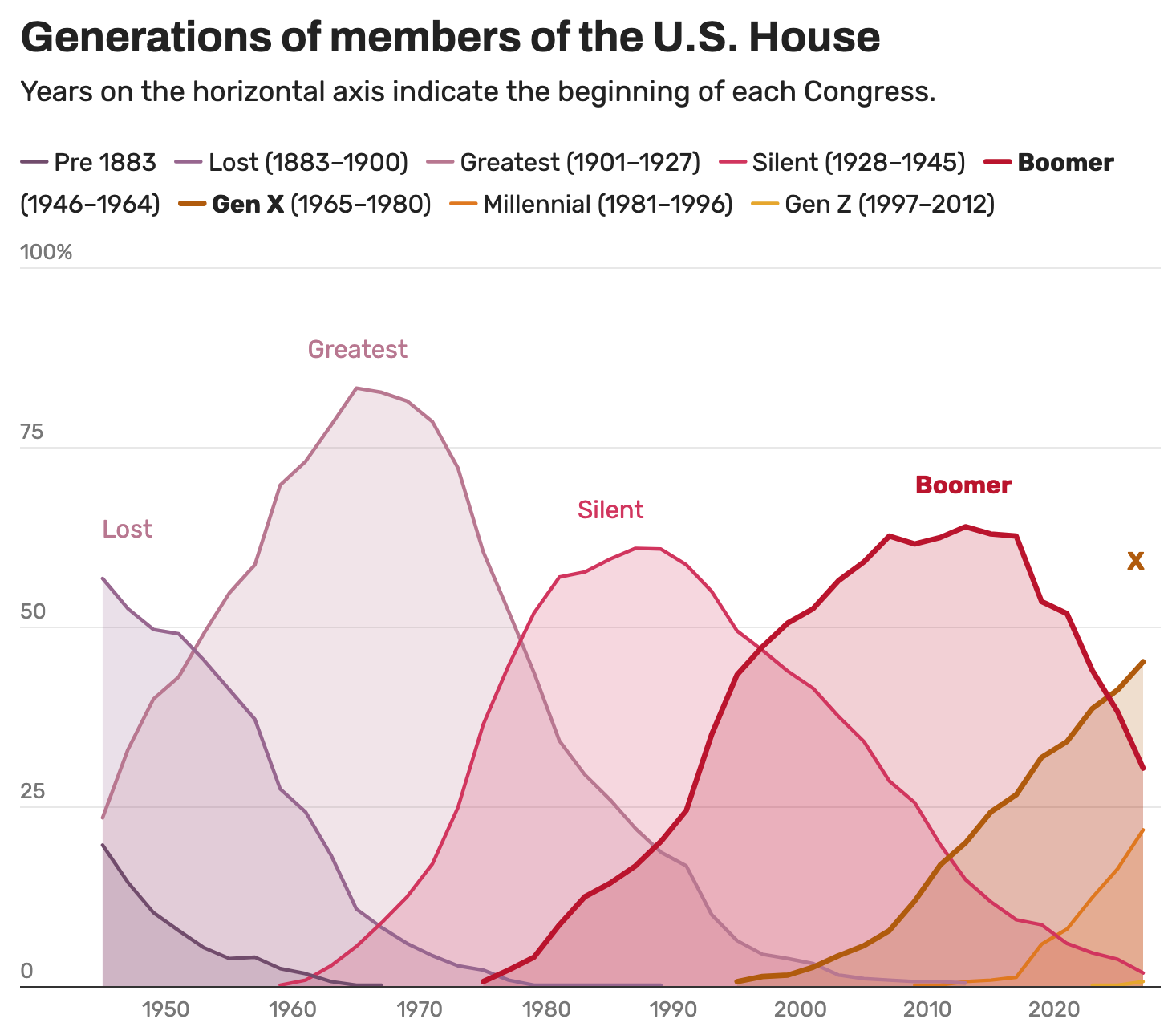
Since 1999, Baby Boomers (the generation born between 1946 and 1964) have made up a larger share of the US’s House of Representatives than any other generation. But last week’s wave midterm elections are bringing in one of the largest freshman classes in recent history, and the Baby Boomers’ reign is now ending: there will be more Gen X representatives in the House than any other generation. That 27-year-long period of Boomer dominance was a bit longer than the dominance of the preceding Silent Generation (who were on top from 1979–1999) and Greatest Generation (1955–1979). Interestingly, Millennials are catching up on Gen X, which is a historical anomaly and suggests that Gen X’s time on top may be brief. (Meanwhile, Boomers will still make up the lion’s share of senators, since the Senate is a more exclusive body for experienced politicians and sees slower turnover.)
🚏 England suffered its worst harvest on record
A farming analyst recently wrote that summer 2026 was England’s worst harvest for cereal and oilseed crops (which include soybeans, canola, and sunflower) since detailed recordkeeping began in 1984. What’s more, “four of the five worst harvests have now occurred since 2020.” An obvious factor is England’s incessant heatwaves and droughts; 2026 marked England’s hottest summer on record, and dead grass due to brutal droughts led farmers to warn about this very crop shortage back in August. It’s not just staple crops, either: in October, Cheshire’s annual Apple Day was canceled for the first time in 24 years due to a poor apple harvest.
🚏🚕 AI agents called just four Uber rides on Halloween week
In an earnings call, Uber revealed that, of its 320 million Uber rides and Uber Eats deliveries on Halloween week, just four rides were arranged by third-party AI agents. Agents placed more Uber Eats orders — “around 500” — though that’s still a tiny fraction of the overall volume. The figures are similarly low across the board: DoorDash’s CEO said agents had only placed “maybe several hundred orders” all-time, and Airbnb’s CEO said agent bookings were “very non-material.” (Airbnb, for its part, is building its own AI travel agent to help with planning and booking trips.)
🚏🏴☠️ The Black Sea is now the world’s deadliest maritime shipping route
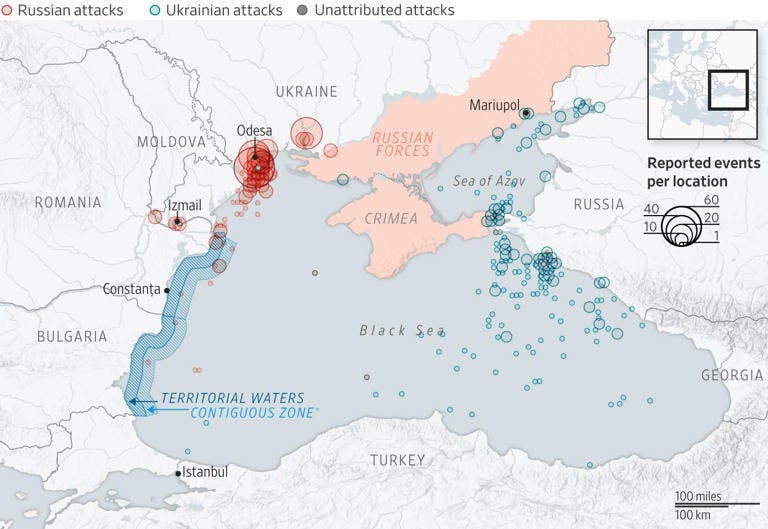
Over 570 ships have been attacked in the Black Sea (primarily by Russian drones), typically in the northwestern part around Odesa and the mouths of the Danube, Dniester, and Dnieper rivers. While Russia has long been targeting Ukrainian ports like Odesa, it’s also expanded to striking the waters off Romania and Bulgaria. These strikes have resulted in at least 40 sailors’ deaths, compared to 24 deaths in the Strait of Hormuz, making the Black Sea “the most dangerous maritime route in the world,” in the words of one maritime research group.
📖⏳ Worth your time
Some especially insightful pieces we’ve read, watched, and listened to recently.
The Reasons Behind the Collapse of the Chinese AI Short Drama Bubble (Eichan) — An originally Japanese-language essay about how AI-generated films briefly dominated the short drama film market in China, only to collapse as the industry moved back toward human-created works. The flood of AI-generated films made exposure harder to get, which made advertising prices skyrocket and thus neutralized AI’s production cost advantage. Moreover, the volume of generic, samey content led consumers to flee toward higher-quality shows with top-flight craftsmanship or quirkier indie productions — precisely the domains that humans, not AI, excel at.
The Rise and Fall of Jev Hype (Alex Ewerlöf) — Dissects how a new kind of AI ‘decision model’ named Jev speed-ran the hype cycle, from a buzzy launch full of name-dropping, jargon, ambiguity, and inflated expectations to a sobering realization of the technology’s limitations and the rise of infinite competitors (including open-weight models) that do the same thing. The author argues that this “manipulative marketing” is all too common in AI, especially since most current innovations are fairly incremental and thus require breathless hype to get people excited.
It’s Mostly Mothers Who Pass on Mitochondria (Scientific American) — Argues that, in evolutionary biology, males are essentially running an r-strategy at the cellular level with sperm (high quantity, low investment, with disposable mitochondria), while females run K-strategy with eggs (low quantity, high investment, with protected mitochondria). Did these two strategies predate anisogamy itself — and did sexes arise from a division of labor?
Why Did Van Halen Demand Concert Venues Remove Brown M&M’s From the Menu? (Smithsonian Magazine) — Explores the famous story of the rock band slipping a provision banning brown M&M’s into their 53-page contract rider for venues. There are layers to the story: the obvious read is that Van Halen were fussy and excessive rock stars; the “smart” read (echoed in many business books) is that it was a clever way to check if the venue had read the whole contract and thus adhered to all the safety standards; and the author’s advanced read is that the M&M’s provision actually had no bearing on safety, because the catering staff was usually separate from the technical staff, and so the whole story was just a publicity stunt to make Van Halen look cool, sophisticated, and demanding.
🔍📆 Lens of the week
Introducing new ways to see the world and new tools to add to your mental arsenal.
This week’s lens: leverage points.
“Don’t eat anything that comes from a crinkly bag.” This rule of thumb can be surprisingly effective if you’re trying to avoid junk food. While not perfect, there’s a high enough correlation between crinkly bags and junk food that creating a simple rule can have a disproportionately large effect.
This is an example of a leverage point, which Donella Meadows describes as “places within a complex system… where a small shift in one thing can produce big changes in everything.” The key point is that a leverage point gives, well, leverage, the ability to multiply the force of an action. Finding a good leverage point can feel like magic but as Meadows describes, they are often hiding in well-known places: in rules, in delays, in feedback loops, in paradigms of belief.
The value of leverage points is that, because they are small relative to their impact, they often can be changed more easily than a broader change effort. Changing some numbers on a piece of paper may not do anything by itself, but if those numbers are in the tax system, we can change incentives around how people run businesses or buy homes.
The flip side is that if we change a leverage point unknowingly, we may be surprised at how big of an impact the change has. If, suddenly, we make failures more costly, we might see that all of a sudden everything takes longer because people are hedging, checking, and adding excessive redundancy throughout the whole lifecycle.
Effective use of leverage points often requires experimentation to understand the downstream and upstream effects of the change. So it’s always good to start with smaller perturbations… unless dramatic change is the goal. In which case, hit the gas! (And know the risks.)
Whether or not we use them, being aware of leverage points helps us see systems in a deeper way. So spend some time today looking for the leverage points in your life.
© 2026 The FLUX Collective. All rights reserved. Questions? Contact flux-collective@googlegroups.com.