

Episode 258 — November 5th, 2026 — Available at read.fluxcollective.org/p/258
Contributors to this issue: Erika Rice Scherpelz, Laura Eberly, Neel Mehta, Boris Smus, MK
Additional insights from: Ade Oshineye, Ben Mathes, Dart Lindsley, Jasen Robillard, Jon Lebensold, Justin Quimby, Lisie Lillianfeld, Robinson Eaton, Spencer Pitman, Stefano Mazzocchi, Wesley Beary, and the rest of the FLUX Collective
We’re a ragtag band of systems thinkers who have been dedicating our early mornings to finding new lenses to help you make sense of the complex world we live in. This newsletter is a collection of patterns we’ve noticed in recent weeks.
“Anxious, inexperienced writers obey rules. Rebellious, unschooled writers break rules. Artists master the form.”
— Robert McKee
🤖✉️ Dear Eliza, …
“Our new product is a scalable, end-to-end, frictionless platform that uses proprietary machine learning to deliver personalized, actionable insights to users in real time. Our secret sauce is our synergistic ecosystem flywheel, which creates a virtuous cycle of engagement, retention, and delight.”
AI slop, much? Yes, literally and, in this case, intentionally. But all too often, we see these sorts of wordy, mostly empty types of text sent under the guise of real communication. We’ve all seen text that was copied from AI and then published, with no editing and no attribution. Even when the text itself reasonably communicates the point, it still creates discomfort. Should we share dontpastetheai.com? Should we set norms of labeling this, “AI;DR” as the parallel to “TL;DR”? Is sharing the AI’s work plagiarism of the AI? Is it plAgAIrism? Or is that when the AI copies from us? Where should “fair use” or Creative Commons-style crediting come in?
Where is the modern Dear Abby? Abby talks about what to do when a coworker is smelly after they go to the gym and no one has any idea how to tell them and it’s really offensive to even talk about but everyone is tired of suffering through it. Who is the arbiter blessing new etiquette? While we don’t expect a literal Dear Abby to arise, the parallel points to something important: it’s not just that these norms are still evolving. It’s that there are legitimately hard questions to answer.
Just as there’s tension in the social norms around the smelly coworker, there’s tension between social norms in AI writing. AI can be a great tool for thought. It can help people express ideas more clearly and deeply than they might have without it. It can also become a way to skip the thinking altogether. And there are gray areas, like people who are trying to write in a non-native language or using a chatbot as assistive technology due to a disability that affects their writing.
There’s also a flipside: if someone becomes tainted by AI writing, readers may ignore them. And since the signals that tip readers off evolve over time, the writer may not even suspect this is happening. When we’re developing an idea with AI, we see the depth of our intention… but without that intervening context, everyone else sees it as AI slop. (Similar, in a way, to how one’s own spreadsheet is amazing and everyone else’s is a brittle mess.)
Perhaps someone could tell the writer that we can see through the facade, but there’s no way to do this politely. But is it more akin to the forbidden, like telling someone their baby is ugly? Or is it more akin to telling someone their fly is open, which they’ll probably appreciate? (And which Pittsburghese even has a phrase for: “Kennywood’s Open.”) It seems more like the latter case.
And once someone is “caught” pasting AI, can they regain credibility? Can they fix the problem with the ease of zipping a zipper?
The point of all these questions is that there aren’t answers yet. There’s no “Dear Eliza” to teach us AI etiquette. And just as Dear Abby isn’t actually an oracle, there will never be one true answer to many of these questions. But perhaps, thinking about this through the lens of a challenging social etiquette question, we can more easily see the tensions under the surface.
🛣️🚩 Signposts
Clues that point to where our changing world might lead us.
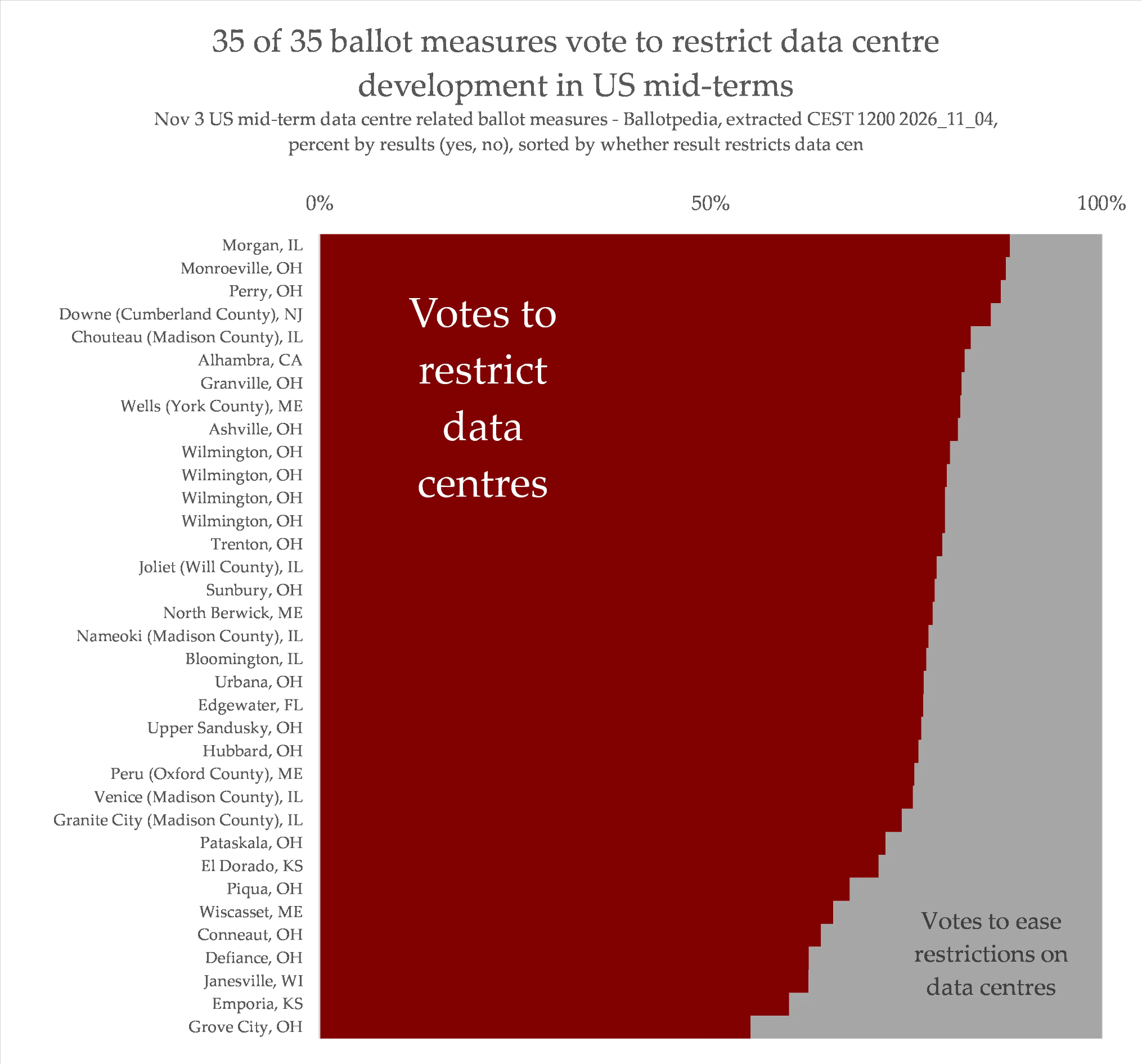
🚏🏬 Voters backed 46 of 47 anti-data-center ballot measures in US elections
So far this year, 47 data-center-related ballot measures have appeared on American ballots; examples include an Illinois initiative to “impose a moratorium on building large-scale data centers” or various Ohio referendums to rezone land for data centers. This week’s midterms alone included 41 such measures. Overall, 46 of the 47 ballot measures resulted in restrictions on data centers; many ended up with 60%+ supermajorities voting to prohibit their construction.
🚏🤝 A plan to eliminate the Electoral College may now have enough votes
The US’s Electoral College, where states allot electoral votes on a winner-take-all basis, is a famously indirect way of choosing the president and has resulted in several presidents winning office despite losing the popular vote. The National Popular Vote Interstate Compact, or NPVIC, is a planned agreement among states to allocate their electoral votes to the national popular vote winner; it would take effect once states totaling 270 EVs (just enough to win) have all signed, thus effectively neutralizing the Electoral College. So far, states worth 222 EVs have signed, but Tuesday’s wave elections have granted Democrats (the party pushing the NPVIC) control over five new states worth 61 EVs. Thus, if these states join the NPVIC, it will hit 283 EVs, which (if it holds up in court) would push the NPVIC past the tipping point and finally turn presidential elections into popular vote contests.
🚏☀️ Solar panels are popular in Nigerian wedding registries
Nigeria’s struggling grid and rising fuel prices have driven a boom in the country’s solar industry; in fact, Nigeria’s small-scale solar installations now provide more power than the entire national grid. These systems aren’t cheap to install, costing $4,500 for a three-person household, which has led many young couples to start including solar panels, batteries, and inverters on their wedding gift lists.
🚏🗾 Japanese fashion brands are designing clothing for hotter summers
Japan’s recent surge in heat waves and ever-longer summers (which are shrinking spring and fall) have increased consumer demand for clothing suited for hot, sticky days. So, brands like Uniqlo and Muji have been launching clothes made with moisture-wicking, fast-drying, odor-minimizing, and even UV-protecting fabric. There are all manner of breathable, sweat-wicking shirts; quick-drying, linen-like shorts; ventilated hats; and even waffle socks made with a breathable yarn spun from washi, Japan’s traditional paper.

📖⏳ Worth your time
Some especially insightful pieces we’ve read, watched, and listened to recently.
Math 2.0 (Terence Tao) — The famous mathematician argues that proofs are digital and checkable like code, so AI is bringing an era of proof abundance that moves human value from problem-solving to problem-finding, plus new work like “open exposition problems” where the goal is a clear explanation of an opaque proof. Tao’s thought experiment about a Lean-certified cancer cure is a great illustration that human understanding is critical for psychological trust.
AI at Amazon: A Case Study of Brittleness (Surfing Complexity) — Examines an essay about a stagnating team within Amazon through the lens of brittle systems, which can’t adapt to evolving situations. The author finds examples of three patterns shown by brittle systems: decreasing ability to adapt as challenges mount, getting stuck using outdated strategies, and falling into “behavior that is locally adaptive but globally maladaptive.”
A Simple Way to Create Suspense (The New York Times) — Argues that suspense isn’t about the cake (the payoff) but the hunger (the wait). By implying questions and withholding answers—a habit the author attributes to TV writers fighting the remote control—authors can hack the human need for closure, though this “drip-feed” mechanic sits in direct tension with modern “bottom line up front” communication habits.
Social Network Analysis and Agent-Based Modeling in Social Epidemiology (Epidemiologic Perspectives & Innovations) — A paper from newly elected Senator Abdul El-Sayed, who was previously a public health professor, that applies concepts from complex adaptive systems to epidemiology. For instance, agent-based modeling can help us understand the “contagion” effect of non-infectious diseases like obesity and alcohol abuse in populations, since people have “complex, non-linear” effects on each other’s health outcomes. Network theory and feedback loops also make appearances.
🔍📆 Lens of the week
Introducing new ways to see the world and new tools to add to your mental arsenal.
This week’s lens: sense-making.
It’s a bird! It’s a plane! It’s… Superman! How do we go through the process of figuring out what’s going on around us? This is the process of sense-making, where people give meaning to their experience. Sense-making is more than just understanding. The interesting applications of sense-making occur when it’s applied in situations of ambiguity. The flying object seems like a bird… but it’s going too fast… maybe it’s a plane… but it has arms and legs. Well, the only flying human around here is Superman!
Sense-making is more than just gathering and explaining data. Rather, it’s an active process of framing, elaborating, preserving, and reframing. What each of these steps does is look at the data through a frame of the looker’s existing knowledge and experience. As we continue to gather data, we realize that some data allows us to go deeper and resolve ambiguity. Other data may contradict the frame and may lead us to reinterpret the data or adjust the frame.
Eventually we reach a conclusion, but that conclusion is always provisional. Sense-making itself is important, but perhaps even more important is the realization that it is an ongoing process. Our current conclusions are always the best we can do in the present moment. But as we learn more, we elaborate, preserve, and reframe our ideas. It’s ever changing.
© 2026 The FLUX Collective. All rights reserved. Questions? Contact flux-collective@googlegroups.com.