

Episode 257 — October 29th, 2026 — Available at read.fluxcollective.org/p/257
Contributors to this issue: Neel Mehta, Boris Smus, Ade Oshineye, Stefano Mazzocchi, Robinson Eaton, Erika Rice Scherpelz, Justin Quimby, MK
Additional insights from: Ben Mathes, Dart Lindsley, Jasen Robillard, Jon Lebensold, Laura Eberly, Lisie Lillianfeld, Spencer Pitman, Wesley Beary, and the rest of the FLUX Collective
We’re a ragtag band of systems thinkers who have been dedicating our early mornings to finding new lenses to help you make sense of the complex world we live in. This newsletter is a collection of patterns we’ve noticed in recent weeks.
“If you want the present to be different from the past, study the past.”
— Baruch Spinoza
🐎🏎️ Unbuilding the future
Hello cars, goodbye horse-drawn carriages! Hello cell phones, goodbye landlines! Hello AI, goodbye… well, we’re still working that one out.
One thing we sometimes forget about progress is that it must also include obsolescence. The march of culture and technology is littered with new solutions. New problems, though, those are rare. New solutions are often replacing something, although not always fully. We can stream video on our phone, but a large, fixed television still has better affordances for immersion and group viewing. And the Jevons paradox means that new solutions can create new demand too. We can watch those videos anywhere.
Still, progress involves obsolescence and, very often, a sense of loss. Sometimes, it’s romanticized nostalgia, but it’s not just that. Everyone imagines they’ll be the heralds of progress rather than the ones disrupted by something that’s 10x better than they thought was possible. And that’s the rub. If someone out-innovates us because they execute on something we envisioned, that’s bad enough. But if they see and achieve that which we couldn’t even imagine, that leaves us feeling small.
Once we go through the stages of grief that come with such a loss, what are we to do? One approach is to turn this into a source of ambition. This requires a certain appetite for risk. Pushing harder means more failure, but also more upside when we do succeed.
This same phenomenon impacts not just individuals, but also organizations. For example, when it comes to software, getting things out there is now so easy. The half-life of software development has been reduced 10x by the agentic frontier. Foundational infrastructure can be obsoleted and replaced seemingly overnight.
But personal egos, eng leadership, and incentive schemes have not yet adjusted to that reality. But stability does still matter… sometimes. How can an organization balance this tension? Like with the dawn of electrification and the internet, the tsunami is on the horizon but has not landed yet. Everything is going to change, so the benefits of incentivizing and rewarding change are huge. But if everything is brittle AI slop, then the chances of disaster spike. And like with fire-prone knob-and-tube wiring, eventually we’ll have to pull it all out because of the accumulated risk.
Perhaps that’s the cost of learning. But we can take inspiration from tools like Taleb’s barbell strategy, which says that it’s better to have a mix of very safe and very high-risk/high-reward investments than trying to go down the middle of the road. The extreme of safety is where individuals and organizations build the foundation that can absorb losses, and the realm of high variance is where wins are generated.
But that comes back to where we started… this only works if we’re ambitious enough for our “bets” to actually be worthy of the name.
So take a moment and think about an area where you think you’re being ambitious and ask yourself… what would it look like if I were to push myself beyond what I can currently imagine?
🛣️🚩 Signposts
Clues that point to where our changing world might lead us.
🚏🇨🇳 China will limit the export of some AI-related technologies
China is planning new rules that would ban or restrict the export of 23 AI-related technologies such as “advanced models,” autonomous AI agents, and methods for designing and coordinating AI chips. The extent of the rules is still unclear, but it’s possible that foreign companies may be barred from buying Chinese AI firms (indeed, Beijing already blocked Meta from its planned $2 billion acquisition of Chinese AI startup Manus), and Chinese firms may not be able to run their most advanced models on foreign data centers. However, open-source models would be largely exempted, and Chinese companies would likely be allowed to build and run their own data centers abroad. Indeed, popular Chinese AI firms DeepSeek and MiniMax have already gained approval to continue exporting their open-weight models.
🚏🎮 Game developers canceled a public demo, fearing AI clones
The creators of an upcoming indie video game canceled a planned public demo out of fear that someone could use AI to clone it and pre-empt their launch; the devs instead opted for a private demo with a limited group of testers. This cloning problem has happened before, and the worries come amidst a broader crisis of game “decomping”—wherein AI agents have become proficient at rebuilding the source code of a video game, thereby enabling easy modding and spin-offs—and a sharp rise in AI-generated games on stores like Steam.
🚏🏭 “Virtual power plants” will pay people to reduce electricity usage to help data centers
Google is working with a large “distributed energy resource” firm to build a one-gigawatt virtual power plant (VPP) to support Google’s data centers. This VPP will offer “roughly the output of a large nuclear reactor,” but it won’t actually generate its own electricity: instead, it will pay homes and businesses on one grid in the Mid-Atlantic to reduce their electricity usage at periods of peak demand, thereby freeing up some juice for data centers. The companies say this VPP is a “critical short-term solution,” but eventually they’ll need to build real power plants to keep up with demand.
🚏🌳 Amazon deforestation fell to the lowest level since 1988
Deforestation of the Amazon—a huge carbon sink—is a major contributor to global warming, to say nothing of its harms to biodiversity. Between 2019 and 2022, Brazil lost 45,000 square kilometers (17,400 square miles) of its share of the rainforest, but recent policies have reduced deforestation by 71% since 2023. In the twelve months ending in July 2026, only 3,335 km2 (1,300 mi2) of the Brazilian Amazon was lost, the lowest amount since 1988. Anti-deforestation policies that have succeeded in the past include crackdowns on illegal mining and logging, promotion of sustainable industries like ecotourism, and expansions of protected areas.
📖⏳ Worth your time
Some especially insightful pieces we’ve read, watched, and listened to recently.
The October Inflection Point for Vibe Game Development (Simon Willison) — Argues that this month marked a turning point where AI agents have finally gotten good enough to build video games that are not only technically competent but also fun to play. It mirrors the “inflection point for coding agents” of November 2025, where AI models became good enough for professional software engineers to use daily. Willison shares some miniature web games he made entirely with AI and observes that the LLMs did a pretty good job when simply told to “make it more fun.”
Developing Creative Identity (Michael Nielsen) — Reframes creative identity away from labels like “writer” toward being an explorer who writes, distinguishing Brand’s writing-to-explore from Darwin’s writing-with-a-goal, and insists that the best “research process” is a rich life. Writing is just a downstream byproduct created from the raw material of a vibrant life and extraordinary work.
The New Moneyball Is Beautiful (Foolish Bailey / YouTube) — Argues that the World Series champion Brewers and the runner-up Rays played unusually “beautiful” baseball focused on fundamentals, defense, small-ball, and other aspects of the game that traditionalists usually enjoy. It’s not a coincidence: “Moneyball” is all about exploiting techniques that the market undervalues, and after many years of “ugly” strategies dominating, “beautiful” strategies have become underappreciated. For small-market teams like Milwaukee and Tampa Bay, this was the only way to overcome powerhouses like the Dodgers and Yankees.
Pre-Modern Armies for Worldbuilders, Part I: Why They Fight (ACOUP) — Historian Bret Devereaux observes that pre-modern militaries usually reflected their civilian social structures and hierarchies. For instance, professional standing armies are usually only possible in strong centralized states with extensive bureaucracies and tax-collecting apparatuses, while fragmented states typically rely on a decentralized network of military aristocrats who rally armies from their clients, retainers, or vassals.
📚🛋️ Book for your shelf
A book that will help you dip your toes into systems thinking or explore its broader applications.
This week, we recommend The Dispossessed by Ursula K. Le Guin (1974, 384 pages).
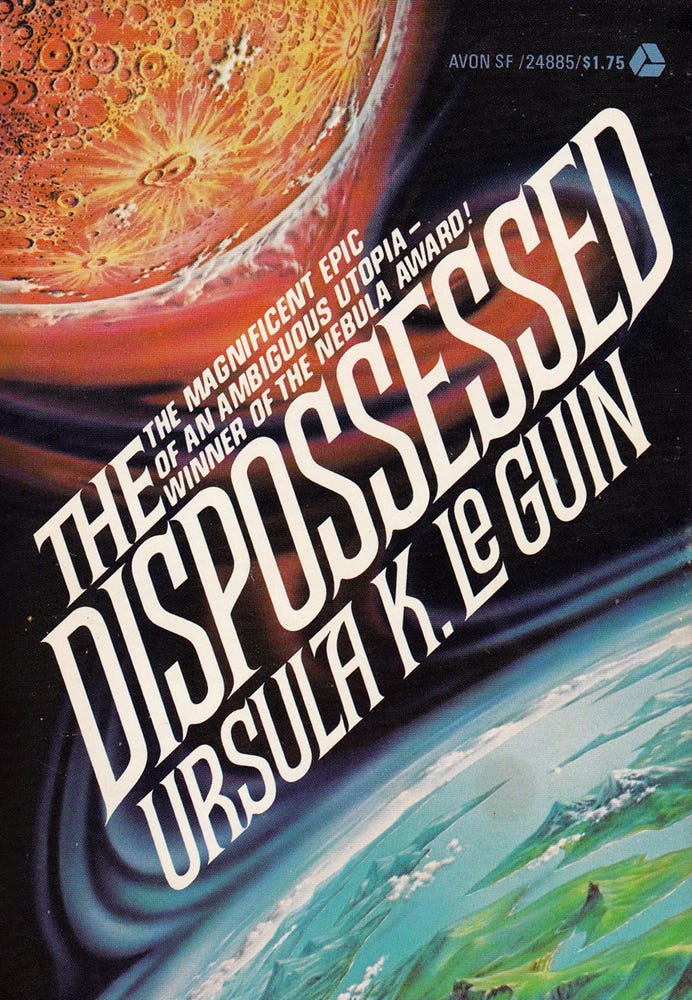
Ursula K. Le Guin’s The Dispossessed reads like a fictionalized study of how all political systems evolve beyond their founders’ intentions. Anarchist Anarres abolished formal hierarchy, yet power games reappear as its citizens jostle for reputation, compliance, and control over scarce resources. Even anarchy needs its middle managers.
Although she is sympathetic to the anarchists, Le Guin shows how collective behavior emerges from local incentives and dependencies, regardless of what was written into the system’s constitution. She explores how the illegibility of the hierarchy makes it even harder to challenge.
Over generations, the institutions built to sustain freedom gradually drift and atrophy. Freedom therefore requires continual maintenance; each generation must learn and practice it anew. This is especially challenging since they inherit many of their institutions without having made the conscious choices that made these institutions work.
The protagonist’s decision to release his scientific discoveries beyond his homeworld, Anarres, prevents a single institution from monopolizing the work. It lets others build on it in ways its creator could never anticipate, echoing the open-source movement. Discoveries become inputs to further discovery, with outcomes no central planner could specify. A great illustration of the power of fiction, Le Guin’s masterpiece won the Hugo, Locus, and Nebula awards for best science fiction or fantasy novel.
© 2026 The FLUX Collective. All rights reserved. Questions? Contact flux-collective@googlegroups.com.