

Episode 1111 1111 — October 15th, 2026 — Available at read.fluxcollective.org/p/255
Contributors to this issue: Erika Rice Scherpelz, Justin Quimby, Neel Mehta, Boris Smus, MK
Additional insights from: Ade Oshineye, Ben Mathes, Dart Lindsley, Jasen Robillard, Jon Lebensold, Laura Eberly, Lisie Lillianfeld, Robinson Eaton, Spencer Pitman, Stefano Mazzocchi, Wesley Beary, and the rest of the FLUX Collective
We’re a ragtag band of systems thinkers who have been dedicating our early mornings to finding new lenses to help you make sense of the complex world we live in. This newsletter is a collection of patterns we’ve noticed in recent weeks.
“You know how in video games, if you get the super-duper high score, it eventually flips back to zero? Well, sometimes Homestar does something so stupid, he flips back to smart.”
— Strong Bad, “4 branches,” Strong Bad Email #161 (2006)
📝 Editor’s note: This is episode 255. In honor of the maximum value that can be stored in a single unsigned byte, we’ve decided to theme this episode around the concept of “fullness.” We hope you enjoy it.
💯😵💫 Dying at capacity
We’ve noticed waste at our grocery store: open registers with no line, food prepped at the deli that doesn’t get sold, a steady rotation of an employee or two who don’t seem to have anything to do. Clearly, we need to up efficiency. So we cut the number of employees in the store by 25%. Deli items are held to a strict “no overage” policy. And if a register has no line for more than five minutes, we send the employee elsewhere. A couple weeks later, register lines are long enough that they start running into each other. Customers complain of shortages at the deli. Deliveries start piling up because they can’t be shelved quickly enough.
This probably seems obvious. When you take all the slack out of a system, it becomes impossible to respond to natural variance in the system. That deli overage (which, it turns out, was only a small percentage of the day’s throughput) is the price to pay for having product available on demand. The idle cashiers and slight excess of staffing allow you to deal with the variable rates at which products flow in and out of the store.
What is more surprising is how much slack a system needs to operate well. It turns out that a system can start degrading at somewhere between 70% and 90% capacity. This is the realm of queueing theory. To give a brief overview: In any system where work flows in and has a time delay before completion, work will start to build up whenever the inflow exceeds the rate at which new work can be absorbed into a system. If work arrives steadily and is processed steadily, we can understand the behavior of our queues exactly. But in most real queues, both the input rate and the processing rate vary. For our grocery store example, customers may arrive in bursts (e.g., shopping after work) and cashiers have different speeds at which they can scan and bag. (The second is why the self-serve line can often feel frustratingly slow; the amateur cashiers vary greatly in how quickly they can get things from cart to bag.)
As Donald G. Reinertsen derives in The Principles of Product Development Flow, a key variable for a queue is the proportion of time spent waiting for an average item. An item that can proceed straight to work spends 0% of its time waiting. An item that waits twice as long as it spends in process spends 66% of its time waiting. Depending on exactly how our queue works, we start seeing dramatic upticks in the proportion of time spent waiting. And as many consumers know from experience, once you start spending more time waiting than on the thing, it’s almost inevitably frustrating.
A more human-centric take on a similar idea comes in Tom DeMarco’s Slack. Although the book’s discussion of Dilbert feels a bit dated, DeMarco’s basic thesis is still sound: companies try to maximize efficiency, but by doing so they remove their ability to respond nimbly to changing conditions. Maximizing efficiency feels like it will allow a company to move most quickly, but both variability and unpredictability mean that too much efficiency can trap us in a corner. We all need more slack in our lives (and yes, we consider it ironic that the Slack app reduces slack).
Queues and variability are a fact of life; after all, we don’t want people sitting around bored or idle. So what can we do about it? Reinertsen and DeMarco both give us some clues: first, don’t try to look at utilization. It can be hard to measure well and doesn’t provide much actionable guidance. Instead, monitor queue length and wait time. These can provide useful guidance about capacity. Additionally, we can also be thoughtful about how we take items from the queue. First in, first out (FIFO) can work if queue items have comparable economic value and expected processing time. However, once we introduce variability, it can help to take that into account. For example, an emergency room triage system ensures that the most “valuable” cases — the critical injuries — are processed most quickly. On the processing side, processing a number of quick-delivery items can clear out the queue enough to reduce average wait time.
On the human side, DeMarco recommends that we give people capacity to sense and respond to change. Some of this is about culture: we must learn to embrace risk and exploration. It’s okay if not every piece of work generates success. Some advice is about the day-to-day: reduce low-value busywork that keeps people occupied but prevents them from having time to explore. Yet at the base of it all is attitude: humans are not machines. We should respect and value the need for downtime, not as waste but as a reset.
So as we, on episode 255, fill out our first 8 bits of capacity, we want to take a moment to respect the spare capacity that allows us to keep producing this newsletter and allows you to spend some of your precious time reading it.
🛣️🚩 Signposts
Clues that point to where our changing world might lead us.
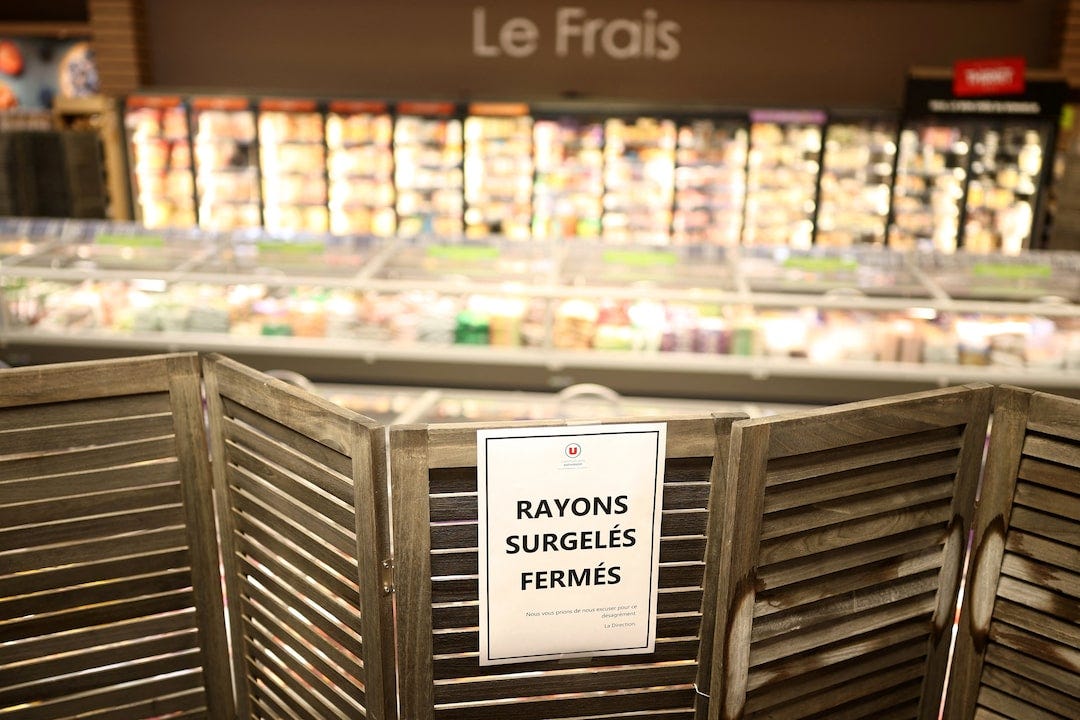
🚏🍧 Hackers heated up fridges at French supermarkets, spoiling food and causing fires
150 French grocery stores were hit by hackers who raised the temperatures of their refrigerators and freezers to “as high as 50 degrees Celsius (122 degrees Fahrenheit),” which spoiled food, started fires, and forced refrigerated food aisles to close. Many of these fridges were connected to the internet to let maintenance companies remotely adjust temperatures, but they were running “outdated firmware” that left them vulnerable. The attacks reportedly resemble recent fridge hacks at grocery stores on US military bases; these “commissaries” are a key benefit for military families and veterans, giving them substantial discounts over civilian stores and a boost to morale.
🚏🇮🇩 Indonesians are being recruited into the Russian army over social media
Social media recruiters are messaging Indonesians and offering them jobs as cooks, drivers, cleaners, nurses, and more in Russia, even offering to pay for airfare and e-visas. But, according to their families, dozens of young people were instead pressed into signing contracts (in the Russian language) to join the Russian army or build drones on the front lines; several couldn’t leave because their ‘sponsors’ took their passports. Indonesia isn’t the only country with this problem: India, Sri Lanka, Nepal, Colombia, Vietnam, and several African nations (among many others in the Global South) have had problems with their citizens getting duped into joining the Russian army.
🚏📲 Norway plans to temporarily ban smart glasses in public
Norway is planning a temporary ban on smart glasses with audio/video recording functionality in public places such as “parks, beaches, museums, shopping centers,” and more, citing concerns about people being recorded without their knowledge. Over in the UK, some cinemas and pub chains are banning smart glasses on their premises, while the Australian government is weighing a ban on smart glasses in government offices.
🚏🪃 A YouTube political commentator used AI to fake an Aussie accent and talk politics
A YouTube channel called Oceania Unfiltered racked up over 3 million video views talking about Australian and New Zealand politics. Its host appeared to talk with a thick Aussie accent, but it turned out he’s a Brazilian man who used AI to change his voice and edit the video to make his lip movements match. He used his platform to promote a far-right Australian party and got thousands of comments from real Aussies. Meanwhile, Facebook is also overrun with AI-generated posts about Australian politics, which are largely created by people from Indonesia, Sri Lanka, Vietnam, Bangladesh, etc. When users engage with these posts, the creators get paid in Australian dollars — which convert to a lot of money in these developing countries’ local currencies.
📖⏳ Worth your time
Some especially insightful pieces we’ve read, watched, and listened to recently.
Why AGI Will Not Happen (Tim Dettmers) — Argues that intelligence hits physical walls: human brains are already maxed out (pregnant women can’t metabolically support larger ones), GPUs plateaued in 2018, and linear capability gains now demand exponential resources. As a result, China’s model of “useful AI at reasonable cost” will beat the USA’s unrealistic ambitions of superintelligence, which the author dismisses as an Oxford philosophers’ fantasy. The notion of an AGI that improves itself (thus causing a runaway effect and the ‘singularity’) is a “deeply flawed idea” that “treats intelligence as purely abstract and not grounded in physical reality… to improve any system, you need resources,” and resources get limited quickly.
Artificial Deadlines: Evidence of Fraud in an Influential Study About Procrastination (Data Colada) — A team of behavioral scientists reveal irregularities in the data from an influential Dan Ariely psychology study. In this post and its follow-up, they use forensic methods to find evidence of data duplication, implausibly large effect sizes, and intentional data alteration to support a hypothesis. One interesting heuristic: participants in the study self-reported the number of minutes they spent on certain tasks, and while a replication showed that people tend to round time intervals to round numbers like multiples of 10 or 15, the original data had a smooth distribution with no round-number bias — suggesting that an algorithm or RNG was used to generate these “human-reported” stats.
Brand New India (Phenomenal World) — Historian Ravinder Kaur argues that, in developing countries like India, economic liberalization and globalization have counterintuitively gone hand-in-hand with democratic backsliding and ethnonationalism. One mechanism is the commodification of the nation-state, where a country becomes a brand for foreign investment and tourism and thus tends to promote the majority culture in its advertising and publicity campaigns. Also, liberalizing economic reforms tend to require centralization of power as the national government breaks down regional barriers to trade and imposes a single market.
Is Kinetic Energy Actually ½mv²? (Stand-Up Maths / YouTube) — Mathematician Matt Parker does a satisfying calculus derivation to prove that our familiar equation for kinetic energy, as with most equations from Newtonian physics, is just a first-order approximation for the real relativistic equation, but close enough at low speeds. He also chats with a CERN scientist about how they compute energy amounts at the Large Hadron Collider’s mind-melting speeds.
🔮📬 Postcard from the Future: Inbox Zero Never
A ‘what if’ piece of speculative fiction about a possible future that could result from the systemic forces changing our world.
// What might the impact of the broad adoption of agents have on the general populace’s inboxes?
2028: The interior of a local coffee shop in Westwood, Massachusetts (a town a half hour south of Boston and well outside of the MIT/Harvard University Zone).
Two old friends sit down for a cup of Dunkin on Saturday morning. One looks bedraggled.
“It’s been a minute, Riley! You look awful. What’s going on?”
“It’s my damn email—” <ding - their phone notification rings> “Ever since every store and every Tom, Dick, and Harry in my contact list started using AI, their damn Agents are flooding <ding> my inbox <ding> with messages!”
Casey ruefully shakes their head in acknowledgment. “My younger cousin was telling me why when I was complaining about the same thing. Email is apparently this ‘universal protocol’ that all the AIs can use to talk to each other. So now our inboxes are turning into their switchboards.”
“Yeah! I thought the old spam and political emails were bad, now I’m sorting through dozens of messages a day! I used to only get ten emails a day… those were the good old days!” <ding> “And now Google, Microsoft, and Yahoo are charging more money for their ‘custom personal Agents’ to sort the whole thing out. I’m not paying them more for a problem they created!”
They both sigh and take a sip of their coffee.
<ding>
“Riley, at least turn off those damn notifications!”
© 2026 The FLUX Collective. All rights reserved. Questions? Contact flux-collective@googlegroups.com.