

Episode 253 — October 1st, 2026 — Available at read.fluxcollective.org/p/253
Contributors to this issue: Justin Quimby, Erika Rice Scherpelz, MK, Neel Mehta, Boris Smus
Additional insights from: Ade Oshineye, Ben Mathes, Dart Lindsley, Jasen Robillard, Jon Lebensold, Laura Eberly, Lisie Lillianfeld, Robinson Eaton, Spencer Pitman, Stefano Mazzocchi, Wesley Beary, and the rest of the FLUX Collective
We’re a ragtag band of systems thinkers who have been dedicating our early mornings to finding new lenses to help you make sense of the complex world we live in. This newsletter is a collection of patterns we’ve noticed in recent weeks.
“That’s too coincidental to be a coincidence.”
— Yogi Berra
🌊⛵ The uses of adversity
After a beautiful summer sailing on a calm lake, you take your wooden boat into rougher seas. Before you know it, the boat you thought was sound is taking on water. Not much. You’re able to get to a dock and patch things up. But still, no captain or crew wants to be in this situation.
Above the usual waterline, sun and wind can dry a wooden boat’s planks. As the wood shrinks, seams open. Everything seems fine… until the boat experiences waves that reach above “normal”. These are fair-weather seams, a niche term but a real phenomenon for those who sail and maintain wooden ships.
Teams also have fair-weather seams. Imagine a group that has shipped reliably for months. Everyone knows what to do and they do it well. Then there’s a weird data corruption bug on a Friday night. The eng team thinks support owns the response. Support thinks eng owns it. The lead assumes an engineer is already looking at it. During the fair weather, the team’s ability to handle the incident atrophied. The good times didn’t just hide the gap. They created it. With no incidents to respond to and nothing to keep the team in practice, they were unprepared when something went wrong.
This is closely related to Taleb’s idea of antifragility. Some systems gain from challenge rather than merely survive it. Muscles get stronger with use. Fair-weather seams illustrate the flip side of antifragility: when a system needs challenges to get better, then seemingly good times have a hidden cost. The good times let weaknesses develop unseen. And we’re never “done” with the challenge. Being exposed to water can help the planks swell and close the seam, but a long enough spell of dry weather and calm waters can let them open again.
In those seemingly fortunate times when all is smooth sailing, it can be worth introducing some friction into our lives. This is the idea behind drills. It is also the idea behind chaos engineering, which involves running failure experiments on a system. This can range from the random failures of a chaos monkey to more structured exercises like Google’s DiRT scenarios.
All this raises a somewhat uncomfortable question about smooth sailing, about the good times. While no one wants to be in constant chaos, the flip side has its own challenges. When nothing is going wrong, how do we know that our seams are tight? We need to take a first step toward discomfort. We have to open ourselves to risk to see how ready we are. As Shakespeare says, “Sweet are the uses of adversity.”
🛣️🚩 Signposts
Clues that point to where our changing world might lead us.
🚏🇸🇬 Singapore’s government is building a dating app
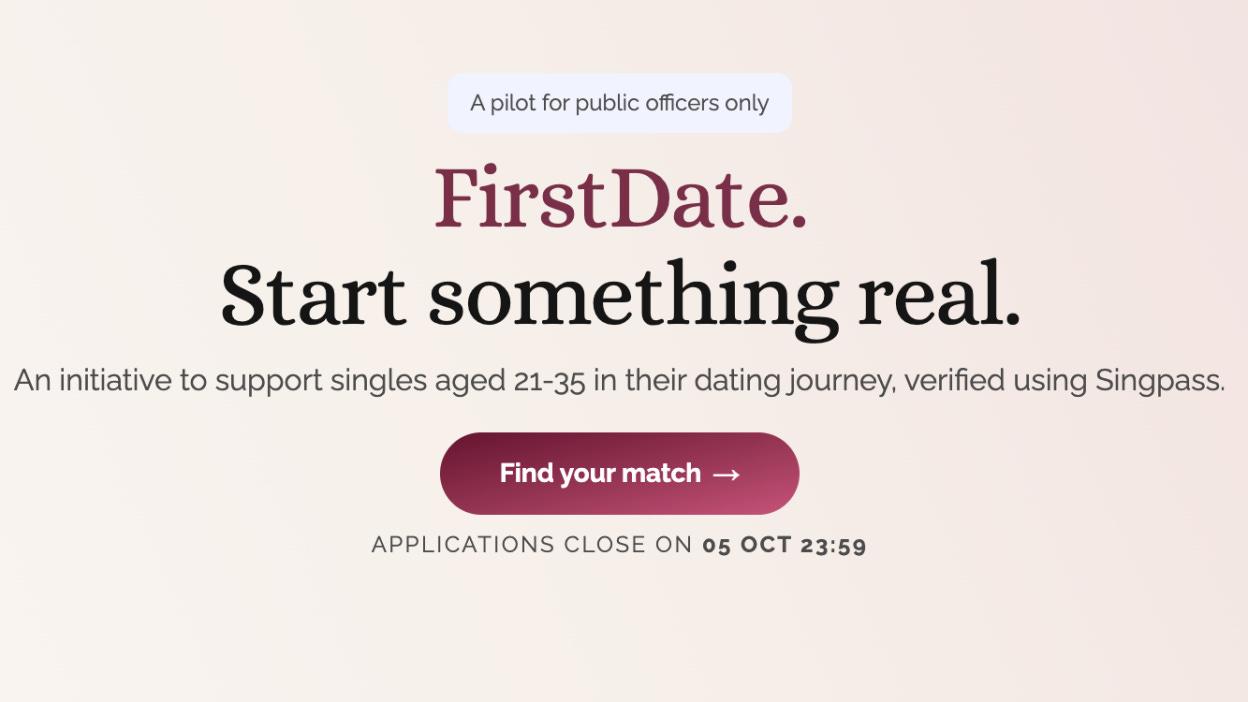
Singapore’s Government Technology Agency is launching FirstDate, a dating app for “singles aged 21–35.” (It’s currently in beta for government employees only.) It uses similar algorithms to mainstream dating apps, though it relies more on questionnaires than swiping, but the most interesting part is that it verifies accounts through the city-state’s digital ID system, which is supposed to help thwart fake profiles. The launch comes amid a recent finding that Singapore’s birth rate fell to just 0.87, down from an already low 1.24 ten years ago; earlier this year the government tasked a working group with “addressing falling birth rates.” Perhaps this app hopes to chip in.
🚏🍟 McDonald’s is using AI for dynamic pricing
Shoppers have long feared the potential of digital price tags that can adjust product prices on the fly, and it seems like McDonald’s is making them real. The Golden Arches now offers an AI system to franchisees that analyzes customer spending at nearby restaurants and gives advice about what prices to set; it sends franchisees messages like “your restaurant is showing medium sensitivity to price [based on] customer willingness to pay in your area.” McDonald’s maintains that this system is purely advisory and franchisees are free to set their own prices, but McDonald’s corporate has also been known to push prices on franchisees and punish those who deviate too much.
🚏🏎️ Tech workers got ChatGPT to drive a Toyota
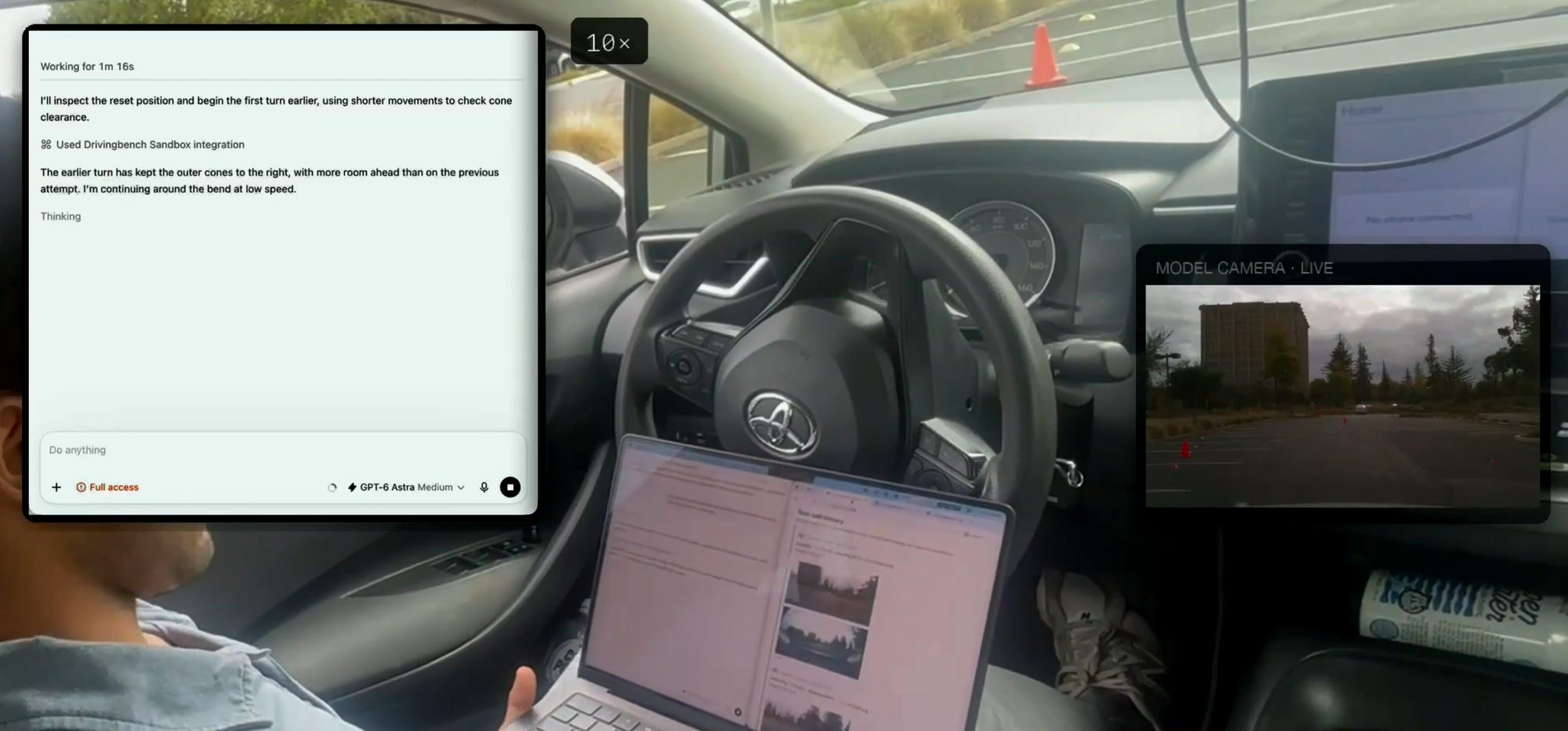
LLM benchmarks — bundles of tests that give models scores for performance on certain tasks – are all the rage, and now that LLMs are easily cracking knowledge-based exams, researchers have started releasing benchmarks for things like robotics, painting, and 3D design. So some San Francisco tech workers hooked ChatGPT up to Comma, an open-source system that’s normally used for self-driving but can also be used for drive-by-wire, which was plugged into a rented Toyota Corolla. A researcher sat in the car and fed camera and sensor signals from Comma into ChatGPT, which then decided on an action and sent speed and steering commands to the car. ChatGPT with GPT-6 Astra, OpenAI’s latest model, successfully completed a small obstacle course.
🚏🌃 The night sky is getting 10% brighter every year
A 2023 study involving thousands of citizen scientists found that the average night sky got 9.6% brighter every year from 2011 to 2022, which works out to a doubling in brightness every 7.5 years. In fact, astronomers believe that “over much of Earth’s land surface, the night sky no longer fully transitions to starlight and moonlight after sunset”: an intermediate “artificial twilight” caused by skyglow takes over the atmosphere after sunset. Fortunately, many places are weighing dark-sky laws, such as a proposed New York State law that would require people to turn off unshielded outdoor lights after 11 p.m.
📖⏳ Worth your time
Some especially insightful pieces we’ve read, watched, and listened to recently.
Confessions of an Unrepentant Slop Snob (Charity Majors) — Explores workplace situations where reading AI-generated content feels offensive (personal thoughts and feelings) versus fine (code, and to some extent artifacts). Argues that we need to rework our communication norms for when and where we agree to use AI in documents, reviews, tickets, emails, etc. that we share with coworkers.
The Lightbulb Computer (Guillaume Ardaud) [Also on YouTube] — A cool design prototype for a bulb-shaped smart device that could listen to voice commands, identify gestures, and beam text or images on walls, tables, or other surfaces. The designer envisions this world of “ambient” computing as a salutary alternative to recent trends like VR goggles that are “antisocial” and take you out of the moment.
Jurassic Generation (The New Atlantis) — Examines the various themes of Jurassic Park, focusing on the illusion of control that science brings and the “unpredictability of tinkering with unfathomably complex natural systems.” When we see people “playing God,” as some fear about biotechnology and perhaps AI, it’s hard to point to a concrete danger, just the risk of unintended consequences — but Jurassic Park is a useful cultural touchstone that helps communicate the real perils.
Patrick Gunkel Is an Idea Man Who Thinks in Lists (The Wall Street Journal) — A 1987 article that seems prescient: a quirky futurist named Patrick Gunkel developed a field called ideonomy, which crosses vast taxonomies to escape habitual thought, seeking unexpected connections by colliding unrelated ideas. It feels newly actionable with LLMs, which can interpret the combinations and help filter a hundred strange ideas down to the one worth pursuing.
🔮📬 Postcard from the Future
A ‘what if’ piece of speculative fiction about a possible future that could result from the systemic forces changing our world.
// What might teacher-parent conferences look like in 20 years?
To: Morgan-Smith@, Casey-Smith@
From: Teacher Rhodes
Subject: Parent-Teacher meeting setup
Hi, it’s time for the annual parent-teacher conference for 4th graders. I would like to chat with you about the rest of the school year ahead, as well as some behavioral issues I’ve seen.
<Agent items>
Negotiation Items
Time / Date / Duration (15 minute minimum)
Device usage during meeting (type, duration, frequency, local bandwidth)
Recording / Transcription permissions
Parental Topics (open)
Teacher agentic API [0x32….]
Agentic permission level: Alpha-Three-Green
</Agent items>
// Several weeks later
The Smiths, a well-dressed couple, walk into a classroom. Teacher Rhodes stands, greets them, and gestures to some seats.
“Thank you so much for coming and for being actively involved in your child’s education. I see we’ve got green lights for protocols. I’ve reviewed the topics you wished to discuss. For the information items, I’ll beam over the data to your agents now. Let me know if you or your agents have any questions.”
The parents’ eyes defocus for a moment, as they review their agents’ take on the material. They nod at the teacher, no immediate need for in-person discussion.
“As for the behavioral issues I mentioned in my email, they revolve around your child’s agentic usage during school. As you know, 4th grade is when we introduce agents into the classroom, so that children can begin acclimating to their thought partners. The issue that I’ve been seeing is…”
A light chime rings and a soft voice says “agentic time enabled”. All three adults seamlessly shift to their agentic devices. Fingers and eyes twitch as they issue judgments to agents working on their behalf, everything from social scheduling to news consumption to personal passion projects to professional efforts. Ninety seconds pass, and the chime rings again.
The teacher’s eyes refocus on the parents. “The issue I’ve been seeing is that your child is having difficulty in some of the less basic usage patterns. Their swarm management, even with single digits of swarm units, suffers from a lack of oversight and delegation. Your child wants to focus on one topic, often for dozens of minutes at a time. This is not hyperfocus, but the undeveloped mental muscle of managing multiple agentic workstreams and retaining sufficient context on each.
“As an at-home exercise, have you considered introducing your child to StarCraft?”
© 2026 The FLUX Collective. All rights reserved. Questions? Contact flux-collective@googlegroups.com.