

Episode 249 — August 27th, 2026 — Available at read.fluxcollective.org/p/249
Contributors to this issue: Laura Eberly, Justin Quimby, Erika Rice Scherpelz, Neel Mehta, Boris Smus, MK
Additional insights from: Ade Oshineye, Ben Mathes, Dart Lindsley, Jasen Robillard, Jon Lebensold, Lisie Lillianfeld, Robinson Eaton, Spencer Pitman, Stefano Mazzocchi, Wesley Beary, and the rest of the FLUX Collective
We’re a ragtag band of systems thinkers who have been dedicating our early mornings to finding new lenses to help you make sense of the complex world we live in. This newsletter is a collection of patterns we’ve noticed in recent weeks.
“We dream, we wake on a cold hillside, we pursue the dream again. In the beginning was the dream, and the work of disenchantment never ends.”
— Kim Stanley Robinson
📝 Editor’s note: We’ll be off next week for the US Labor Day holiday. We’ll see you again the week after!
🖊️🤖 Language evolves, truth-telling endures
What’s a writer to do? Some of us have been using em-dashes since before they were uncool. Emojis to start headings are a long FLUX tradition. And we’ve even been known to delve on occasion. Yet nowadays, all of these are “tells” for AI writing. People who never noticed these patterns before are suddenly greatly concerned about their use. There’s pressure to remove AI-associated language, lest the writing be perceived as inauthentic. However, LLMs are trained on vast amounts of textual data. If these patterns appear in AI-assisted writing, it’s because they appeared in human writing first.
A piece of the puzzle is that superficial writing quality used to be “proof of thought.” Similar to how Latin was once the lingua franca of scholars, the proper usage of an em-dash or less common vocabulary correlated with someone who had put thought into what they were writing. “Smart” writing had a veneer of intelligence, signaling a certain type of education, whether or not the underlying idea deserved it.
Now these are decoupled. It’s easier than ever for a mediocre idea to hide behind writing that passes the sniff test of having been reasoned out. The easy-to-detect markers are no longer reliable. And because AI-generated writing often uses these markers, we have started to become suspicious whenever we see them.
In a recent example, Hank Green was “caught” using AI because his script included the phrase “Thanks for the pushback.” Why the scare quotes? People thought they found a “tell.” It turned out that the phrase was not generated by AI, although he admitted to using AI elsewhere in his creative process in ways that he felt were unhealthy. A coincidence became a scandal because people thought they could sniff out “just paste the AI” writing and use it to make judgments about the entirety of Hank’s work. Even the discussion gets meta. In a long-form, multi-generational discussion on Hank Green’s AI use, one of the commentators said — unscripted, unironically — “I appreciate the push.” They then joked that the speaker was “secretly AI” who could no longer be trusted.
Are LLM “tells” erasing legitimate use of language? LLMs first learned those patterns from good writing. Those LLMs are then used in generating writing both good and bad (witness the explosive growth of slop on LinkedIn). Now those patterns have a negative association. One way this goes is that parts of language are lost to humans, given over to AI entirely. Then, when good writing shifts and LLMs go through a future round of training, new phrases are denylisted.
Or we can go another direction. As readers and writers we can hold ourselves accountable to ideas. Sometimes we need to delve into an idea — perhaps with a side thought here and there — regardless of what the AI detector thinks 😉. But don’t stop there. AI writing may appear good at first glance, but upon closer inspection, the writing is often internally incoherent. As writers, we can ask ourselves, “What am I really trying to say? Did I accomplish that?” As readers, we can ask ourselves, “What is the underlying idea here?” And for lower-stakes writing, sometimes all it takes is a round of reading and editing.
Writing quality does matter. Smart-sounding writing getting cheaper will change what we perceive as good or bad. However, at the end of the day, the truth of a piece is what will last, no matter how it’s expressed.
🛣️🚩 Signposts
Clues that point to where our changing world might lead us.
🚏🎯 Canada’s retaliatory tariffs are targeting states with upcoming Senate elections
After US President Donald Trump slapped 50% tariffs on a wide range of Canadian imports this week, Canadian Prime Minister Mark Carney announced his country will unleash “dollar for dollar” retaliatory tariffs next month. Carney appears to be strategically picking industries to target swing states that have Senate elections this November: tariffs on steel and auto parts will affect Michigan, metal tariffs will hit Ohio, seafood tariffs will hit Maine and Alaska, and agriculture tariffs will affect Maine and Iowa. Meanwhile, Ontario Premier Doug Ford wrote a letter to Carney advising him to focus tariffs on imports from “politically significant states to the current administration’s base of support,” naming eight mostly Republican states: Alabama, Arkansas, Florida, Iowa, Missouri, Montana, Texas and Wisconsin.
🚏🚰 Iranian hackers targeted over 100 water systems across the USA
Last month, a spate of cyberattacks from Iranian hackers shut down water plants in several large suburbs in Minnesota, marking a new front in the US-Iranian war. It turns out that wasn’t an isolated incident: the Cybersecurity and Infrastructure Security Agency (CISA) issued a report this week that revealed that “malicious cyber activity” had targeted “over 100 internet-exposed [water] systems” nationwide, primarily through internet-connected programmable logic controllers (rugged computers designed for industrial settings). Agencies said that hackers are using “AI-generated exploitation scripts,” and cybersecurity experts warn that the numerous attacks so far may be “test runs for a larger-scale attack.”
🚏🌞 American solar generation is up 20% year-over-year
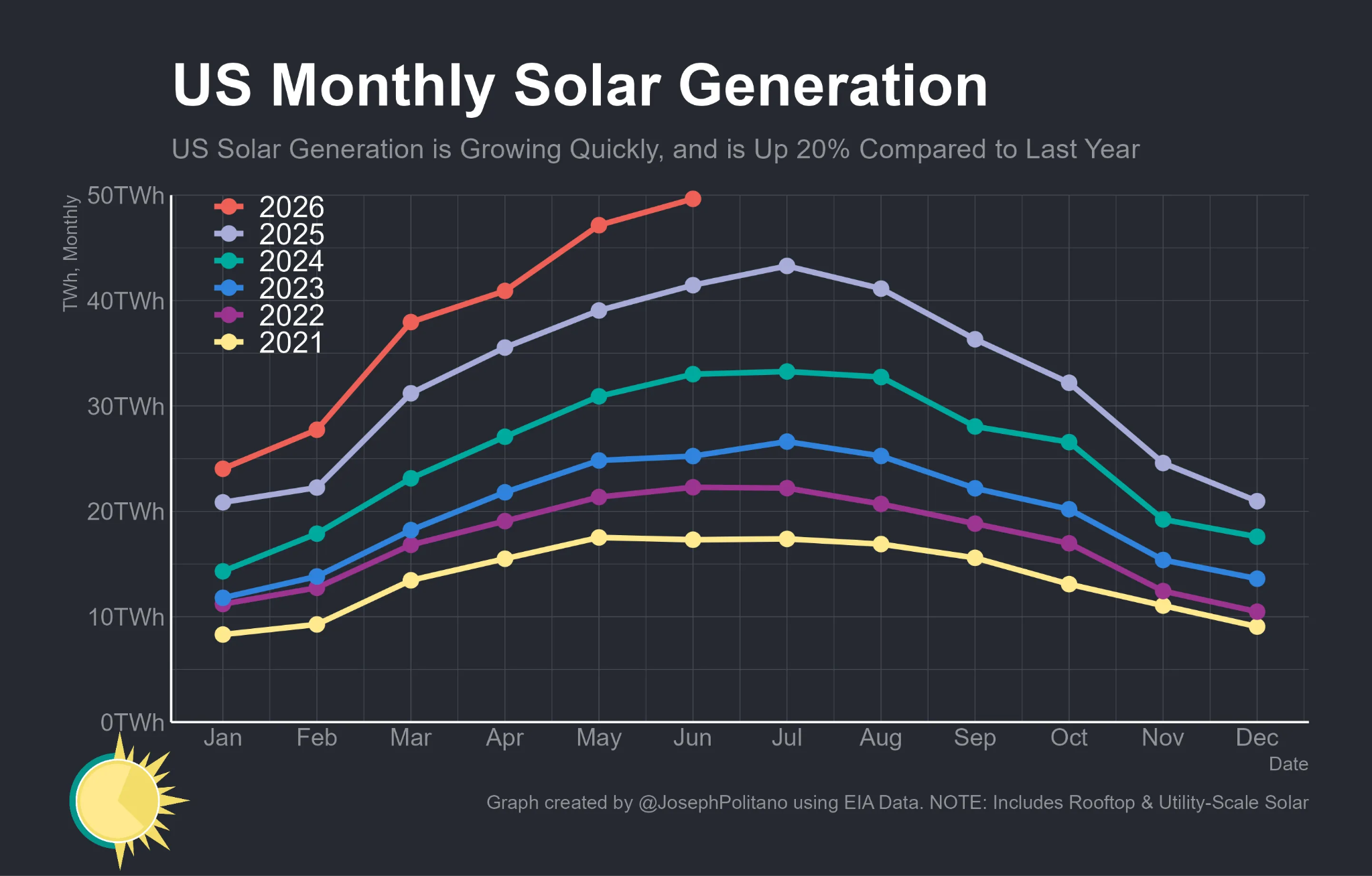
Although coal and natural gas plants have been making a heavily publicized comeback in the US, solar power is continuing to accelerate regardless. New data from the Energy Information Administration shows that solar generation hit a record high and is up 20% compared to this time last year. Solar now represents 9.3% of US electricity generation (averaged across the last twelve months), another record high. Texas has, somewhat surprisingly, been one of the top solar states: it saw a 31% year-over-year increase in solar production, and solar now makes up 12.2% of the Lone Star State’s electricity production.
🚏♨️ The world’s oceans hit their highest temperature on record during El Niño
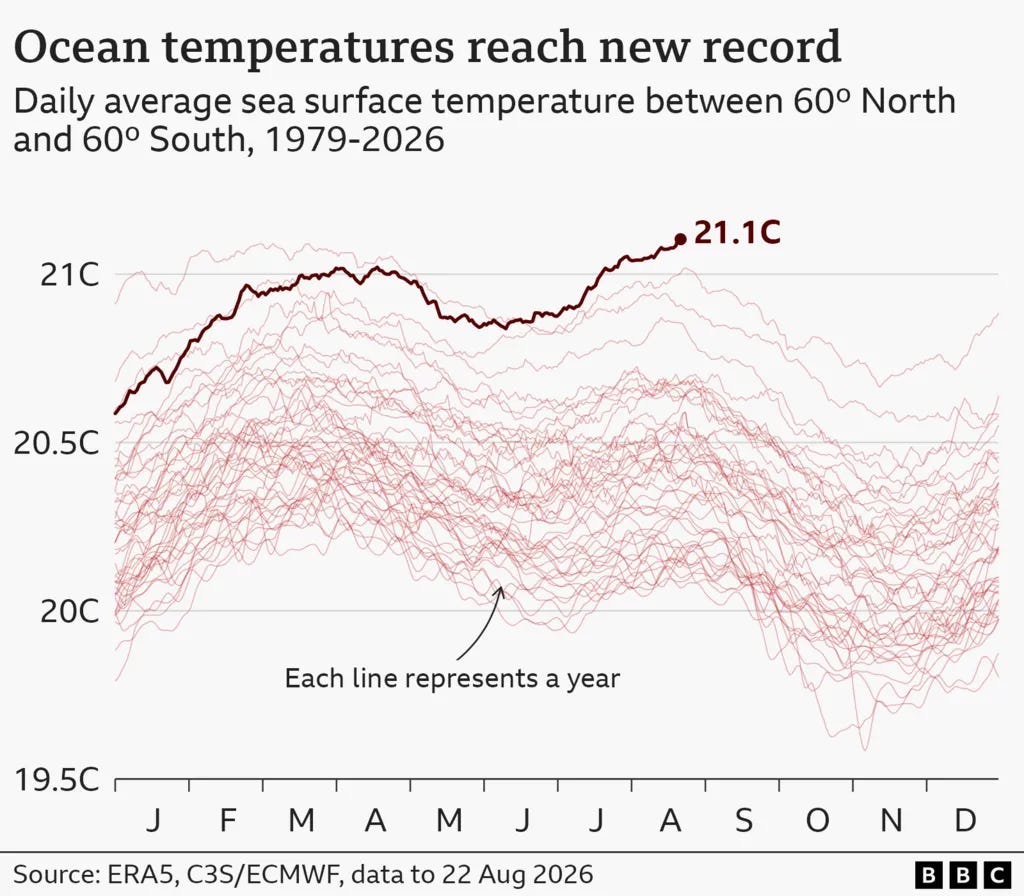
The highest sea surface temperatures typically appear in March or April, toward the tail end of summer in the watery southern hemisphere, and yet this August 22nd, in the depths of the southern winter, set an all-time record for highest sea surface temperature at 21.1 °C (70 °F). This year’s unusually strong El Niño is partly to blame, as is global warming, which stores far more heat in the oceans than in the air.
📖⏳ Worth your time
Some especially insightful pieces we’ve read, watched, and listened to recently.
SaaS Isn’t Dead. Sameness Is. (Chad Fowler) — Argues that the foundational assumption of software-as-a-service – that thousands of customers could all share the same software – is broken now that custom apps and interfaces are easier to generate than ever. Still, there’s an advantage to everyone sharing the same underlying infrastructure (identity, security, data models, payment rails, etc). The author likens it to pace layers: everyone will build their own applications (the faster-moving layers) on top of a shared, stable substrate (the slower-moving layers). SaaS companies will survive and thrive if they become substrate companies and differentiate based on their infra, not their interface.
Why the West Can’t Build a Cheap EV (Modern MBA) — Argues that the “outsource everything” business model of America’s legacy automakers left them structurally unable to win in the EV market, where vertical integration is key. This is where Chinese upstarts have come to dominate the EV space. It also helps that the Chinese government invested early and often in the industry through charging networks, tax breaks, policy concessions, and more, treating EVs as a strategic national priority. Meanwhile, the US showers benefits on already successful for-profit companies, which is great for innovation and shareholder returns but struggles with long-term, capital-intensive infrastructure projects.
Dependence Depends, Doesn’t It? (Dan Davies) — Argues that, in international relations, weaponized interdependence (controlling an important chokepoint that everyone needs) works better as a threat than as something you actually use. Systems are pretty good at routing around chokepoints, so if you block one and everyone adapts, you’re revealed to be a paper tiger. Plus, sometimes blocking the chokepoint hurts you more than the enemy. Better to bluff than to let things reach a showdown.
The Megaflood That Created the Mediterranean (Uncharted Territories) — Recounts how, 5.3 million years ago, the fully dried-out Mediterranean basin refilled in mere months via a 1.5 km tall waterfall, with inflows over 100 times that of all the world’s rivers combined. Given the scale of catastrophe it’s tempting (but completely wrong) to read this Zanclean flood as the source of the flood myths present in many human cultures, as it predates humans by millions of years.
🔮📬 Postcard from the Future
A ‘what if’ piece of speculative fiction about a possible future that could result from the systemic forces changing our world.
// How might people try to escape the “AI hiring doom loop” in the coming decade?
// 2053. A cozy family room in a tasteful home, windows overlooking a wooded valley. The wall opposite the windows is full of books and the occasional industry award. A mug of tea sits beside the rocking chair, occupied by the woman who won those awards. Her niece sits on the couch, a frustrated yet inquisitive look on her face.
“I don’t get it, Auntie! In our ‘History of the 21st century’ class, I’ve been learning all about how the early phases of AI ricocheted through the economy in the late 20s before the Big AI Retraction of the 30s. From everything I’ve read and seen, it sounds like getting a job in that era was really hard. So how did you manage to get a job at one of the top companies at that time? We played through some simulations of what job hunting was like with the tools available and not a single person in my pod was able to even land a callback!”
The older lady smiles and chortles before taking a sip of her tea.
“Oh, that was a rough time. Fresh grads used AI to apply for jobs at scale with perfectly targeted resumes and cover letters. Companies, facing 1,000x the regular scale of applicants, turned to AI to filter applicants. It was an AI hiring arms race, with each person’s career on the line.
“In-person networks and referrals became the fallback, which then led to candidates stalking hiring managers, or anyone else. The front door to jobs was jammed, so people tried every side door they could. I looked at the problem slightly differently.”
She reaches to the table her tea mug sits on and flips a small switch. A light hum emanates from the bookcase. The niece’s eyes go wide. “What happened to my BrainPal? I can’t connect to the netcloud!?!”
The Aunt pats the base of the bookcase. “Just a small EM field to jam transmissions. I don’t want this part of our conversation getting added to the training data set just yet!
“Where was I? Oh right. So for me, I didn’t want to try the side door, I went for the Back Door. And by that, I mean I took the AI tools available and used them to find security weaknesses in every company I wanted to get hired at. And the playbook was relatively simple: first, penetrate their network security. Second, figure out which AI tools and systems they were using for the hiring process. Third, inject data into the company-specific hiring data which would boost my recommendation score and downgrade other applicants at each stage of the hiring pipeline. I never put myself at the top, but in the top three. That way, I’d get to the in-person interviews. At the end of the hiring process, hired or not, I’d then erase my tracks.
“When faced with the Kobayashi Maru, it pays to think differently.”
© 2026 The FLUX Collective. All rights reserved. Questions? Contact flux-collective@googlegroups.com.