

Episode 247 — August 13th, 2026 — Available at read.fluxcollective.org/p/247
Contributors to this issue: Neel Mehta, Boris Smus, MK
Additional insights from: Ade Oshineye, Ben Mathes, Dart Lindsley, Erika Rice Scherpelz, Jasen Robillard, Jon Lebensold, Justin Quimby, Lisie Lillianfeld, Robinson Eaton, Spencer Pitman, Stefano Mazzocchi, Wesley Beary, and the rest of the FLUX Collective
We’re a ragtag band of systems thinkers who have been dedicating our early mornings to finding new lenses to help you make sense of the complex world we live in. This newsletter is a collection of patterns we’ve noticed in recent weeks.
“In general, we’re least aware of what our minds do best.”
— Marvin Minsky, The Society of Mind (1986)
💎⚾ Crystallized insights from the baseball diamond
It’s an old adage that’s drilled into the head of every young baseball player: “Never make the first or third out at third base.” That is, if you’re standing on second base and deciding whether to steal third – or if you just hit a double and are thinking about legging it out to third base – only do so if there’s one out in the inning (and not zero or two). It’s an oddly specific strategic rule of thumb, but its accuracy is generally borne out by the data.
Though the rule is easy to remember and easy to follow, the trouble comes when a kid asks their coach why it’s true. Most likely, after some fumbling around with rules and partial explanations, the exasperated coach will just have to ask the kid to trust them.
The actual explanation is interesting in its own systems-y way; we’ll mention it at the end of this episode.[1]1 The upshot is that it takes several minutes to explain and even more time to digest; requires balancing risk and reward probabilities at various game states; and demands an intuitive feeling for the game that your average six-year-old just won’t have. And when you’re hustling hard toward second base, helmet flying off, you typically don’t have the luxury of time to piece together the optimal strategy.
As a result, it’s much easier for everyone to just memorize the one-line catchphrase. This is the advantage of mental shortcuts, or heuristics: they let you compress a hard-to-calculate insight into a clear and easily applied rule. We use these shortcuts every day, from matching our belts to our shoes to not dishwashing our cast-iron pans. We could rediscover everything from first principles or sift through piles of data, but we typically find that the shortcut is good enough and our time is better spent elsewhere.
Of course, the downside of just knowing the rule – without the full logic chain that produced it – is that your reasoning is brittle and not able to adapt to altered situations. Normally you shouldn’t steal third with two outs, but what if there’s a runner on first as well? What if you’d be the tying run? What if the current batter hits a lot of grounders? Armed with our adage alone, you’d have no idea what to do. You couldn’t possibly memorize a special version of the rule for every conceivable situation; at a certain point the scale tips and it’s more efficient to know the game well enough that you can reason through things from the ground up. This is the advantage of intuition and experience: they help you handle novel situations that no heuristic could possibly cover.
The other drawback of relying on shortcuts is that sometimes the underlying logic or facts shift and the shortcut gets “stale”... or sometimes we realize that the conventional wisdom has always been wrong. With modern dishwashers, it’s actually okay (or perhaps better) to not pre-wash your dishes. The old advice about booking flights on Tuesdays no longer applies thanks to airlines’ evolving pricing algorithms. And baseball diehards know that lineup construction has changed due to analytics and new rules: you now want to put your best batter second instead of third or cleanup.
And yet, despite all the flaws of mental shortcuts, we keep turning to them. These crystallized nuggets of advice provide a clear, memorable punch of knowledge that’s still close enough to the complex truth. Perhaps more importantly, they’re easy to transmit – so we end up picking up a lot of them from our parents, teachers, and coaches. That’s the beauty of (lossy) compression, just as it’s easier to email a ZIP file than a giant document or transport a boxed-up air mattress than the unwieldy, inflated version.
Still, we have to revisit these rules periodically and know when to build out our own mental machinery instead of relying on received guidance. Sometimes, it’s helpful to be like that persistent kid who’s always asking their coach “why”: you’ll come away with a more flexible strategic mind, and you might just overturn the conventional wisdom while you’re at it.
🛣️🚩 Signposts
Clues that point to where our changing world might lead us.
🚏🎓 Physics PhDs are leaving the US at record rates
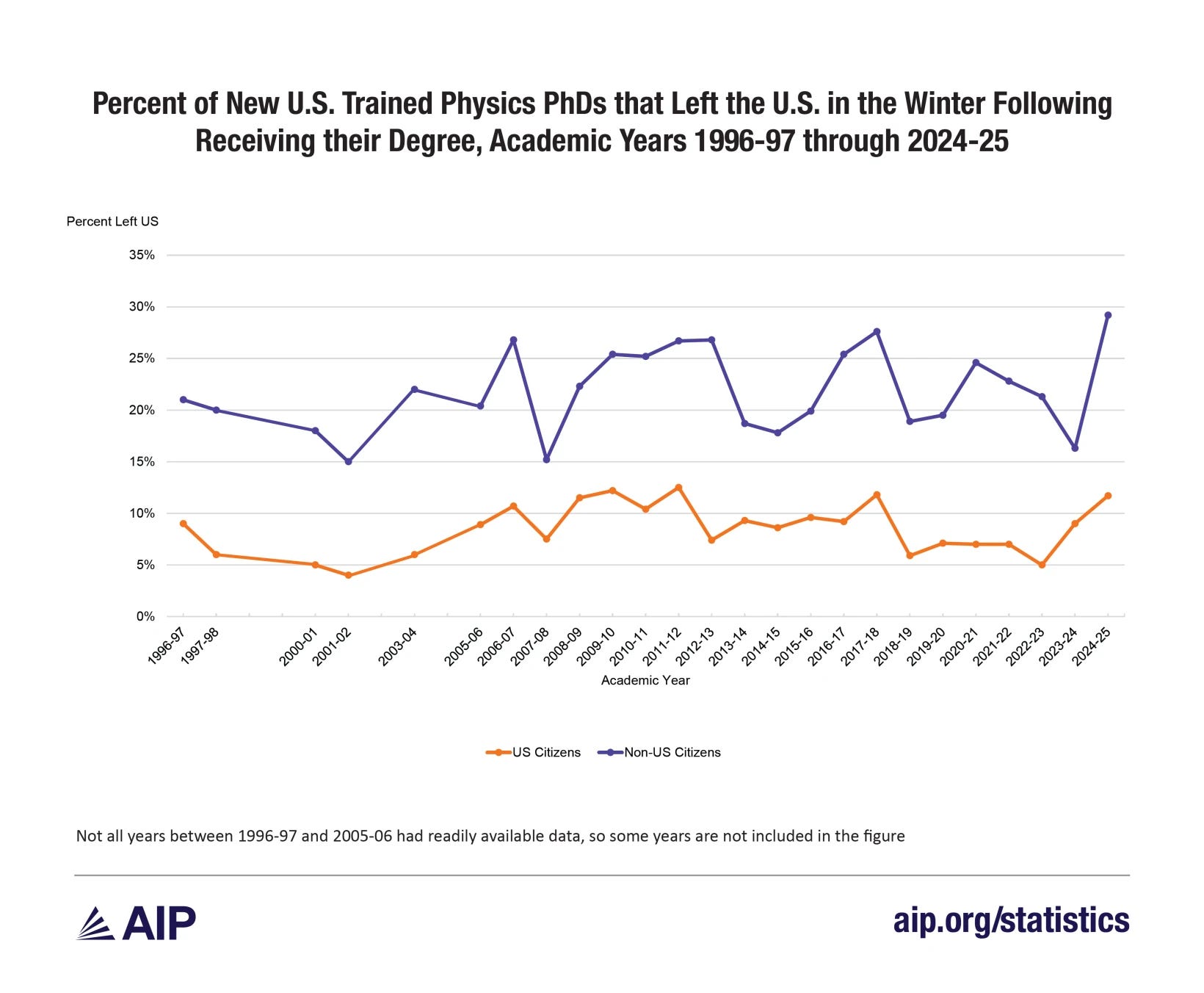
New data shows that nearly 30% of graduates of American physics PhD programs left the country in 2025, the highest rate in 30 years; what’s more, 12% of US citizen graduates departed, a significant increase from 9% the previous year and 5% the year before that. Similar recent studies on brain drain have found that physics and astronomy programs in the US have seen sharp declines in enrollment, and that young biomedical researchers have been leaving the US at increased rates as well. Policy changes are a likely factor – such as restrictions on student visa length, deep cuts to science funding, and rumored $100k fees that may be coming to the OPT visa that many PhD grads use.
🚏🩶 Cars and houses are becoming increasingly gray and beige
American cars are becoming increasingly monochrome: the share of new cars in grayscale colors rose from 60% in 2004 to 80% in 2023, as production of purple cars dropped by 93% and gold by 97%. Observers have noted similar patterns in houses from San Francisco to DC, where gray, white, black, or beige façades are taking over neighborhoods formerly dominated by colorful Victorians. (Small wonder, then, that the top paint colors from Sherwin-Williams include “Crushed Ice,” “Agreeable Gray,” and “Universal Khaki” – the last being its 2026 “color of the year.”) Designers think one psychological reason for the shift to neutrals is “cocooning,” where customers seek safety in purchases: they’d rather have a bland color than a bright one they might regret later. And in a world with ultra-expensive cars and houses, people may also prefer inoffensive colors to avoid risking their items’ resale values.
🚏🌋 Energy IPOs are booming amid the AI datacenter buildout
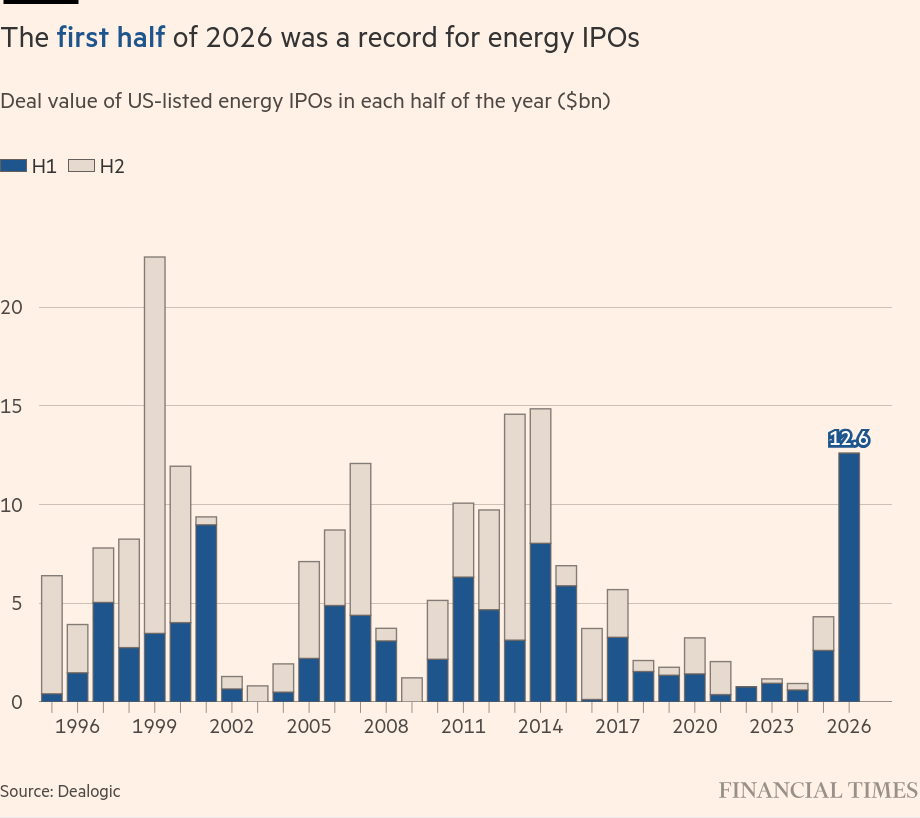
Semiconductor and memory stocks have cooled down in recent months, so the “picks and shovels” strategy of investing in AI infrastructure has shifted to companies providing power to datacenters, such as those building geothermal or nuclear plants or those making transformers and other electrical distribution equipment. The first half of 2026 saw energy firms raise a record $12.6 billion in IPOs. However, many of these now-public companies are still building experimental technology that’s not commercially viable, and they may be overvalued, as many new energy stocks have seen swift valuation drops shortly after going public.
🚏🧀 An Italian cheese wheel bank is threatened by climate change
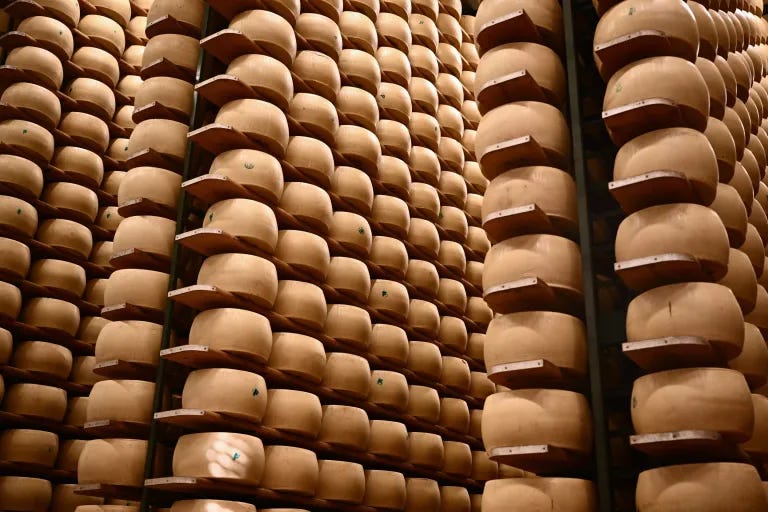
One bank in northern Italy stores nearly half a million wheels of Parmigiano Reggiano cheese (worth over 300 million euros) in a giant vault. Dairy farmers give this cheese as collateral for loans they take out; they often need cash advances because the cheese wheels take years to age. But the famous cheese bank is under threat as heat waves across Europe are forcing it to spend ever more on cooling systems and insulation, not to mention that hotter temperatures make cows eat less and thus produce less milk.
📖⏳ Worth your time
Some especially insightful pieces we’ve read, watched, and listened to recently.
Fighting Fire With Fire: Scalable Oral Exams With an ElevenLabs Voice AI Agent (Panos Ipeirotis) — To combat the ease of cheating in any take-home exam, an NYU prof deployed AI voice agents to conduct oral exams at scale utilizing a “Council of LLMs” to triangulate grades. While students found the format stressful and preferred written tests, they conceded it was a more accurate measure of understanding. But will this format accidentally select for oral charisma rather than deep knowledge?
BRICS in 2025 (Phenomenal World) — Argues that you can get a glimpse of the post-American future by looking at BRICS, the loosely aligned grouping of developing economies consisting of Russia, China, India, Brazil, South Africa, Indonesia, and Egypt. They’re reorienting to an economy built around green energy, electrification, high-tech manufacturing (from EVs to robots to AI), dedollarization, and diverse trade partnerships. As the US moves back toward fossil fuels and protectionism, you can increasingly see the two worlds pulling apart.
Is Switzerland Tired of Prosperity? (The Guardian) — De Weck argues Switzerland’s looming referendum to cap population/immigration is self-sabotage: openness, not control, built its prosperity. He invokes Thomas Mann’s Buddenbrooks framing that prosperity breeds complacency, eroding the pragmatism that built it, and notes that Nestlé, Swatch, and Novartis, the most “Swiss” of institutions, were themselves built by immigrants.
Preliminary Theory of the In-Group Contrarian (Outsider Theory) — Applies philosopher René Girard’s mimetic theory (where we desire what we see our group members desiring) to social media, exploring how many platforms see the rise of an “In-Group Contrarian,” who shares the values of their broader group but objects to certain actions. The group may love to pile on the contrarian, but they can rarely expel them, because “hatred of the [contrarian] can become one of the main things that binds the in-group together.”
🧩🕹️ Systemic tools and toys
Games, gadgets, demos, and other nifty interactives to stretch your systems-thinking capacity.
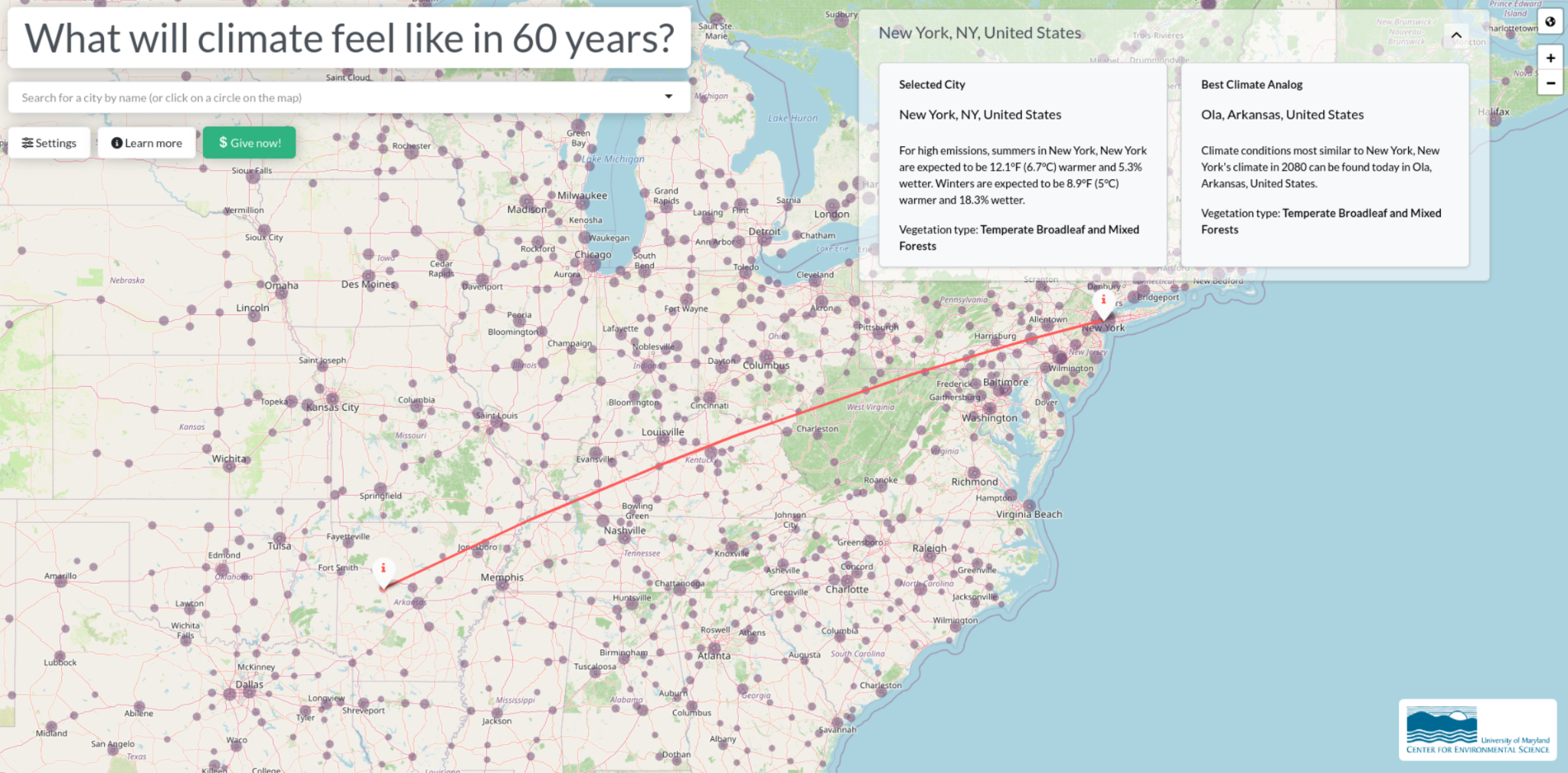
By 2080, the climate in New York City will feel like that of modern-day central Arkansas; Bay Area residents will feel like they’ve moved to deep SoCal. That’s what a fun interactive map from the University of Maryland Center for Environmental Science shows: pick anywhere in the world and you’ll see what current-day location matches its projected 2080 climate, assuming we don’t get emissions under control.
It’s interesting to click around and see which areas will be affected the most or the least. For instance, you’ll see huge “movements” in eastern North America and central Europe, but hardly any around coastal South America or South Africa. Try to find surprising shifts – we won’t spoil the result, but try clicking on Miami, Shanghai, or the Yucatán Peninsula. For an extra shock, try clicking anywhere in the Amazon basin, Singapore, or the Persian Gulf.
© 2026 The FLUX Collective. All rights reserved. Questions? Contact flux-collective@googlegroups.com.
The general logic behind the maxim “never making the first or third out at third base”: being on third base isn’t that much better than being on second base, since you’ll usually score on a single regardless; the slight advantage is that being on third lets you also score on a sacrifice fly, wild pitch, squeeze, etc. When nobody’s out, that extra edge isn’t worth the risk of getting thrown out at third, since your team has plenty of other chances to get you home. With two outs, getting caught stealing ends the inning, so it’s also not worth it. (Runners also sprint on contact when there are two outs, rather than waiting, as they normally do, to see if the ball is caught first, so the extra 90-foot advantage of going to third isn’t that useful.) Having one out is the sweet spot, where the risk gets low enough and the reward high enough that it makes sense to steal, assuming you’re fast enough. This whole thing goes to show that the state machine of baseball has some fascinating emergent behavior that arises out of just a handful of rules. But more on that another day.