

Episode 244 — July 23rd, 2026 — Available at read.fluxcollective.org/p/244
Contributors to this issue: Neel Mehta, Erika Rice Scherpelz, MK, Boris Smus
Additional insights from: Ade Oshineye, Ben Mathes, Dart Lindsley, Jasen Robillard, Jon Lebensold, Justin Quimby, Lisie Lillianfeld, Robinson Eaton, Spencer Pitman, Stefano Mazzocchi, Wesley Beary, and the rest of the FLUX Collective
We’re a ragtag band of systems thinkers who have been dedicating our early mornings to finding new lenses to help you make sense of the complex world we live in. This newsletter is a collection of patterns we’ve noticed in recent weeks.
“Poets are not to blame for how things are.”
— Emily Wilson, The Odyssey
🧑✈️🔗 How trouble travels
You’re flying from NYC to Cabo, connecting in Dallas. The flight gets delayed four hours because of mechanical issues. That’s okay, you’re still going to Cabo. Wait, the gate just changed and there’s a new plane. Fortunately, you make it to the gate on time and you finally board.
Hurrah!
Except… not. By the time you’ve boarded the plane, the pilots have surpassed their duty time limitations. Now you have to wait for a new crew to come, leading to even more delays. They finally arrive and the plane finally gets going… just moments before a 15-minute thunderstorm throws the takeoff schedule into chaos for the next three hours. (And good luck if you missed your connection in Dallas by even five minutes, which may force you to wait several hours for the next flight to Cabo.)
Aviation runs on such tight margins that the schedule has no room for error. This leads to the system becoming very brittle. In general, tightly allocated resources, be they time, supplies, or anything else, can lead to cascading failures. Cascading failures aren’t simply when one failure comes after another, but specifically when the interconnectivity between parts of a system causes one failure to trigger the next.
The more tightly a system is put together, the more prone it is to cascading failures. A physical manifestation is dominoes. Put them close enough, and the “failure” to stand up propagates, often to impressive ends. Put them sufficiently far apart, though, and the isolation prevents individual failures from propagating through the whole system.
As the domino example shows, the mechanics of a cascade need not be negative. The generalization, where a tightly coupled system makes it easier for state to propagate through the system, can be used to positive effect if you want to spread something. The sociological concept of a tipping point is broader and is often used in positive contexts, such as the increasing popularity of a product.
But in the sadly frequent case where you truly are talking about cascading failures, what can we do? A common technique is to introduce slack: extra time, extra resources, or extra capacity that can be used to cover the gap when something goes wrong — and something always goes wrong. Too much slack is inefficient, but too little slack can be even worse.
The broader principle is that coupling can be a source of value or a source of risk. By understanding how much our system is coupled and where we have opportunities to increase or decrease that coupling, we can adjust — though not control — our resilience to cascading state changes.
🛣️🚩 Signposts
Clues that point to where our changing world might lead us.
🚏🗳️ More Congresspeople are leaving their seats than in any year since 2000
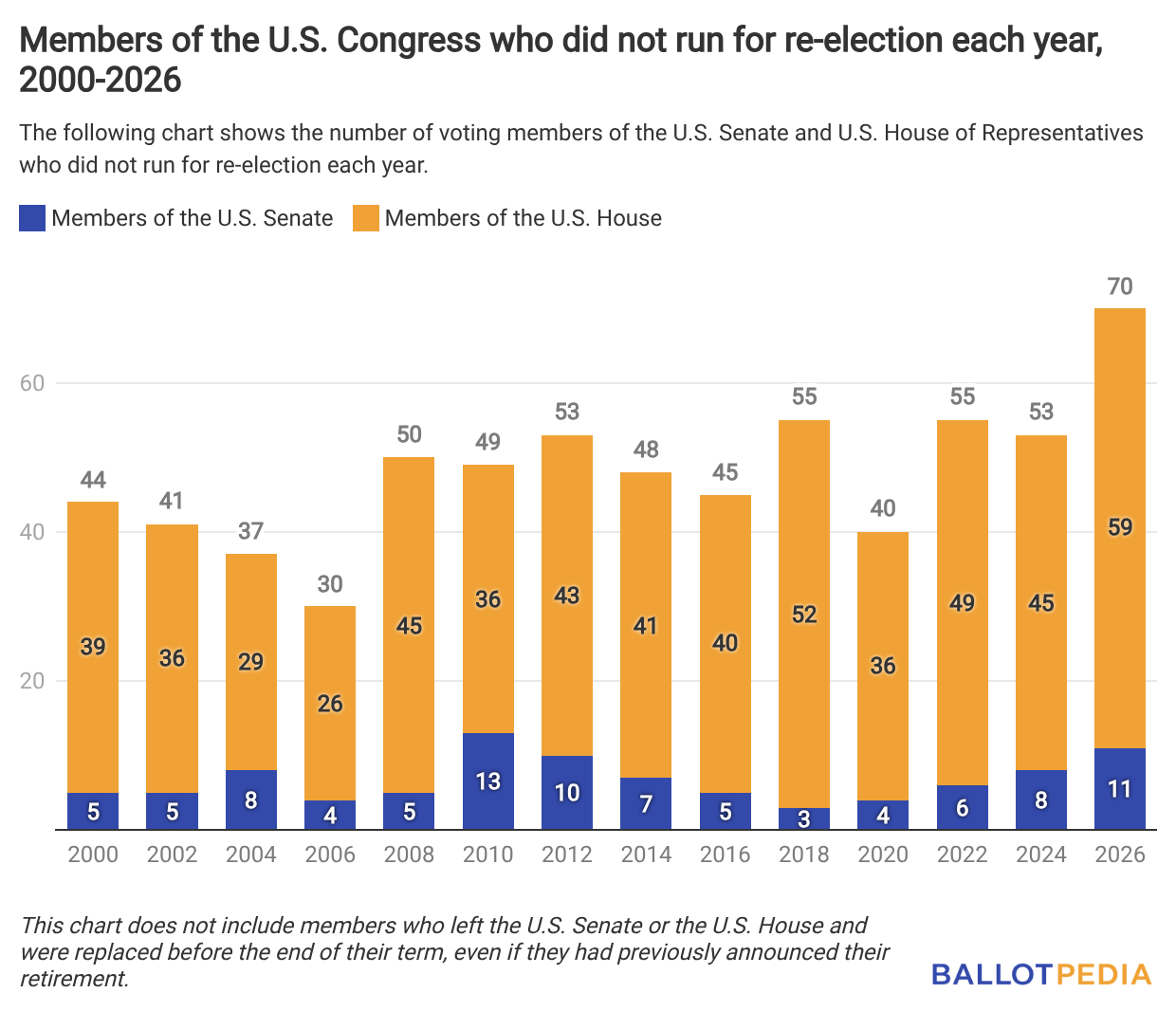
So far, 11 members of the US Senate and 59 members of the House of Representatives have not filed to run in this November’s federal elections. This total of 70 members not running is by far the most since 2000. More Republicans than Democrats are stepping down: 7R-4D in the Senate and 36R-23D in the House. Note that many Representatives are aiming for higher office (Senate and governor), but a full 27 Representatives aren’t running for anything else — the most retirements since 2012.
🚏🛢️ Tech giants are moving data out of the Gulf along oil pipelines
Most of the internet cables connecting the Gulf states to the rest of the world run underwater through the Persian Gulf, Strait of Hormuz, and Red Sea. The war in the Middle East has put these cables at risk, so cloud giants like Google and Amazon have been turning to a backup: fiber-optic cables that take a land-based route from Iraq to Turkey and onward to Europe. These cables run alongside oil and gas pipelines, so they can piggyback on the existing right-of-way and security infrastructure. (However, even if the fiber routes are taken care of, data centers in the region remain at risk, as Iran has already bombed AWS data centers and caused outages.)
🚏☕ Seattle’s job market is shifting from tech back to frontline/service work
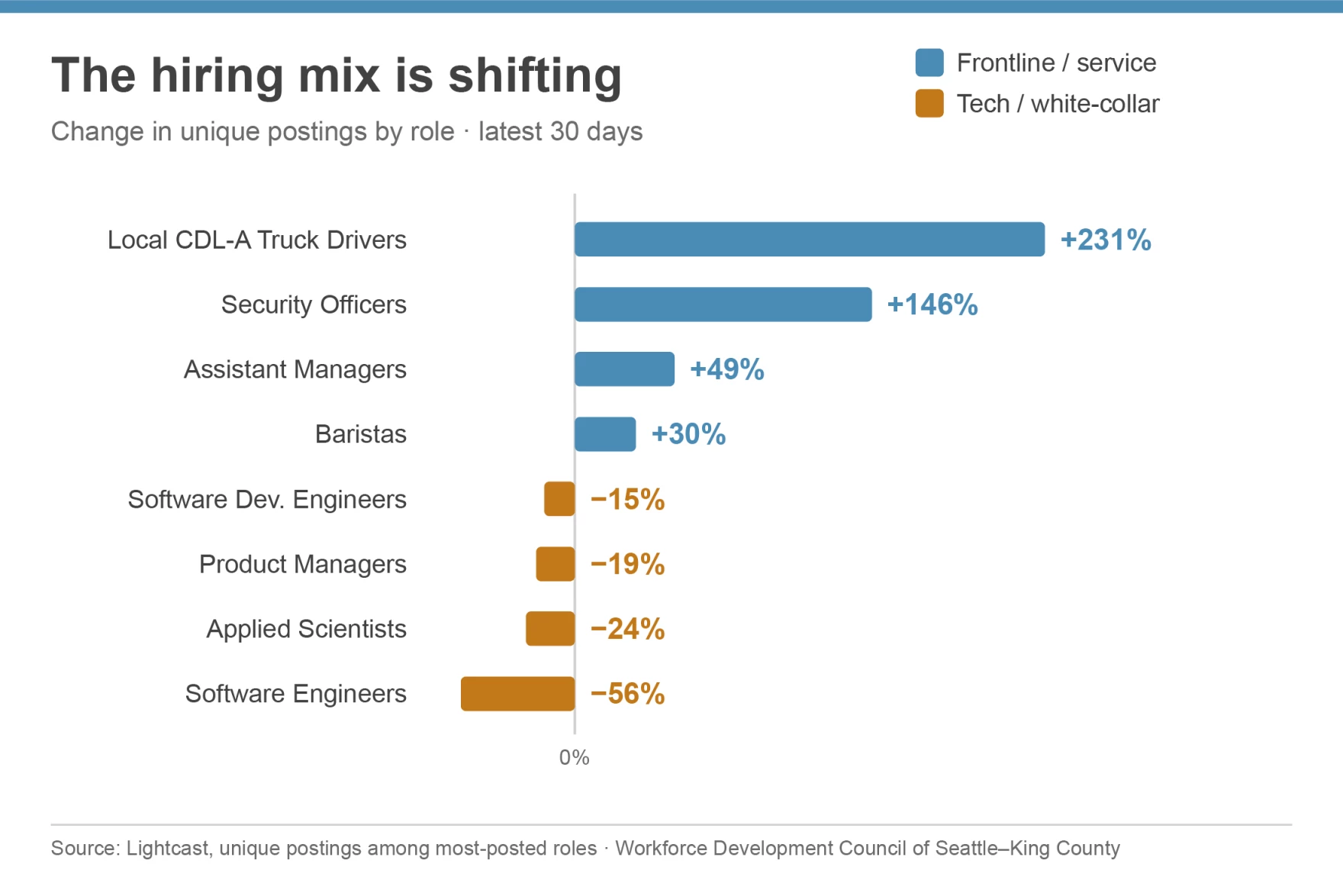
Washington State suffered the second-most tech layoffs (11,000+) of any state from May 2025 to April 2026, only trailing California. A new report looked at job postings in the Seattle area and found that the Emerald City has shifted sharply away from its ‘traditional’ driver of big tech jobs and toward frontline and service workers such as truck drivers (+ 231% in the last 30 days), security guards (+146%), and baristas (+30%). Meanwhile, openings for software engineers fell 56% and those for product managers were down 19%. The growth still outweighs the declines, as the region’s overall unemployment rate dropped from 5.7% to 5.0%. However, economists warn that some of the service-sector hiring boom may have been transient due to the soccer World Cup.
🚏⚡️ Autonomous micro-drones can shoot down mosquitoes from the air
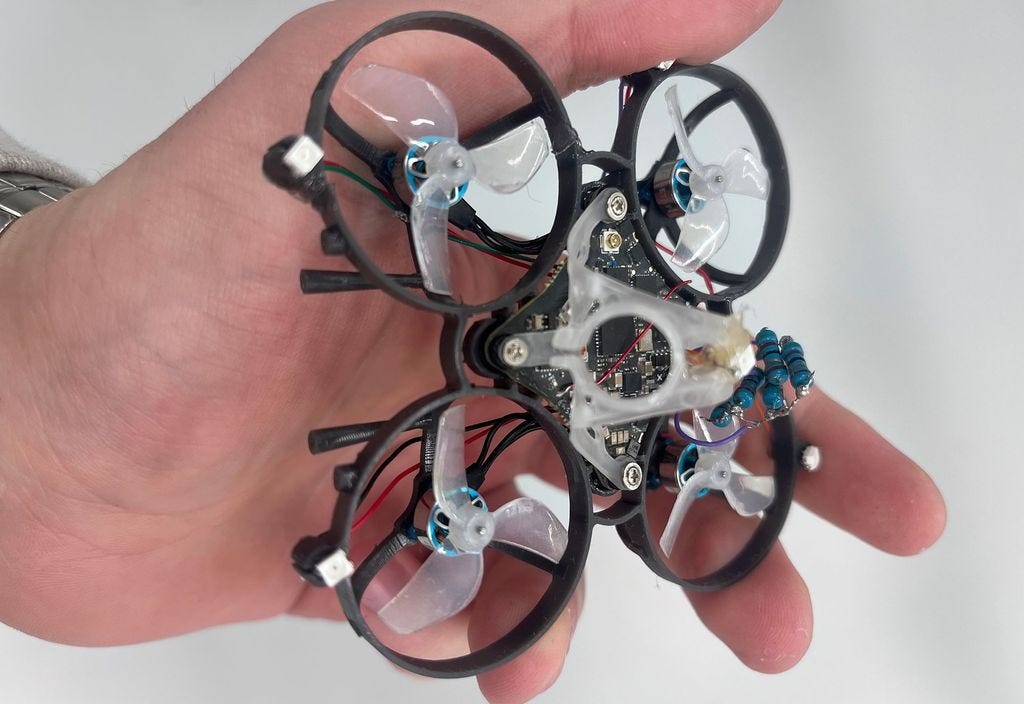
Large combat drones have made waves in the Ukraine war, but micro-drones have been finding uses in an unusual domain: pest control. One startup has created a new gadget that uses a “phased array sonar base station” with hundreds of microphones to map a small area down to tiny scales and identify mosquitoes by their “unique wingbeat signature.” Then, a computer sends remote commands to a 40-gram aerial drone that kills identified mosquitoes up to 8 meters (26 ft) away.
📖⏳ Worth your time
Some especially insightful pieces we’ve read, watched, and listened to recently.
Underrated Ways to Change the World (Adam Mastroianni) — Argues that you don’t need the soul-crushing wealth of “earning to give” or the saintly sacrifice of scrubbing orphanage toilets to improve society. Meaningful progress often comes from overlooked, low-status middle paths. Mastroianni champions “first followers” who validate whistleblowers to expose massive frauds, social “switchboarders” who forge a scenius among isolated idealists, and everyday amateur researchers who use their total freedom to solve overlooked problems. The piece is an inspiring defense of the unglamorous maintainers — rather than the founders or billionaires — who actually keep civilization running.
Who’s Afraid of Frontier Models? (Stratechery) — Ben Thompson argues that the cost structure of serving AI models, where marginal costs for inference are high, requires us to analyze the LLM industry more like conventional commodity manufacturing than like zero-marginal-cost tech businesses. The upshot is that American frontier LLM labs shouldn’t be too worried about Chinese open-weight models undercutting them, because it’s unlikely that the latter will be able to achieve a substantial edge on marginal cost. Still, he argues that the US should spur the development of homegrown open-weight models by removing restrictions on distilling (which is a big part of how they can be trained so cheaply).
The Vibecession Hasn’t Gone Away (Matt Darling) — Shows data suggesting that the gap between actual economic conditions and self-reported consumer sentiment (the “vibecession”) has only increased since 2021, rather than being a temporary COVID trend. The gap is visible across all income classes, and in fact it’s slightly higher among wealthier Americans. The author draws on Polish economist Michał Kalecki to theorize that the dissatisfaction we’re seeing comes from how low unemployment drove up wages among lower earners, which increased costs for services like health care and food delivery. This may tell an uncomfortable story about the political ramifications of workers gaining bargaining power.
Movin’ On Up: How Costly New Homes Create Affordable Old Homes (California YIMBY) — Examines two mechanisms whereby building new market-rate (or even luxury) homes ends up increasing the supply of affordable homes. “Filtering” is a slower method whereby new houses gradually depreciate and become available for lower-income buyers. A quicker mechanism is “moving chains,” where wealthier people immediately move into pricey new homes, freeing up their old homes for the less wealthy, and so on down the food chain.
🔍📆 Lens of the week
Introducing new ways to see the world and new tools to add to your mental arsenal.
This week’s lens: terminus post quem and terminus ante quem.
Suppose you’re rummaging through a desk drawer and find a nice photo of you and your friends, but you don’t remember when it was taken. Fortunately, you can use context from the photo itself and its surroundings to help you date it.
For instance, if your friend is holding an iPhone 15 in the photo, you know it can’t have been taken any earlier than the iPhone 15’s release date — this gives you what’s known in archaeology as the terminus post quem, which is Latin for “time after which.” That is, it’s the ‘early bound’ on when the photo was taken.
Meanwhile, if you found the photo buried underneath tickets to a baseball game from a certain date, you can assume it was taken on or before that day — this is the terminus ante quem, or “time before which.” However, this dating is less secure: it relies on the assumption that the relative ordering of objects reflects the order in which they were placed. In other words, you assume that nobody has shuffled things around and that you didn’t (for some reason) bury the photo deep in the drawer when you initially dropped it there.
Our photo example was a basic one, but this pair of concepts is extremely important in archaeology, where you’re constantly faced with layers of buried artifacts that don’t advertise their origins and where even a few decades’ swing in the date of an artifact can completely change the narrative you’re constructing. And you’d be surprised how often these concepts can help you sleuth in your daily life: when was this undated corporate strategy doc written (and thus, did it account for market shift X or reorg Y)? What year did Grandpa graduate from college again? Or even, how long have these leftovers been sitting in the fridge?
© 2026 The FLUX Collective. All rights reserved. Questions? Contact flux-collective@googlegroups.com.