

Episode 242 — July 9th, 2026 — Available at read.fluxcollective.org/p/242
Contributors to this issue: Neel Mehta, Boris Smus, Erika Rice Scherpelz
Additional insights from: Ade Oshineye, Ben Mathes, Dart Lindsley, Jasen Robillard, Jon Lebensold, Justin Quimby, Lisie Lillianfeld, MK, Robinson Eaton, Spencer Pitman, Stefano Mazzocchi, Wesley Beary, and the rest of the FLUX Collective
We’re a ragtag band of systems thinkers who have been dedicating our early mornings to finding new lenses to help you make sense of the complex world we live in. This newsletter is a collection of patterns we’ve noticed in recent weeks.
“True education is a kind of never ending story — a matter of continual beginnings, of habitual fresh starts, of persistent newness.”
— J. R. R. Tolkien
📝 Editor’s note: Our last issue was delayed due to publishing issues. We apologize for the delay!
🐒🦍 When everything is at scale
Note: Today’s piece dives deep on code, but that’s mainly because code is further ahead in this disruption than many other domains. The pattern of “what happens to our understanding when the decisions were made without human supervision?” will apply more and more broadly as more areas become subject to massive AI disruption.
AI is writing more of our code… so what happens when no human holds the whole system in their head? When no one remembers why the retry logic backs off that way, or what — if anything — that defensive ‘if’ still guards. We fear we’ll be maintaining code we no longer understand.
It’s a real concern. It is also, mostly, a eulogy for something we never really had at scale.
Folks who have spent time in a large scale production code base — especially an older one — know that many critical subsystems were already black boxes. The person who made the original decision left long ago. The undocumented constraint already changed. When the debt was built up by humans, we held hope that someone would remember the when and why of it, but that was usually more dream than reality.
So what actually changes now? Our intuitions do have some truth. Managing a large scale code base has changed. AI does not magically abolish the difficulty of maintaining a large code base, nor does it make it uniformly worse. It redistributes the challenge — some of it easier now, some of it worse.
To take another example, self-driving cars are, on average, safer than the humans they replace. But when they fail, they fail strangely such as stopping dead in an empty intersection or mistaking a truck for sky. A human’s bad code smells bad in familiar ways: out-of-date comments, misleading variable names. AI generated code loses those smells. So when things fail, it often feels weird: how can code that looks so good be so wrong?
Some things get better. Documentation, decision logs, and tooling can get better because they get cheaper. Chat transcripts have the potential to capture a lot of the intent that was traditionally lost. But we should remember the limits of these tools: the effort it took before might have been hiding a deeper problem of making sure artifacts provide actual value.
The solution was never to understand everything. As we figure out how to move forward, we will reach for the familiar tools that let us change systems we don’t understand: CI/CD, documentation, automated testing, observability and monitoring, etc.
While it’s true that some of this will require novel responses, we’ll also find that the systems that had the best practices in place before will be the ones best able to absorb the change. We might now need to treat our weekend project like something written by a team of twenty, but fortunately we have their experience to learn from.
🛣️🚩 Signposts
Clues that point to where our changing world might lead us.
🚏🐍 Amazon will stop accepting new customers for Mechanical Turk
Amazon’s venerable Mechanical Turk marketplace, where companies can pay freelance workers a few cents to do manual tasks like data entry or filling out forms, seems to be winding down, as Amazon has announced that it’ll stop accepting new customers for the service. LLMs can now do many of those basic tasks, and ironically, a 2023 report found that more than a third of MTurk workers were using AI to automate the supposedly human work they were doing. (Many ‘turkers’ have moved on to other freelancing sites, so some demand for this kind of work still exists; ‘requesters’ have also apparently moved on due to rampant “bots and fraud.”)
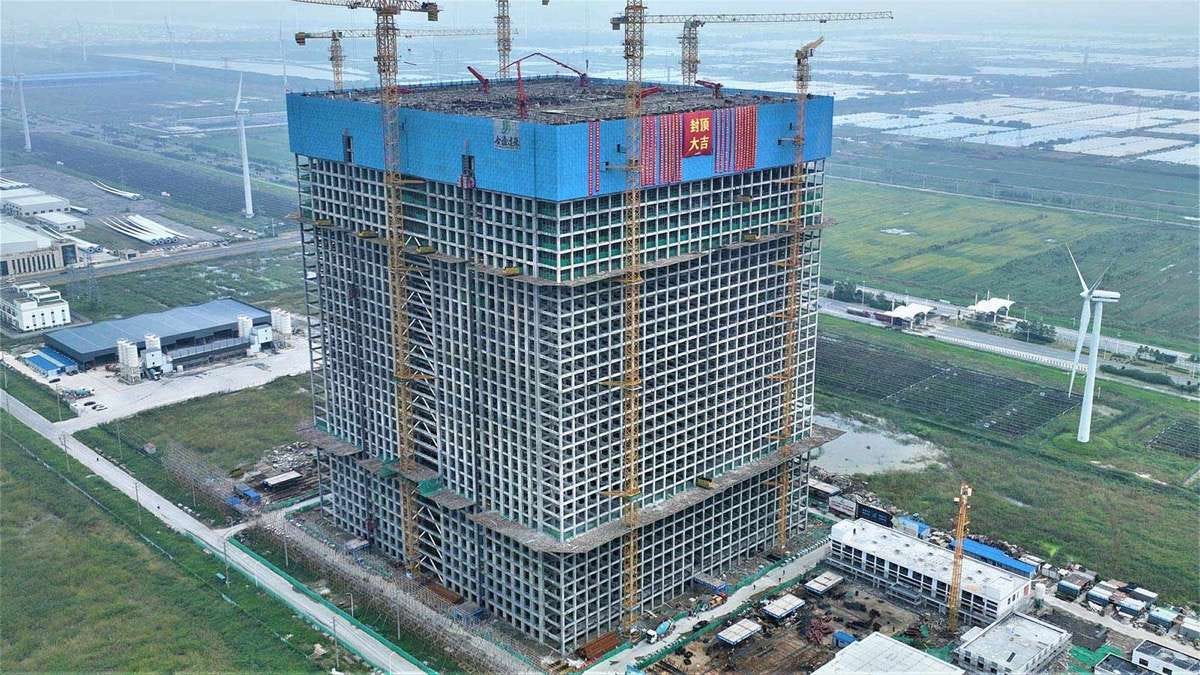
🚏🏗️ China is storing surplus wind power by stacking concrete blocks up to 40 stories
Storing excess wind power for when the breeze isn’t blowing requires some sort of battery — but lithium-ion batteries are expensive and degrade over time. Pumping water uphill to convert chemical energy to potential energy, and then releasing the water to harvest the energy, is much cheaper but requires a body of water. So, a grid operator in China found an even lower-tech solution: use surplus wind power to drive cranes that lift 35-ton concrete blocks up a 148m (486ft) tower, then drop the blocks to spin a generator whenever the grid needs electricity. The new tower is expected to have a 35-year lifespan and should enjoy 80% round-trip efficiency with no chemical degradation (or water evaporation).
🚏🏭 The US now invests more in fossil fuel energy than China does
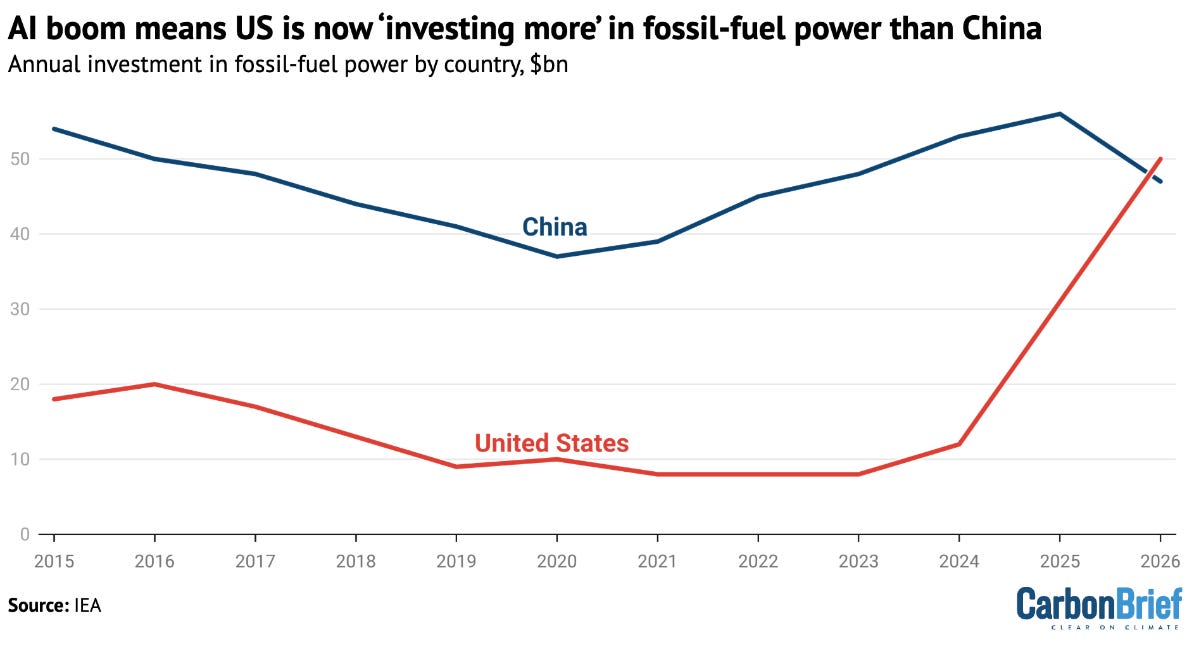
For decades, China invested more in fossil fuel energy generation than the US did, but a combination of recent policy changes and Iran-war-related shortages has led China to cut investment, while the datacenter boom and political shifts have led the US to quintuple its annual investments in fossil fuel generation over the last few years. And so, the US has suddenly overtaken China in fossil fuel investments after decades of sitting comfortably behind. In related news, every region of the world, bar one, reduced its carbon intensity of energy (how much CO2 is emitted for a given amount of energy generated) in 2025, meaning their energy mix became greener… the lone exception being North America, which saw a substantial increase.
🚏🗽 NYC apartment construction hit a 60-year high
The United States continues to struggle with housing shortages — nationwide apartment construction recently hit a 15-year low — but New York City has been building apartments at a record pace: it added 38,682 units to its housing stock last year, the largest gain since 1965. The boom “shows no sign of slowing down,” either, with over 16,000 units proposed in the first quarter of 2026 alone. But the Big Apple’s metro area is still 400,000 homes short of meeting demand, according to Zillow, and the city’s median rent has skyrocketed since COVID.
📖⏳ Worth your time
Some especially insightful pieces we’ve read, watched, and listened to recently.
Theory-Free Takeoff (Learning From Examples) — Argues that technological progress doesn’t necessarily require scientific breakthroughs: you can iteratively improve a technology (within a finite search space) without understanding the core mechanisms at play. Humans have been doing this kind of “theory-free search” for thousands of years, and recent improvements in frontier AI — where LLMs’ utility progresses faster than our understanding — are just the latest example.
The Rise and Fall of Rad Power Bikes (Geekwire) — Argues that the collapse of North America’s largest electric bicycle brand was a casualty of too much growth too fast, showing that massive funding rounds can be a death sentence for hardware businesses with thin margins, not a sign of health. What’s more, like many businesses that boomed during COVID, Rad mistook a temporary spike in demand during the pandemic for a permanent, secular shift in the market.
The Thermodynamics of Capital (Monthly Review) — Argues that, despite the common imagery of AI as a pristine digital product freed from the dirty physical world, it’s subject to the same “political economy of entropy” as any other technology: it consumes low-entropy inputs (water, power, and minerals), processes them in the material world (in the form of data centers), and outputs high-entropy waste (such as noise pollution, CO2 emissions, and e-waste). This “dissipative” model of using an entropy gradient to do work is common to many complex adaptive systems, like a living cell or a hurricane.
California Is Chasing Wealth That Has Feet (Progress and Poverty) — Argues that the Golden State’s potential wealth tax on billionaires is likely to fail for the simple reason that it’s trivially easy for hyper-wealthy people to move out of state. Taxing land value would be better because California actually has eight times more money in its land than in the pockets of all its billionaires combined, and land (obviously) can’t get up and move. (The root problem is California’s Prop 13, which limits how much property tax the state can collect, forcing it to rely on high income taxes and now wealth taxes.)
🔍📆 Lens of the week
Introducing new ways to see the world and new tools to add to your mental arsenal.
This week’s lens: accountability.
Well, your account was disabled. The email doesn’t say why. The appeal button leads to a form. You find and follow the phone tree and finally get to a person, just to be told, with utmost sympathy, that there’s nothing they can do. A decision was made, but you have no way to understand or remedy it. It feels like no one is accountable.
What is accountability? Often it gets reduced to a vague concept of responsibility. But we can be more specific. In his recent encyclical Magnifica Humanitas, Pope Leo XIV offers a usefully concrete definition. Accountability means identifying who must “account” for a decision: justify it, monitor it, and when needed, answer challenges and remedy the harm. This moves accountability from a vague virtue to a set of observable properties, each of which can fail independently.
And yet, these are not all equal. No amount of justification, monitoring, and challenging makes a system accountable if there isn’t room for remedy. This can happen in any system but especially prevalent when human judgment is removed from the system, be it through “the algorithm,” “the policy,” or a committee. It doesn’t take negative intent to lose accountability. The process which adds more consistency is great until it makes a technically right but obviously wrong decision.
What we can do is always ask ourselves where the accountability lies. Who can justify, monitor, challenge, and remedy? And if you can’t tell the answer, it may be time for something to change.
© 2026 The FLUX Collective. All rights reserved. Questions? Contact flux-collective@googlegroups.com.