

Episode 240 — June 18th, 2026 — Available at read.fluxcollective.org/p/239
Contributors to this issue: Jasen Robillard, Erika Rice Scherpelz, Ade Oshineye, Neel Mehta, Boris Smus, MK
Additional insights from: Ben Mathes, Dart Lindsley, Jon Lebensold, Justin Quimby, Lisie Lillianfeld, Robinson Eaton, Spencer Pitman, Stefano Mazzocchi, Wesley Beary, and the rest of the FLUX Collective
We’re a ragtag band of systems thinkers who have been dedicating our early mornings to finding new lenses to help you make sense of the complex world we live in. This newsletter is a collection of patterns we’ve noticed in recent weeks.
“We have simply got to make people aware that none of us are free until we’re all free.”
— Opal Lee
🪂🪜 Failing from above and below
Watch two athletes training to compete as Olympic lugers. The first is patient, methodical, studious — she does as her coaches tell her and trusts the limits they set. Hers is an incremental-win approach. The second is impatient, unorthodox, “wild,” intuitive. She plays at the edges, thinks and competes outside the box, and trusts the safety systems to catch her when she overcooks a turn. Hers is an innovation/disruption approach: fail early, fail often, yet fail safely. Competing on the same ice, the two have completely different relationships to failure.
Optimal performance lives just below the surface of failure. This surface of failure isn’t a flat plane; it is a complex three-dimensional edge, one whose shape shifts with skill, mood, the day. Push right up to it and you find your best. But you’ll crash if you breach it.
The cautious athlete fails from below the surface, from the ground of known safety. She approaches that edge cautiously, often with an ingrained sense of trepidation. She can struggle to reach her best, leaving real performance on the table. This is the failure to lift off for fear of melting one’s Icarus wings.
The wild athlete fails from above. She ignores the risk or perhaps trusts the safety net. She lives by the motto: “If I’m not failing, I’m not trying hard enough.” Thus rather than fail with timidity, she fails quite spectacularly. Many of the most important lessons get learned this way, half by accident. But the risk is that when she fails, the failure might be catastrophic, ending a career or even a life. When Icarus gets too close to the sun without a failsafe, he falls to his doom.
Yet the evidence of failed flight attempts maps out a corridor of success that the rest of us can navigate through.
The wild athletes chart the boundary; the careful ones turn that knowledge into repeatable wins. Both approaches interact with the same envelope of failure. What changes is how fast, and at what cost, the athletes learn from their timid and spectacular mistakes. Both approaches benefit from failsafes which unlock recoverable failure as the engine of learning. A failsafe doesn’t prevent failure — it determines the tuition you pay when failures invariably show up.
So, let the wild thrill seekers safely play at the edge. Coach those with lower risk tolerance to push past their comfort zone to learn and grow from where the spectacular failures landed. Allow both to succeed in their way, by leaning on systems designed so that failure leaves wax and feathers on the ground, not a body in the water.
🛣️🚩 Signposts
Clues that point to where our changing world might lead us.
🚏🛩️ The world’s first crewed, battery-powered plane just took off
Fixed-wing airplanes have long been seen as difficult to electrify, since weight is everything in the air and lithium-ion batteries don’t have nearly the same energy density as jet fuel (to say nothing of their flammability problem.) But one startup has created solid-state batteries that hit 60% more power per kilogram than their previous lithium-ion pack; they plugged those into their prototype plane for a test flight this month in Florida, making it “the first crewed, fixed-wing aircraft ever to fly on solid-state batteries.” The plane, which started life as a motorized glider, can also recharge mid-flight with wing-mounted solar panels and a turbine that generates power from wind.

🚏🤠 Austin’s housing boom drove down rents despite the city’s rapid growth
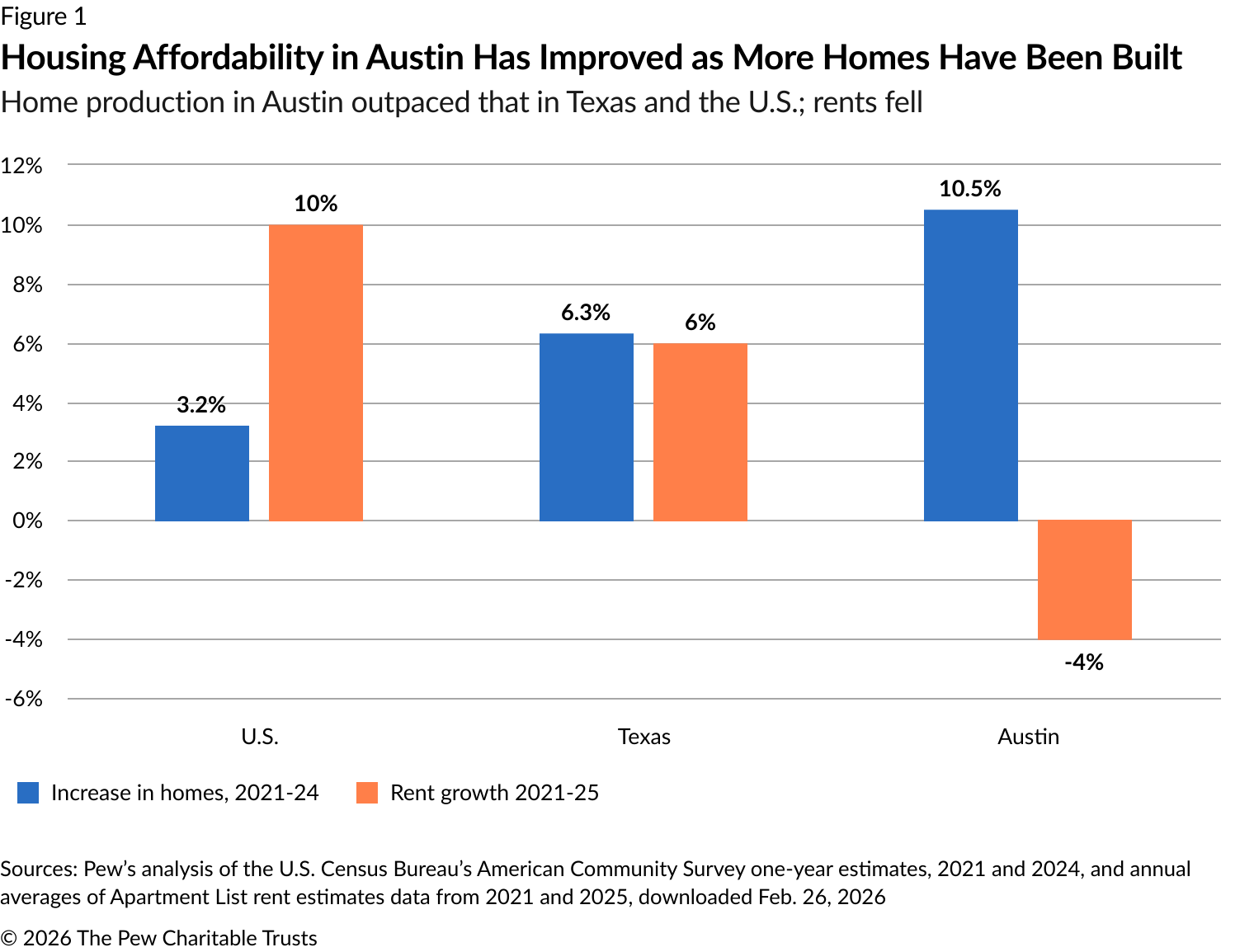
Austin, Texas has been booming since the 2000s, but it came at a cost: rents rose 93% from 2010 to 2019, the most of any major American city, and home prices rose 82%, more than any other Texas metro. But a slate of zoning reforms in 2015 (such as removing parking minimums and enabling ADU construction), plus a huge bond measure to build affordable housing, led Austin to add 120,000 housing units from 2015 to 2024. That’s an increase of 30%, more than triple the US’s overall housing growth rate of 9%. The increased supply has been great news for renters: Austin’s median rent fell from $1,546 per month in 2021 to $1,296 this year, putting it below the US’s nationwide median of $1,353.
🚏🧸 The UK will ban social media for children under 16
Following an Australian law that bans children under 16 from using social media, the UK has announced a similar rule that will bar under-16s from social platforms like Instagram, YouTube, TikTok, and Snapchat, though messaging apps like WhatsApp will be exempt. The move comes amid concerns over excessive screen time’s impact on kids’ well-being and the mental health effects of social media; one British poll found that 90% of parents supported a ban like this. However, enforcement has proven difficult, as kids often find ways around age verification, video selfies with fake mustaches or AI-generated videos; 70% of Aussie parents said their kids still use social media despite the ban down under. There are also significant privacy and security risks when tech companies need to gather people’s IDs or facial scans for mandatory age verification.
🚏🍏 Apple will raise phone prices amid the memory crisis
The price of memory chips has been skyrocketing due to the AI boom, and it’s been slamming the smartphone market hard: global smartphone sales are projected to decline 15% this year and a research firm predicts that phones’ average selling price will rise 20% this year. While Apple may have been resistant to passing along increased costs to consumers, outgoing CEO Tim Cook said that price hikes are now “inevitable” as the memory situation has become “unstable.” He didn’t specify what the exact price rises would be, but analysts predict that the next-gen iPhones will cost $150 more than the current iPhone 17s.
📖⏳ Worth your time
Some especially insightful pieces we’ve read, watched, and listened to recently.
Technology Weakens Our Minds. We Can Fix This. (The New York Times) — Cal Newport, author of “Deep Work,” argues that our current attention crisis requires a cognitive fitness revolution, drawing a parallel to how the 1970s jogging/aerobics boom transformed a sedentary American physical culture into a more active one. Algorithmic feeds, even non-ad-driven decentralized ones, run on the same rapid-fire, fragmented, high-dopamine feedback loops that are the cognitive equivalent of junk foods. What would a gym for the mind look like?
Asymmetry of Verification and Verifier’s Rule (Jason Wei) — Argues that machine learning’s ability to optimize anything that can be measured means that AIs will be most successful solving problems whose solutions are easy to verify. In other words, there’s a single success metric that everyone agrees on, and any given solution can be verified quickly, cheaply, and in parallel. Beyond computation, look for AI to excel in spaces with easily-verified solutions, like “finding the best catalyst to speed up a chemical reaction” or picking “the best aerodynamic car design for the fastest quarter-mile time.”
Why Do Commercial Spaces Sit Vacant? (Strong Towns) — Examines how the unusual financing of commercial real estate loans leads to unintuitive behavior: namely, how commercial landlords would rather let storefronts sit empty than rent them out at a discount. Specifically, the value of a commercial building is determined by its going rent, so if you cut the rent, you may become underwater on your loan. Better to “extend and pretend” to maintain your building’s paper value.
🌀🖋 More from FLUXers
Highlighting independent publications from FLUX contributors.
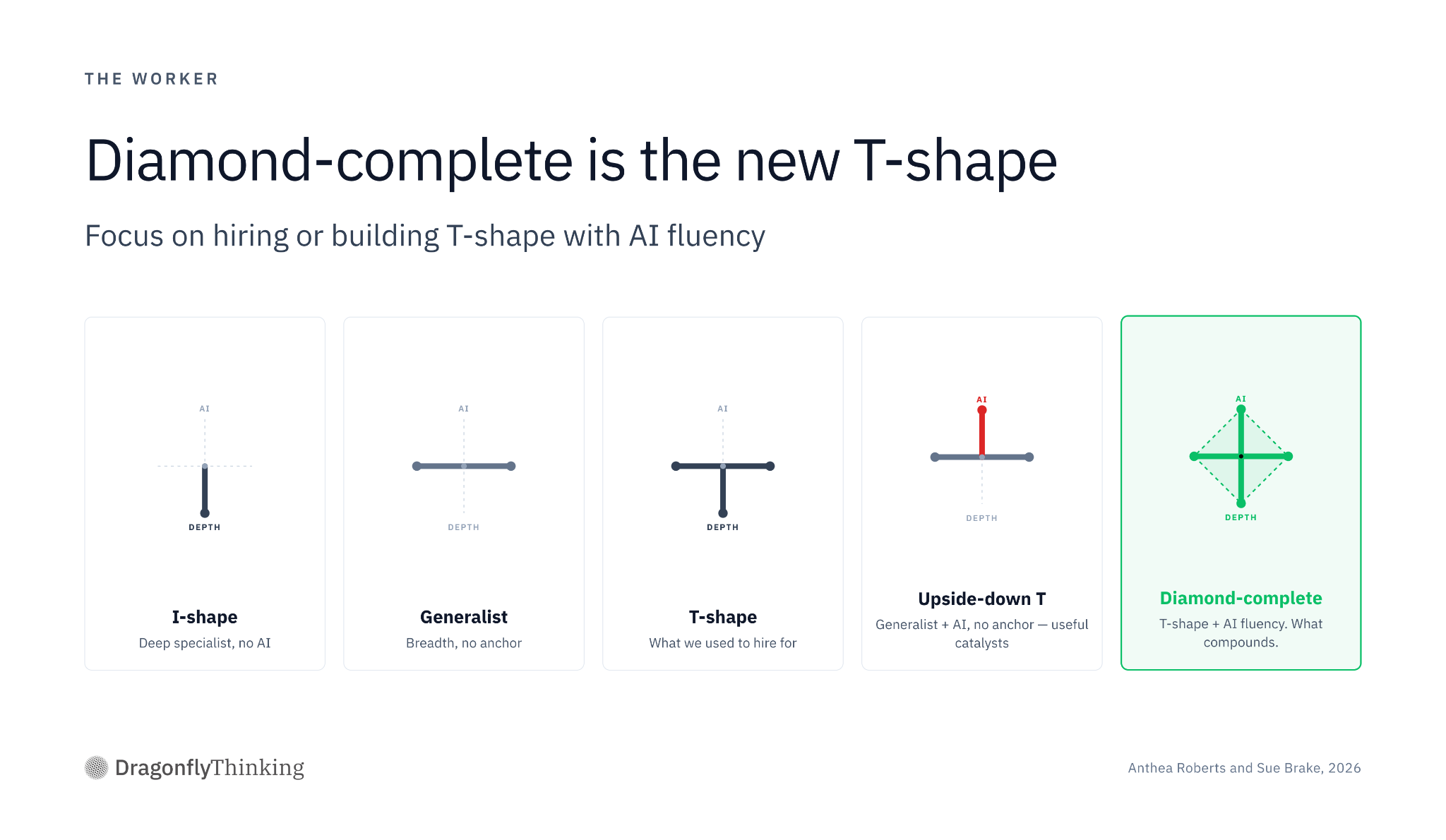
In “Diamond-Complete: The Shape of Work That Compounds with AI,” FLUX’s own Anthea Roberts takes a fresh look at the “T-shaped” metaphor for skills, where someone has both broad generalist knowledge (a horizontal line) and deep knowledge of one particular field (the downward line).
Anthea writes that in the age of AI, horizontal generalists are at risk of being replaced because LLMs (which have a decent, if flawed, understanding of every topic under the sun) can do their jobs; vertical specialists have a domain-specific edge on AI, but it erodes every year as LLMs get smarter. Being T-shaped helps, but the best move is to gain AI proficiency, which in this metaphor adds an upward line to the T, forming a perfect plus-sign and making oneself “diamond-complete.”
This blend of AI fluency, general knowledge, and domain expertise allows you to get the most out of AI with a mindset of, “I know how to direct AI to get better results than it produces by default, and I know where the model fails in my corner, and I catch it before it costs anything.” Developing diamond-shaped talent in an organization is highly difficult, though, and we can’t “let AI quietly eat the apprenticeship”: keep developing juniors who can develop the “downward line” that’s perhaps the hardest part of the diamond to learn.
🔍📅 Lens of the week
Introducing new ways to see the world and new tools to add to your mental arsenal.
This week’s lens: transaction costs.
You break a glass and someone offers to help clean it up. But you don’t really want their help. Still, it feels a bit callous to reject help sincerely given.
But help does not come without cost. All exchanges, even social exchanges, come with a transaction cost. Exchange creates overhead, and sometimes that overhead can be worth more than the exchange itself.
For example, the offer of “help” can create work, as anyone who has gotten help from a toddler can attest (we let the toddler help for other reasons, bonding, education… not the value of their output). Getting help creates a cost of delegation: you have to explain the task and review the output. Especially if you’re still doing part of the work, the mental energy of doing this can be more than having just done it yourself.
There’s a sneaky type of transaction cost that comes when an exchange, once offered, can’t be declined for free. These sorts of costs are especially prevalent in social situations, whether it’s the potential ingratitude of refusing sincerely offered help or the relationship-changing fallout of refusing a marriage proposal (“we can just keep dating, right?” rarely goes over well).
It’s not that we should think of everything through a cost/benefit lens. But when a reaction — yours or someone else’s — feels a bit too strong for the situation… it’s worth taking a look at what hidden transaction costs may be in play.
© 2026 The FLUX Collective. All rights reserved. Questions? Contact flux-collective@googlegroups.com.