

Episode 239 — June 16th, 2026 — Available at read.fluxcollective.org/p/239
Contributors to this issue: Neel Mehta, Justin Quimby, Jon Lebensold, Erika Rice Scherpelz, MK
Additional insights from: Ade Oshineye, Ben Mathes, Boris Smus, Dart Lindsley, Jasen Robillard, Lisie Lillianfeld, Robinson Eaton, Spencer Pitman, Stefano Mazzocchi, Wesley Beary, and the rest of the FLUX Collective
We’re a ragtag band of systems thinkers who have been dedicating our early mornings to finding new lenses to help you make sense of the complex world we live in. This newsletter is a collection of patterns we’ve noticed in recent weeks.
“In a fully developed bureaucracy there is nobody left with whom one can argue, to whom one can present grievances, on whom the pressures of power can be exerted. Bureaucracy is the form of government in which everybody is deprived of political freedom, of the power to act; for the rule by Nobody is not no-rule, and where all are equally powerless, we have a tyranny without a tyrant.”
— Hannah Arendt, On Violence
👑🖥️ The sovereign’s prompt
For most of history, the ability to command another person was a mark of status. The powerful spoke through intermediaries: scribes, secretaries, amanuenses, chiefs of staff. The privilege of the ruler was that they did not have to descend into the details.
AI agents semi-democratize that privilege. Now almost anyone can have something like a tiny administrative team. When we prompt, we occupy the position of command. (And in The prompt test we noticed how we’re often more patient with these virtual assistants than we are with real people we delegate to.)
But something has changed: who is responsible? When a person gives us the wrong result, we tend to treat the failure as theirs (even if we underspecified the task). In fact, that asymmetry is one of the oldest perks of command. An oft-ignored element of delegating to a person is that if they messed up, it was their neck on the line. And if we, as sovereign, messed up... well, it was often still their neck on the line.
If our agent sends the wrong message, books the wrong trip, or builds the wrong feature, whose judgment was actually operating? Ours? The model’s? The tool that wrapped the model? The prompt starts to look less like a request and more like a chain of command, one where the accountability is vague.
Accountability is not the only thing we lose in this model. If everyone becomes sovereign of their own little kingdom, what happens to the many unstated roles that intermediaries used to play? Intermediaries can translate for the target audience. They can distribute institutional memory. They can add the kind of friction that’s useful, such as making sure change doesn’t happen too quickly for the organization to absorb. Intermediaries can also apply additional judgment, such as when the sovereign’s idea isn’t one that should quite be taken literally. Some of these roles may move into the agents, some may move to the supervisor. But the key thing to note is that the people who “just” executed commands did a lot more than bare execution.
The sovereign’s prompt is not just a better instruction. It is a political object. It reveals what was hidden before: who gets to be vague and who has to be precise, who gets to iterate and who gets blamed.
So as we rebuild our world around AI-based automation, think about what becomes explicit, and the costs and benefits of doing so.
🛣️🚩 Signposts
Clues that point to where our changing world might lead us.
🚏🌯 A meme coding agent runs on “stolen compute” from customer support bots
Chipotle’s customer support chatbot went viral after people realized it could answer coding questions for them. So, some hackers reverse-engineered how to connect to Chipotle’s backend to get free AI calls and plugged it into OpenCode, a popular open-source coding agent. The resulting app, dubbed Chipotlai, thus allows developers to run coding agents for free using “stolen compute” from big companies’ support bots. They’ve since expanded from Chipotle to Lowe’s, the Home Depot, Expedia, IKEA, and more.

🚏🇲🇽 The Mexican government is developing a cheap electric car
The Mexican President recently unveiled a prototype of the Olinia Uno, a planned six-seat electric car that would sell for just $8,500; it’s made in Mexico using primarily domestic parts. The Mexican government invested in the car’s development as part of an initiative to boost the country’s manufacturing sector, and it’ll also install 2,000 charging stations across Mexico City and nearby states. The move comes at a good time, as Mexico’s EV market is booming: EVs account for 9.5% of new vehicle sales in the country, and Mexico is now the leading electric car supplier to the US.

🚏🌨️ Cloudflare says bot traffic now exceeds human traffic on the internet
Cloudflare’s CEO posted on social media that “agentic traffic [is] growing so fast that bots have now passed human traffic online for the first time in the Internet’s history.” Bots now make up about 57% of requests for HTML webpages, though many of these are likely quick, high-volume page scrapes rather than purposeful browsing (meaning that humans probably still dominate in terms of time spent on the web). Certain small regions like Gibraltar and Singapore seem to be hotspots for agents (whether via VPNs or data centers), with over 90% of web activity in those places coming from bots, and most traffic coming from desktop and requesting structured JSON data, a telltale sign of calling APIs.

📖⏳ Worth your time
Some especially insightful pieces we’ve read, watched, and listened to recently.
My Prodigal Brainchild (Neal Stephenson) — The author who coined the term “metaverse” argues that the metaverse has been created in the form of Minecraft, Roblox, Fortnite, et al., and in fact it was inevitable as soon as we got interconnected computers that could show graphics and track persistent game state. However, the 2021-era vision of a metaverse mediated by VR headsets was just one (highly flawed) implementation, and its collapse doesn’t mean the metaverse overall is dead.
Study Solves the Mystery of Why Humans Are Mostly Right Handed (Anton Petrov / YouTube) — Finds that humans, along with most hominins, are primarily right-handed because the left brain (which controls the right side of the body) was ideal for complex tool making, which requires fine motor control and mastery of repetitive, sequential steps. The right hand was better at tool use and therefore became preferred in ancient humans. Interestingly, the “fighting hypothesis” posits that a small fraction of lefties stayed around because they’d get a surprise advantage in combat against right-handed opponents.
The A.I. Fear Keeping Silicon Valley Up at Night (New York Times) — Argues that centralized AI risks consolidating power into a corporate-state feedback loop, creating a “permanent underclass” that exposes the precarity of the tech worker class itself. The antidote may be to reclaim cognitive sovereignty by running local AI models to bypass centralized oligopolies and unlock decentralized production.
The 5 Biggest Obstacles to AI Data Centers in Space (Big Think) — Argues that the much-ballyhooed concept of data centers in space may not live up to the hype. Costs go down and engineering breakthroughs can be achieved, but the laws of physics get the last laugh: cooling is extremely tough in a vacuum where all you have is radiation, and cosmic ray bit-flips are inevitable but difficult to detect or repair.
💊🍀 A dose of hopepunk
An optimistic sign that our world’s systems are changing for the better.
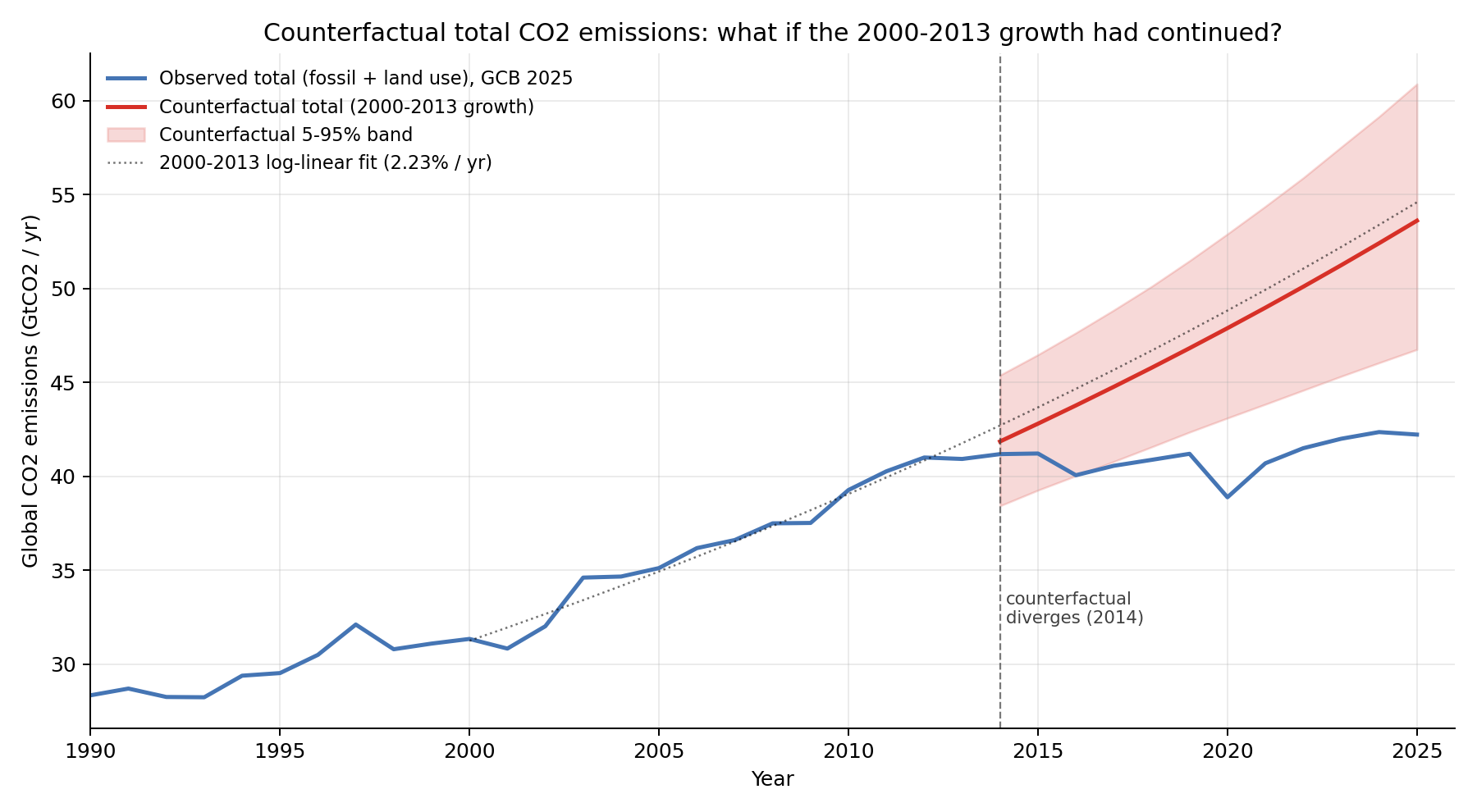
After centuries of rampant growth, carbon emissions are finally starting to plateau: “after increasing by more than 20% in the 2000s, CO2 emissions today are a mere 3% higher than they were in 2013.” Major drivers include the growth of renewable energy and, less obviously, reductions in deforestation. Atmospheric CO2 now sits at 431ppm, well below the earlier “status quo” projections of 439ppm, but it’s still increasing linearly because we still emit more carbon than the planet can absorb. (There’s also an interesting, and unfortunate, second-level feedback loop to consider: carbon sinks may get less effective as the planet warms.)
🧩🕹️ Systemic tools and toys
Games, gadgets, demos, and other nifty interactives to stretch your systems-thinking capacity.
Resource management, long-term planning, and calculated risk-taking are key in a quintet of sports web games where you have to assemble a team of historical players who would go undefeated in a simulation season. There’s the original 82-0 for basketball, 20-0 for American football, 8-0 for soccer (“normal” football), 162-0 for baseball, and 98-0 for ice hockey.
In the first round you can pick any player from a randomly chosen team’s roster, but at the end you only have one position left to fill, so strategic routing is essential: you don’t want to leave a tough position for the last round and be left picking between a pile of duds! For instance, in the baseball game (where FLUX’s high score is 158-4), most teams have a hard-hitting first baseman, so you could leave that slot for the end, whereas decent catchers are very rare, so you want to prioritize grabbing a solid one as soon as possible.

Leaving shortstops to the end was a mistake! See if you can beat us.
🔮📬 Postcard from the future
// What might letters written in the style of US Civil War correspondence during the AI push of 2026 look like?
“Dearest spouse, it is hard to see the glory of our company’s market dominance through the mighty chugging layoff machine, trampling the laid off beneath its cruelest algorithms. Communications cut off in the middle of the night. No last happy hour or lunchtime walk to speak a word of comfort to those impacted. Heaven grant there may be an end soon.”
“Mother and Father, thank you for the recent correspondence and images of you at home. That fixed look of care and sorrow upon your faces fills my soul with the keenest anguish. I would most gladly give all my hopes of happiness to save thee from one moment of pain or grief. But that can not be for the Board has deemed it otherwise, as I must fight with tooth and nail for compute to train my models.”
“I joined my onboarding class some nine months ago with fellow idealistic and driven people. We now number only three. H.J.F. was well when I last heard from him about a month ago from within the maws of the data center. I have not heard from Todd since I left the last all-hands. He is probably in legal review with the dreaded EU compliance teams.”
“Professor Q, I find myself as a cork tossed about on a storm-swept ocean. The lofty goals of greater glory for humanity we wrote about seem to be traded by my leaders for sacks of gold. ‘We must top the frontier model charts’ they cry, whilst urging the bending and skirting of moral and social guides in a quest for context to train upon. I fear the writings of my youth, nigh five years ago, reveal me an idealistic fool, ignorant of the ways of the world.”
© 2026 The FLUX Collective. All rights reserved. Questions? Contact flux-collective@googlegroups.com.