

June 4th, 2026Episode 238 — June 4th, 2026 — Available at read.fluxcollective.org/p/238
Contributors to this issue: Ade Oshineye, Ben Mathes, Erika Rice Scherpelz, Dart Lindsley, Justin Quimby, Neel Mehta, Boris Smus, MK
Additional insights from: Jasen Robillard, Jon Lebensold, Lisie Lillianfeld, Robinson Eaton, Spencer Pitman, Stefano Mazzocchi, Wesley Beary, and the rest of the FLUX Collective
We’re a ragtag band of systems thinkers who have been dedicating our early mornings to finding new lenses to help you make sense of the complex world we live in. This newsletter is a collection of patterns we’ve noticed in recent weeks.
“The prophecy of doom is to be given greater heed than the prophecy of bliss.”
— Hans Jonas
🎲👁️ When the odds aren’t yours
You’re in front of a door that sends nine out of ten people to Disneyland and the remaining one to Mordor. Do you go through?
It looks like a pretty good bet, most likely a day of leisure topped off by fireworks. Most people won’t have to deal with orcs and giant spiders (and the slight inconvenience of probable death). But if you are the one who ends up in Mordor, the average is not terribly consoling. The upside is pleasant. The downside is ruin.
In general, the group average can look fine while the individual path through the system is not (see: non-ergodicity). Push this to the extreme, and we can only afford to get it wrong once. And it doesn’t matter if the odds of unbearable loss are rare when they are unpredictable.
Moreover, when harm is irregularly distributed, internally rational responses can look to observers paranoid or oversensitive. The constant defense of decisions and lived reality ends up becoming a full time role in the management of other people’s skepticism. Over time, we learn to quietly route around danger rather than increasing the legibility of a harmful system to those who are spared its costs.
Asymmetric outcomes are a consequence of how complex systems distribute risk unevenly. So, before judging a decision, we can ask, “Who owns the downside?” When we have some control over the system, we can find ways to distribute the upside and downside more symmetrically. Rather than automatically assuming they’re character flaws, consider that caution and “overreaction” may be signals that we’re missing something.
When someone refuses the door, don’t ask, “Why are they so afraid of Disneyland?” Ask, “What do they know about Mordor?”
🛣️🚩 Signposts
Clues that point to where our changing world might lead us.
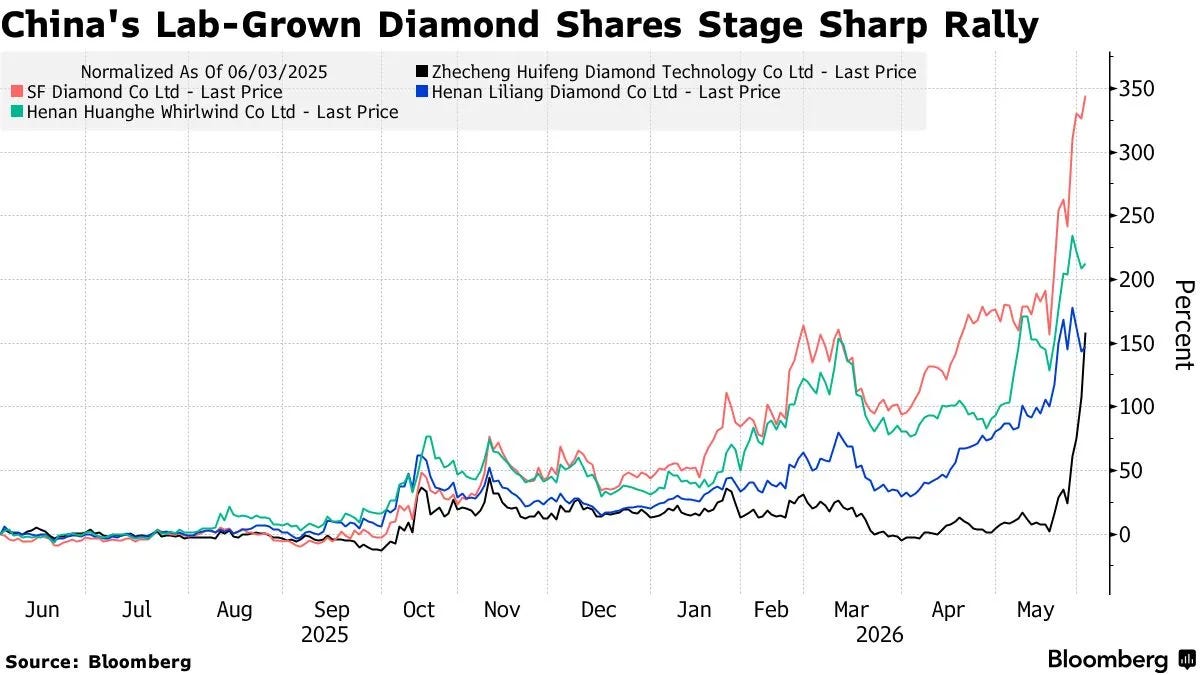
🚏💎 Lab-grown diamonds are the latest beneficiary of the AI boom
Synthetic diamonds are the latest unexpected product to see a surge in demand due to the AI, semiconductor, and datacenter boom; the share prices of several Chinese lab-grown diamond firms have skyrocketed in the last few months. Diamonds are exceptionally good at conducting heat but poor at conducting electricity, which makes them useful ‘heat spreaders’ for silicon chips, enabling denser and thus more powerful chips.
🚏🚀 Nasdaq relaxed its index listing rules right before SpaceX’s IPO
Traditionally, tech stocks would have to wait up to a year between going public and getting listed on the Nasdaq 100, the list of the hundred largest non-financial companies listed on the stock exchange. This rule was designed to give time for price discovery and let the stock price settle; sidestep the post-IPO slump that many stocks experience; stop hedge funds with early access to IPOs from frontrunning investors; and let insiders with 90- or 180-day lockups sell before passive investors in index funds had to buy the stock. But the stock market recently changed the rules to allow companies to enter just 15 days after IPO, a move that was apparently designed to lure SpaceX to IPO on Nasdaq instead of the rival NYSE. And now, as SpaceX looks to launch the biggest IPO in history, many investment advisors view this as a “shameless structural manipulation,” as index investors will be forced to buy potentially overvalued SpaceX stock, turning their 401(k)s into “exit liquidity” for insiders.
🚏🚜 Demand is booming for a “repairable, no-tech tractor”
John Deere’s tractors, harvesters, and other agricultural machines are infamously configured so end users can’t repair them; built-in software will brick the machine unless repairs are done at an authorized dealership. This adds both delays and expense for urgent fixes. The resulting demand for a user-repairable tractor birthed a Canadian tractor company that’s developed a new tractor that’s intentionally “built without computer controls.” Demand for the machine has reportedly been through the roof, with over a thousand farmers from 30 countries writing in for information after the tractor was presented at a farm show.

🚏🚗 An American bill would ban Chinese cars from driving into the US
Two lawmakers from Michigan recently introduced a bill that would ban cars designed or manufactured in China from driving into the US from Mexico or Canada; they called it a “national security issue” because these internet-connected cars could allegedly “collect full-motion video” or “map sensitive infrastructure sites.” (This likely plays well politically in Michigan, where many auto workers feel threatened by Chinese cars.) Meanwhile, cheap Chinese cars are everywhere in Mexico, with BYD controlling 70% of Mexico’s electric car market, while Canada is greatly relaxing its tariffs on EV imports from China and will allow 49,000 Chinese EVs to enter the country this year.
📖⏳ Worth your time
Some especially insightful pieces we’ve read, watched, and listened to recently.
The Platonic Case Against AI Slop (Palladium) — Uses Plato’s imitation hierarchy and model collapse research to argue that slop doesn’t just lower the quality bar, it trains your soul to prefer lower bars. The antidote isn’t to avoid AI altogether, but to avoid engagement-maximizing feeds and curating actively.
Consumer Sentiment Isn’t Politics, but Politics Is Reshaping It (Claudia Sahm) — A renowned economist observes that Michigan’s famous consumer sentiment survey, which measures people’s self-reported satisfaction with the economy, has become largely correlated with people’s political leanings: many people say they’re happy when their party controls the Presidency but instantly switch as soon as the other side takes over. (Goodhart’s Law may be at work, since the media uses consumer sentiment stats as a key indicator for the President’s success or failure.) There’s still some signal in the noise, though, such as a secular downward trend in sentiment since 2020, which matches the “vibecession” phenomenon.
AI Is Killing the Cheap Smartphone (David Oks) — A deep-dive into the economics of the semiconductor memory industry. AI servers need a special kind of memory chip (HBM), rather than the DDR and LPDDR that phones and laptops use, so soaring AI demand has driven memory manufacturers to reallocate lines toward HBM and away from consumer memory, which has driven memory shortages and price hikes in consumer devices, thus rendering many cheap phones “permanently uneconomical.” What’s more, a history of getting punished for overbuilding supply in this cyclical industry has driven manufacturers to purposely restrain themselves from building new factories, which means we can’t simply build our way out of this shortage.
How the US Eradicated Screwworm (Sarah Taber / Bluesky) — Details how the US worked with Central American governments to eradicate flesh-eating screwworms (a scourge of livestock farmers) using the clever method of releasing hordes of sterile male flies that would lead females to lay unviable eggs. However, the US cancelled a screwworm monitoring program last year, and the dangerous bugs have returned to Texas and are threatening livestock there.
🔍📆 Lens of the week
Introducing new ways to see the world and new tools to add to your mental arsenal.
This week’s lens: lens stacking.
Oh no! Your launch is about to slip. Engineering sees a dependency problem. Design sees low quality user experiences. Sales sees a broken business model. Finance sees burn. Each account is true... enough. None is the whole situation.
Each perspective has a lens, and lensical thinking is the practice of noticing that we all see through lenses. Lenses are not neutral, and sometimes they can get stuck to our eyeballs.
Lens stacking is what happens when we deliberately put on more than one lens without collapsing them into a single answer. Instead of asking “who is wrong?” we ask “how might we all be right?”
Each lens adds a layer of information. Like the lenses in a telescope, the stack creates a view that no lens can produce on its own. And this can happen even when the lenses don’t agree. If one says “move faster” and another says “slow down,” the tension may reveal the shape of the problem.
Too much stacking can get us stuck in analysis paralysis, or it can lead us to think we agree when really we’re just being too general. Putting on and taking off both matter. Putting another lens on the stack acknowledges complexity. Taking one off can give us more freedom to act.
Complex systems are too rich for single-lens certainty. Stack the lenses up and we can see farther.
© 2026 The FLUX Collective. All rights reserved. Questions? Contact flux-collective@googlegroups.com.