

Episode 237 — May 28th, 2026 — Available at read.fluxcollective.org/p/237
Contributors to this issue: Justin Quimby, Jon Lebensold, Erika Rice Scherpelz, Neel Mehta, Boris Smus
Additional insights from: Ade Oshineye, Ben Mathes, Dart Lindsley, Jasen Robillard, Lisie Lillianfeld, MK, Robinson Eaton, Spencer Pitman, Stefano Mazzocchi, Wesley Beary, and the rest of the FLUX Collective
We’re a ragtag band of systems thinkers who have been dedicating our early mornings to finding new lenses to help you make sense of the complex world we live in. This newsletter is a collection of patterns we’ve noticed in recent weeks.
“A bad system will beat a good person every time.”
— W. Edwards Deming
💩🔁 Shit work begets shit work
A critical piece of bespoke software has stopped working; a consultant is hired to patch it up ASAP. There is no architecture review, no hard questions asked. Leadership needs it running again. The consultant delivers beautifully: the project was on time and they even fixed some bugs along the way. But three months later, a minor dependency update breaks it all over again. It’s not a great outcome for the client, but at least the consultant has some nice repeat business.
In other words: shit work begets shit work.
When someone expresses satisfaction with our work, they engage in a collaborative relationship calibration: they indicate what they think “good” means (or, at least, good enough) and this feedback articulates the level of care needed to get rewarded. Consequently, new requests arrive already shaped by that lesson.
This dynamic rhymes with Gresham’s Law of “bad money drives out good.” When two coins circulate at the same face value, people spend the weaker and hoard the stronger. While the bad stays visible, the good disappears from use.
Work quality also rhymes with this: if our judges (boss, client, audience) are satisfied by our work, we stay employed. If they are satisfied by mediocre work, we stay mediocre. Those demanding a higher level of craft, they will have to look elsewhere. Nobody has to complain for the system to sort itself out. Meanwhile, our audience narrows around the level of quality we have collaboratively normalized.
Skills follow the same loop. Work done well emits an aura that is more than the functional output. The thinking we skip becomes less fluent. Care, not practiced, gets harder to recapture. And the less often we’re asked for excellence, the fewer chances we get to exercise it.
Work done with unusual care attracts colleagues and clients who value care. They ask better questions. They notice better tradeoffs. Their expectations become a constraint that helps us stay good.
Not every job can be a masterpiece. Budgets are real; deadlines are real. Sometimes “good enough” is good enough. But good enough is a choice relative to a context: good enough for someone, under some set of expectations, with some future implied.
So don’t just ask, “Did this work pass muster?” Ask, “What kind of future work does it select for?”
🛣️🚩 Signposts
Clues that point to where our changing world might lead us.
🚏🥩 Texan steakhouses are going out of business as beef prices skyrocket
Steak prices have risen 17% in the last year and ground beef prices have risen 19%, hitting a record high. In Texas, the price of wholesale brisket meat has risen 28% year-over-year. (Major drivers include tariffs; inflation; and the smallest national cattle herd in 75 years due to droughts, labor shortages, and loss of ranching land.) Barbecue joints and steakhouses have had to raise prices, limit brisket sales to just one day a week, or even shutter entirely. Meanwhile, lower-end chains like Outback Steakhouse and Texas Roadhouse, which use cheaper beef cuts and alternate meats, have shown strong revenue growth. It also helps that price-conscious consumers are looking for cheaper menu items.
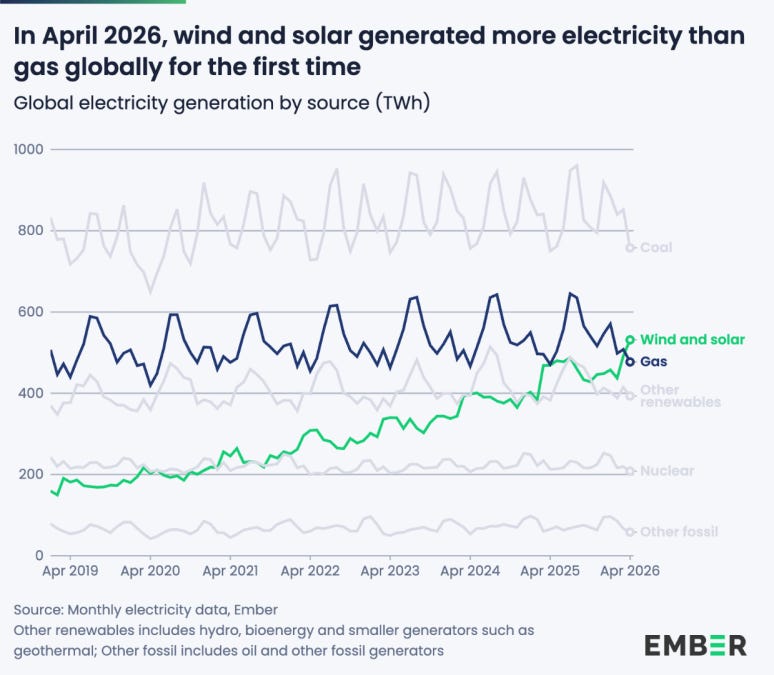
🚏🌸 Wind and solar now generate more power than natural gas globally
Wind and solar power together produced 22% of the world’s electricity this April, compared to natural gas’s 20%. (Both remain far behind coal, though.) It’s the first time that the two renewables have eclipsed gas, and given their rapid growth over the past decade, they seem poised to maintain and expand their lead. It’s not surprising that this milestone first occurred in April, as the month’s mild spring weather in the Northern Hemisphere is typically good for both wind and solar, while the reduced need for heating and cooling reduces demand for gas.
🚏🇳🇱 The Netherlands blocked a US company’s takeover of a key government tech vendor
The Dutch company Solvinity runs the country’s digital ID app, which residents use to “authenticate themselves online… to book a doctor’s appointment, buy a house, or interact with public authorities.” Kyndryl, an American firm spun off from IBM, announced it was going to acquire Solvinity last year, but the Dutch government recently intervened to block the purchase, since foreign ownership of such a major piece of digital infrastructure could pose a “risk to the public interest.” It’s the latest in Europe’s tech sovereignty initiative, where the EU and individual countries across the region are attempting to reduce their reliance on American cloud, AI, and software vendors.
🚏🚕 Uber and Lyft drivers in MA formed the country’s first rideshare drivers’ union
Rideshare drivers in the US are classified as independent contractors, not traditional employees, so they don’t normally have the right to form unions. But a 2024 Massachusetts law created a special framework to allow them to organize if they could get signatures from 25% of the state’s active drivers. The newly formed App Drivers Union recently met that threshold and has now received certification from the Massachusetts Department of Labor Relations to represent the New England state’s nearly 70,000 Uber and Lyft drivers, making it the country’s first official union representing rideshare drivers.
📖⏳ Worth your time
Some especially insightful pieces we’ve read, watched, and listened to recently.
I Think Anthropic and OpenAI Have Found Product-Market Fit (Simon Willison) — Observes that enterprise coding agents have been able to successfully ramp up prices without losing customers (a great sign of PMF), whereas consumer AI products still need subsidies and struggle with monetization. This shift to enterprise is especially apparent if you look at the big labs’ open job listings: almost a third of them are for ‘enterprise-y’ roles like account executives, forward-deployed engineers, and go-to-market people.
Inflation Inequality Meets Wage Compression (Arin Dube) — The economics professor observes that the post-pandemic recovery was unusual in that wages at the bottom grew more than those at the top, leading to a decrease in income inequality (“wage compression”). However, inflation was especially high in categories that poorer people spend more money on, such as food, rent, and energy. This counteracted about 15% of the relative gains at the bottom, suggesting that supply-shock inflation (the kind we experienced post-pandemic) “poses a serious risk to broad-based prosperity.”
AI Fatigue Is Real and Nobody Talks About It (Siddhant Khare) — Argues that the Jevons paradox of AI carries a heavy psychological toll: as task times shrink, capacity expectations expand, forcing us to constantly take on more work. The critical countermeasure is protecting dedicated no-AI time to firmly separate deep human thinking from AI-assisted execution.
Size and Dynastic Decline: The Principal-Agent Problem in Late Imperial China (Explorations in Economic History) — Develops a model to argue that Qing China’s decline in the 19th century was driven largely by a principal-agent problem in tax collecting. The emperor was generally a benevolent dictator whose long time horizon led him to set low tax rates to ensure regime stability in the long run; however, he had to defer to regional tax collectors to observe local economic conditions and collect the appropriate amount of funds, especially in the hinterlands. But these collectors had the short-term incentive to extort taxpayers and keep the excess funds for themselves. This forced the ruler to keep lowering tax rates, ultimately weakening the state’s fiscal capacity.
🍯🧠 From the hive mind
Showcasing useful tools, resources, and essays from the FLUX community.
We all know the broad story about work-from-home: a huge spike at the start of COVID, followed by a gradual decline. But once you dig into the data, there are some wild local patterns. Sunnyvale, California, had the largest percentage increase in WFH in the entire country (1,085%) from 2019 to 2021, and then the largest percentage decrease (-67%) between 2021 and 2024. It’s the epitome of the tech industry boomerang: massive early adoption, then a sharp pullback. Meanwhile, the decline has been much more muted a few counties over in Santa Rosa and Sacramento, and WFH has actually grown in the bedroom city of Stockton.
Check out the stats in your area in a new tool by data explorer Ari Lamstein.
🔮📬 Postcard from the future
A ‘what if’ piece of speculative fiction about a possible future that could result from the systemic forces changing our world.
// Torches flicker in the castle room, illuminating three figures seated around a table.
The Dwarf slams his tankard on the table. “This is ridiculous. They can’t do that to us. We’ve been together for two years, and now this!” His other hand gestures at the tome before them.
The Elf raises a single elegant eyebrow to regard the Dwarf. “Look, we knew things might change as we progressed. We agreed to adjustments. I admit, I was not expecting them to be this… dramatic.” A lithe hand rests on their own copy of the tome, a finger tapping its cover.
The Dwarf pauses only briefly to take a slug of ale, then continues, “Years of building our skills, building trust, creating a shared vision for the future. Now this! Introducing a new core stat for our characters. Which gets set by a roll of the dice that we have no influence over!”
“Oh it is worse than that, friend,” the Draconian says. “This new stat has a direct influence over all the key abilities of characters. My build is now effectively useless. My entire progression arc is going to hit a wall. I might as well reroll.” Smoke exits from its nostrils, tracing a downward path over the table edge onto the floor.
All three snap their heads as the Wizard returns to the room and takes their seat behind the gamemaster screen. They do not need to cast Detect Thoughts to read the room.
“Look, we all agreed to do an accelerated timeline with a minimum of metagaming. That means occasionally massive systemic changes occur. What used to be successful to get experience points and accumulate wealth won’t always work. You just have to decide if you want to keep your current character and adapt; create a new character, but at a much lower level; or drop out entirely. The choice is yours.” The Wizard rises to leave, their rulebooks levitating to follow behind them.
The players look at their tomes with resignation. “A Summoner’s Guide to the Chatbox: Mundanes & Mortgages Expansion Pack.”
© 2026 The FLUX Collective. All rights reserved. Questions? Contact flux-collective@googlegroups.com.