

Episode 236 — May 21st, 2026 — Available at read.fluxcollective.org/p/236
Contributors to this issue: Justin Quimby, Erika Rice Scherpelz, Ade Oshineye, Jon Lebensold, MK, Jasen Robillard, Neel Mehta, Boris Smus
Additional insights from: Ben Mathes, Dart Lindsley, Lisie Lillianfeld, Robinson Eaton, Spencer Pitman, Stefano Mazzocchi, Wesley Beary, and the rest of the FLUX Collective
We’re a ragtag band of systems thinkers who have been dedicating our early mornings to finding new lenses to help you make sense of the complex world we live in. This newsletter is a collection of patterns we’ve noticed in recent weeks.
“A system as a whole is not an object but a way of looking at an object. It focuses on some holistic phenomenon which can only be understood as a product of interaction among parts.”
— Christopher Alexander
👔♟️The games we play
In a world where most can afford decent shoes, function becomes table stakes. Whether $20 or $200, the shoes still protect your feet. And with the baseline met, the details start carrying social meaning: the brand, the colorway, whether they’re perfectly clean or intentionally worn down. Some might say none of this matters. Materially, they’re right. If the shoe fits, wear it. But people do care. Shoes can signal taste, tribe, status, wealth, age, even ambition.
Status games don’t disappear once basic needs are met. They migrate upward. As societies become more materially abundant, people spend less energy distinguishing themselves through access to things that aid survival (more calories, higher quality housing). Instead, that energy goes to distinguishing their lives through identity, aesthetics, and cultural fluency.
So status games always exist. But in a post-scarcity world, you have more choice about which status games you play… hopefully. In some systems, opting out of the status game locks you out of jobs, relationships, or economic security — the traditional stereotype of the lonely high school nerd.
In others, it mostly locks you out of prestige within a particular social scene, but you can often find another to land in — are you a comic book fanatic? A boardgame geek? A chess nerd? There’s a profound difference between a society where status hierarchies determine survival and one where they are a tool for identity and community. (Although both can be harmful for those at the bottom of the hierarchy.)
This is where the distinction between intrinsic and extrinsic status games becomes useful. Extrinsic games revolve around recognition and social legibility. They reward signaling, performance, and visibility within a network. Intrinsic games emerge from direct engagement: becoming more capable, building something durable, developing passion or judgment. This isn’t quite the same distinction as opt-in vs. opt-out games, there’s a correlation.
Even the most abundant society cannot eliminate status competition. But we get to choose which games we want to play. You can check out anytime you like, but you can never leave.
🛣️🚩 Signposts
Clues that point to where our changing world might lead us.
🚏⛓️💥 Iran wants to charge fees for internet cables under the Strait of Hormuz
Fresh off a recent plan to “establish a permanent toll system” for boats transiting the Strait of Hormuz, Iran now wants to “impose fees on internet cables” running along the bottom of the Strait, with the implied threat of cutting the cables (or at least hindering repair boats) if American tech giants don’t pay up. Only 1% of global internet traffic runs through the Strait, but experts warn that cutting cables here could slow financial transactions between Europe and Asia or even drive internet blackouts in East Africa.
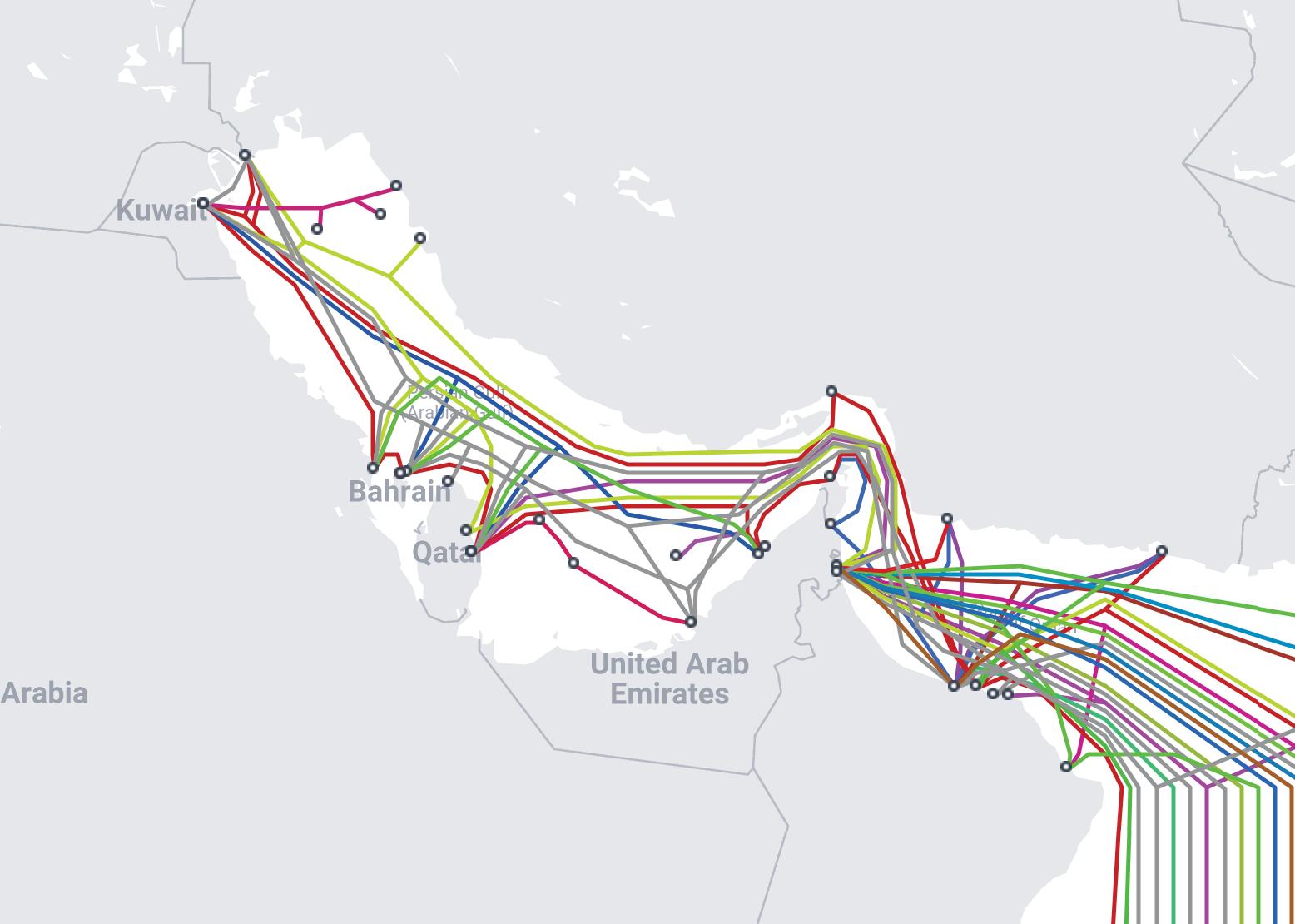
A map of subsea internet cables in the Persian Gulf. Source: Submarine Cable Map
🚏🎰 Minnesota became the first state to ban prediction markets
A new Minnesota law makes it a crime to host or advertise a prediction market, defined as “a system that allows consumers to place a wager on the future outcome of a specified event that is not determined or affected by the performance of the parties to the contract,” within the state. (There’s a small carveout for weather futures, which have non-gambling utility for farmers.) Startups like Kalshi and Polymarket will have to leave the state by August or risk facing felony charges. The CFTC, the federal agency that regulates prediction markets, has sued Minnesota — along with several other states that have attempted to regulate prediction markets — to try to block the bill, saying that only the CFTC should have jurisdiction over these markets.
🚏🔬 arXiv will ban researchers for a year if they submit LLM-generated papers
The online preprint repository arXiv allows researchers to upload papers before they’re peer-reviewed, making it a popular hub for free scientific literature. It has reportedly been getting spammed by low-quality, AI-generated papers: last year it announced it would stop accepting all computer science “review articles and position papers” (though novel research was still allowed). Later, it started requiring first-time posters to get an endorsement from an established scientist. The organization recently enacted an even stricter rule: anyone whose submission has “incontrovertible evidence” of LLM generation will be banned from uploading for a year. Such evidence includes “hallucinated references” or chat output from LLMs like “would you like me to make any changes?” or “fill in the above table with real numbers from your experiments.”
🚏⚜️ New Orleans could be “surrounded by the Gulf of Mexico” by 2100
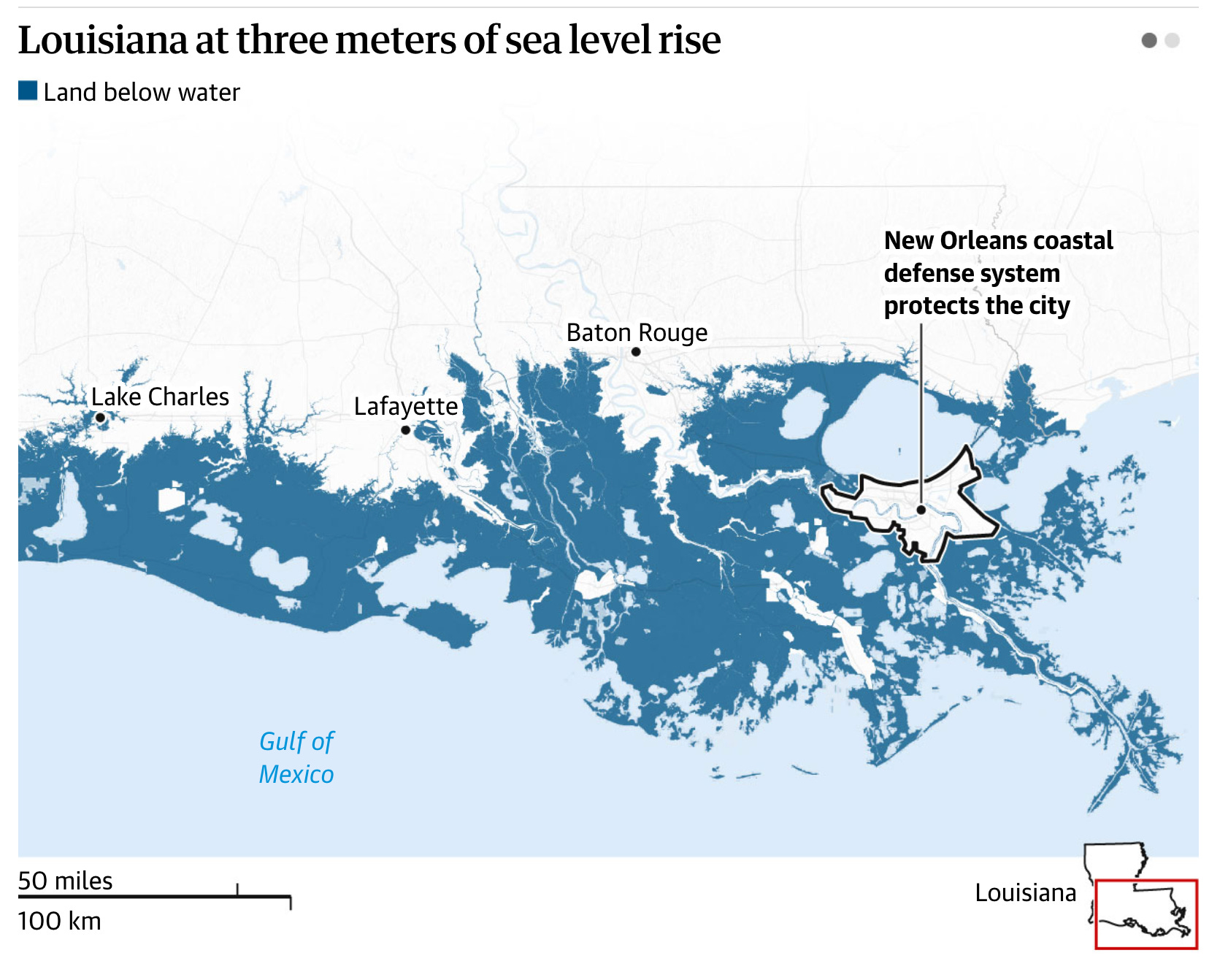
A new study found that Southern Louisiana could be facing 3 to 7 meters of sea level rise by 2100, which would leave New Orleans as a mere island in the Gulf of Mexico in the best case, or completely submerged in the worst case. This dire scenario makes coastal Louisiana perhaps “the most physically vulnerable coastal zone in the world”; it has “evidently already crossed the path of no return.” The study’s authors urged the government to prepare for a managed retreat from NOLA and relocate the city’s inhabitants to higher ground.
📖⏳ Worth your time
Some especially insightful pieces we’ve read, watched, and listened to recently.
What Will Be Scarce? (Alex Imas) — An economics professor argues that economic revolutions like AI make certain goods (and, in this case, services) cheap and abundant, but scarcity still exists; it just shifts, and that reshapes the balance of employment between sectors. In AI’s case, the services sector may become far more efficient, cutting employment there, but things with a human touch will remain scarce and highly demanded, since these feed people’s desires for exclusivity and status (high up on Maslow’s pyramid). Thus, we may see rapid growth of a “relational sector” of the economy, focused on jobs where “the human element is the product,” such as in hospitality, coaching, childcare, live entertainment, and tourism.
Pax Electricana (Energy and Stuff) — Argues that the global economy wastes massive tonnage shipping raw fossil fuels to process raw ores; instead, we should refine materials locally using renewable energy and ship the finished goods (“embedded clean energy”). Because electricity cannot easily cross oceans, refining raw materials at the source is the only practical way to export a country’s clean energy surplus; it has the pleasant side effect of cutting global shipping weight by two-thirds and shifting geopolitical power toward manufactured abundance.
How to Walk Through Walls (Henrik Karlsson) — Building on last week’s “hacker mindset” piece, the author explores how one can develop this mindset of understanding how the atomic machinery of a system actually works and manipulating it at the low level, without getting stuck at the high-level abstractions. As an example, consider the self-trained filmmaker Robert Rodriguez, who broke all the conventional rules of filmmaking when he spent a mere $7,000 to cobble together his film El Mariachi, which ended up grossing millions of dollars internationally.
The “Average” Words for Things (Nardi / YouTube) — While linguists normally think that the relationship between words’ sounds and meanings is arbitrary, certain words have unusual sound patterns across unrelated languages. Many times it’s due to sensory relationships; for instance, many languages use the labial sounds /m/ or /b/ for “mouth” or the nasal sound /n/ for “nose.” This creator made an interactive site called Phonaesthesia that looks for these cross-linguistic patterns and computes an “average” word for each concept across hundreds of languages.
🔮📬 Postcard from the Future
A ‘what if’ piece of speculative fiction about a possible future that could result from the systemic forces changing other worlds.
// What does an oncology convention sound like in 2040?
Transcript of opening address, ASCO Annual Meeting 2040, Chicago.
The speaker at the podium gestures at the screen behind them.
“I want to read three numbers into the record. Ninety-one: the percentage of patients across the top fifteen solid tumors who are alive at five years. Seventy-eight: the same number for pancreatic adenocarcinoma, the disease that, when many of you in this room entered fellowship, had a five-year survival in the single digits. And two-point-one: the average number of Stage IV solid-tumor presentations logged by a Memorial Sloan Kettering fellow last year compared to eighteen in 1996.
“That third number is supposed to alarm us. Some of our fellows have never seen tumors in the wild, only trained against them in simulations. And to that I say good.
“When I was a fellow at Dana-Farber in 1998, I rotated through a Stage IV pancreatic ward of sixteen beds. I learned more about dying than about cancer. I was trained by Dr. Robert Hsieh; at his retirement, he said something I never stopped thinking about.”
“He said: ‘If you do this job well, you will put yourself out of business. And I hope to God you do.’”
“A third-year surprised me at last night’s welcome reception. She said, ‘I’m going to Lagos to study history.’ When I asked her what she meant, she told me she wanted to see the things we have eradicated here, which meant going to the remaining places where AI screening is still not ubiquitous. Living in the future means having to travel to see the past.”
“AI-augmented multi-cancer detection has been deployed at population scale for just a bit more than half of a decade. It has changed so much of human life that historians of medicine are already trying to figure out what to call it. When they realize we already have a name we call it in private and ask us what we call it, we should tell them: ‘The Detection Decade’. No, not the decade where we finally cured cancer. The decade we caught it first.”
© 2026 The FLUX Collective. All rights reserved. Questions? Contact flux-collective@googlegroups.com.