

Episode 233 — April 30th, 2026 — Available at read.fluxcollective.org/p/233
Contributors to this issue: Neel Mehta, Boris Smus, MK, Justin Quimby, Erika Rice Scherpelz,
Additional insights from: Ade Oshineye, Ben Mathes, Dart Lindsley, Jasen Robillard, Jon Lebensold, Lisie Lillianfeld, Robinson Eaton, Spencer Pitman, Stefano Mazzocchi, Wesley Beary, and the rest of the FLUX Collective
We’re a ragtag band of systems thinkers who have been dedicating our early mornings to finding new lenses to help you make sense of the complex world we live in. This newsletter is a collection of patterns we’ve noticed in recent weeks.
“Reading functions as hallucinating a meaning between letters and lines”
— Friedrich Kittler
🫥🎭 The oracle’s disguise
Ask an LLM a contested question and watch what happens: It doesn’t say “I think” or “from where I stand.” Instead, it speaks in an encyclopedia’s authoritative cadence. It sounds like it’s coming from both everywhere and nowhere at once.
The idea of a neutral posture has a long philosophical pedigree. John Rawls’ famous “veil of ignorance“ asks us to design society as if we didn’t know who we’d be within it—rich or poor, healthy or sick, woman or man. Strip away your identity, reason from a position of pure neutrality, and you’ll converge on fairness. It’s elegant. It’s also built on an assumption so deep it’s easy to miss: that such a neutral position exists at all.
Thomas Nagel gave this assumption a name: the view from nowhere. He argued that while we aspire to see reality stripped of any particular perspective, every observer is inescapably situated somewhere. The attempt to transcend perspective doesn’t eliminate it; it just hides it.
Gerald Gaus picks up this thread in The Tyranny of the Ideal. If reasonable people genuinely disagree about values—not because some are confused but because the questions are genuinely hard—then there is no single ideal to converge on. The veil of ignorance doesn’t reveal the one true answer; it smuggles in whichever set of assumptions felt most “neutral” to the person designing the thought experiment.
LLMs have landed squarely in this same trap. They’ve been trained on vast corpora and then fine-tuned to produce responses that feel balanced and authoritative. But the training data reflects particular cultures, particular eras, particular power structures. The whole process encodes particular judgments about what’s helpful, harmless, and honest. There is a view, and it comes from somewhere very specific.
The thing is, this isn’t inevitable. LLMs don’t have to sound like oracles. They sound this way because we’ve trained them to, rewarding certainty over uncertainty. We could train them to surface tension. Instead, we’ve optimized for the smooth, confident answer. We’ve built the assumption of a veil of ignorance into the loss function.
The oracle voice is persuasive precisely because it seems positionless. When a person argues a point, you naturally ask “where are they coming from?” When an LLM does it, that instinct may not fire. Imagine instead systems that make their own vantage point explicit; it’s something we could all use more of, whether we are LLMs or humans.
🛣️🚩 Signposts
Clues that point to where our changing world might lead us.
🚏🌡️ France is investigating weather data tampering due to suspicious bets
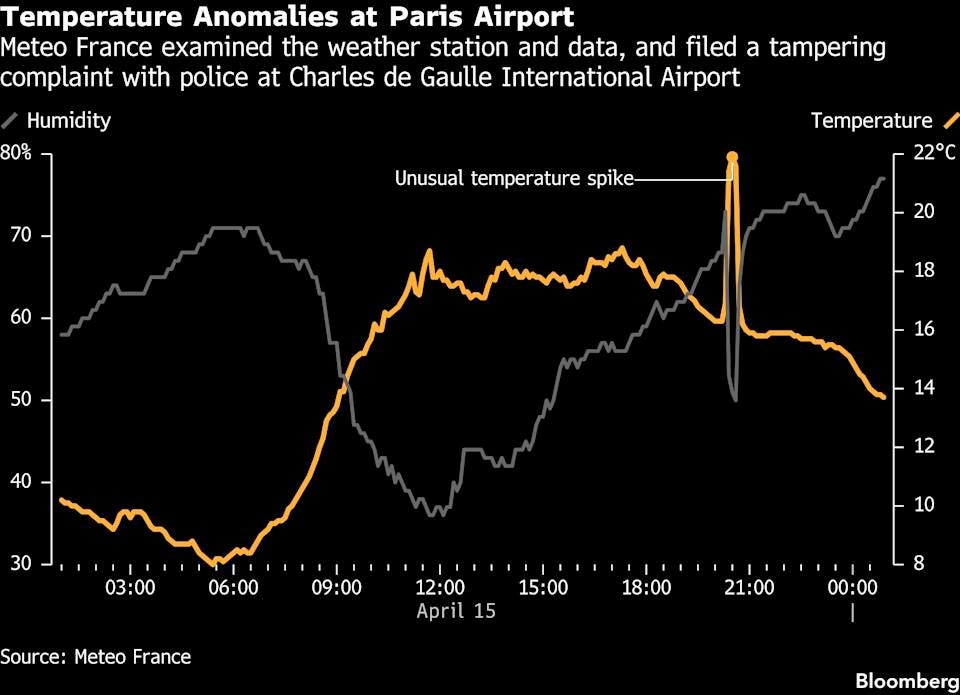
Automated weather readings at Paris’s Charles de Gaulle Airport showed sudden 4–5 °C spikes in temperature on the evenings of April 6 and 15[; those anomalous readings, if real, would’ve represented those days’ all-time high temperatures. These same days showed double the usual amount of betting on Paris temperature ‘contracts’ on the prediction market Polymarket. For instance, one bettor won $21,000 predicting that April 15th’s high temperature would not be 18°C. The French weather forecasting office suspected data tampering and referred the case to airport police.
🚏⛽ Norway went from almost 0% to nearly 100% electric cars in 13 years
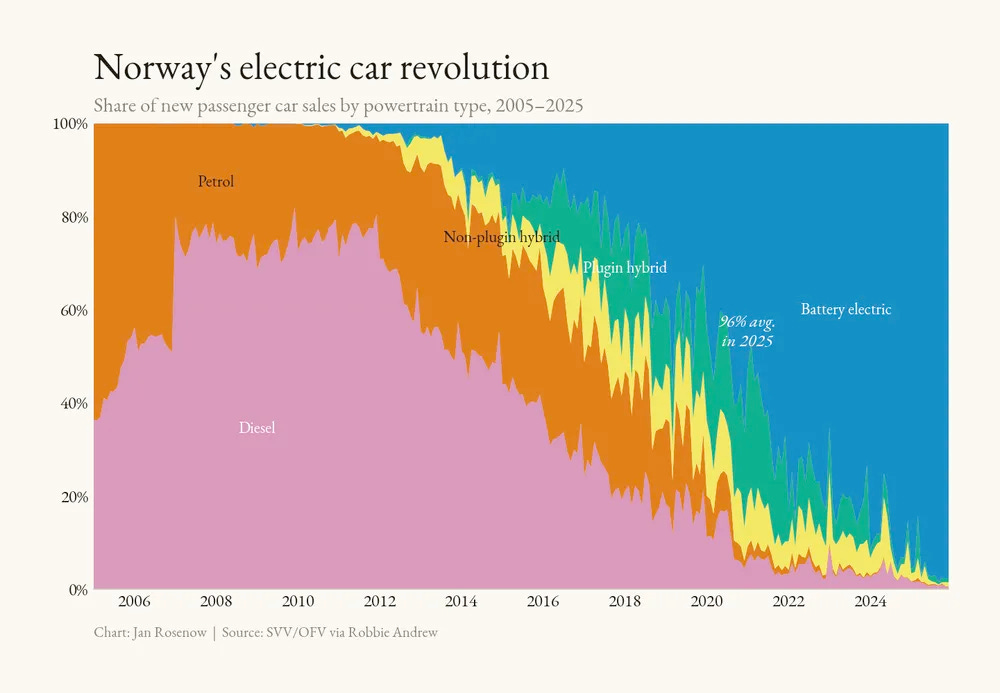
In the early 2010s, almost every single new passenger car sold in Norway was powered by gas or diesel (the majority, interestingly, being diesel). Hybrids and full battery-electric cars exploded in popularity shortly thereafter, and by 2025 battery-electric cars reached 96% market penetration, with hybrids making up most of the remainder and fossil fuels sitting as a vanishingly small rump.
🚏🌥️ “Unfounded” health and safety concerns are derailing American solar growth
Public backlash over health and environmental fears (which are light on evidence) is stifling the growth of solar installations in Michigan, Ohio, Missouri, and elsewhere across the USA. Concerns include inverter noise pollution, toxic materials from panels leaching into the soil, and cancer from electromagnetic radiation, but experts, scientists, and professors have made it clear that none of those fears are realistic. One article from the BYU Law Review went so far as to call them “unfounded” and “rooted in misinformation.” However, local solar bans or limits driven by this controversy, in conjunction with federal policies such as eliminating tax credits for renewable energy, led to a 14% decrease in new solar installations in the US last year.
🚏🗾 Humanoid robots will sort luggage at a Tokyo airport amid a labor shortage
In May, Tokyo’s Haneda Airport will start a pilot program to use humanoid robots as baggage handlers, aircraft cabin cleaners, and other ground crew. Japan has been struggling with a shortage of human ground crew—the number of such employees fell from 26,300 in 2019 to 23,700 in 2023—so the program is testing whether generic humanoid robots can fill these gaps instead of standard specialized machines, which would presumably take longer to set up. A demonstration video showed a robot awkwardly walking toward some cargo on a conveyor belt and giving it a weak push, which drew some skepticism about these bots’ effectiveness.

📖⏳ Worth your time
Some especially insightful pieces we’ve read, watched, and listened to recently.
Agile in the Age of AI (Evan Phoenix) — A startup founder observes that a key part of Agile, besides the more famous concepts of tightening feedback loops and keeping everyone in sync, is being able to operate at a moderately high pace indefinitely. But now that AI agents are always working and churning out more code than any human can hope to review, it’s all too easy for us to try to match their relentless pace and burn ourselves out. Humans are the limiting factor, and managing AI workers carries a high cognitive load, so we have to slow down to match our own capacities.
The Lost Art of Research as Leisure (Kasurian) — Observes that we have the Library of Alexandria in our pockets yet suffer from civilizational ADHD. The author argues we need to reclaim the Greek concept of “scholē,” leisure not as idleness but as directed, playful research driven by genuine curiosity. The key distinction from idle browsing is that it must produce something tangible: an essay, a thread, or a letter that’s shared, tested, and refined in a community.
America as Prussia in 1806 (Secretary of Defense Rock) — Examines the historical context that legendary Prussian general Carl von Clausewitz operated in. Despite Prussia having been a leading power just a generation earlier, by 1806 its military, institutions, and state were brittle and sclerotic, leaving them as easy targets for Napoleon to bulldoze. This profoundly shaped Clausewitz’s views on war, and he concluded that the lack of energy and civic spirit in the Prussian people (compared to the zeal of the nationalistic French) was the ultimate reason for their downfall. The United States, the author warns, sits in a similarly precarious place.
Japan Is Not a Xenophobic Country (Noahpinion) — Noah Smith argues that Japan’s reputation for xenophobia is largely based on stale data: in recent decades Japan has taken in far more immigrants, especially from Indonesia, Brazil, and Thailand. As of 2023, foreigners make up 2.6% of its population; it’s still a far cry from the USA’s 13%, but that fraction has doubled since the 1990s, showing a steep rate of change.
🔍📆 Lens of the week
Introducing new ways to see the world and new tools to add to your mental arsenal.
This week’s lens: edges of the box.
In 1968, Garrett Hardin coined the classic framing of the tragedy of the commons. Every farmer has an incentive to add one more cow to the shared meadow. Repeat that logic across every farmer, and the meadow is eventually stripped bare. It became a shorthand metaphor for why shared resources collapse without top-down regulation or privatization.
This simple framing misses a key point. The farmers are part of a community. If a farmer quietly adds three extra cows, word travels. Shared relationships and dependence create longer-term consequences. Elinor Ostrom earned a Nobel Prize for showing that communities can effectively manage shared resources.
The framing mistake is to draw boundaries too tightly. The edges of the box matter. Moderating forces (social, legal, economic, ecological) are outside the box. In the classic framing, all that matters is “the system,” populated with self-interested actors optimizing for individual gain, and projecting the worst-case outcome forward.
But it’s not about making things as wide as possible. The mistake can be inverted by looking too far in the opposite direction. Utopian planners of all types, including advocates of many new technologies, often fail because they forget the larger world the model sits inside. They forget that the system always kicks back.
Both errors share a belief that the boundary drawn around the analysis is the boundary of the world that matters. They don’t see the moderating forces that will push back, the external forces that will intrude.
When someone presents you with an inevitable trajectory, toward catastrophe or perfection, it’s worth asking what they’ve put inside their box and what they’ve left outside and how those forces will moderate the predictions.
© 2026 The FLUX Collective. All rights reserved. Questions? Contact flux-collective@googlegroups.com.