

“FCP-232” // Photo: MK with Midjourney
Episode 232 — April 23rd, 2026 — Available at read.fluxcollective.org/p/232
Contributors to this issue: Neel Mehta, Boris Smus, MK, Justin Quimby, Erika Rice Scherpelz, Ade Oshineye
Additional insights from: Ben Mathes, Dart Lindsley, Jasen Robillard, Jon Lebensold, Lisie Lillianfeld, Robinson Eaton, Spencer Pitman, Stefano Mazzocchi, Wesley Beary, and the rest of the FLUX Collective
We’re a ragtag band of systems thinkers who have been dedicating our early mornings to finding new lenses to help you make sense of the complex world we live in. This newsletter is a collection of patterns we’ve noticed in recent weeks.
“We live in a world where there is more and more information, and less and less meaning.”
— Jean Baudrillard
🔋🌡️ Team Thermodynamics
It was a great meeting! High energy, real engagement, an important decision made. Then the cynic: two people could have decided this in 20 minutes. True. We wasted time, but maybe we created energy.
Sixty minutes is always sixty minutes. Energy isn’t. The same hour can yield alignment or isolation, insight or burnout, and that variability makes energy a sharper signal of organizational health than time.
Sometimes the two move together. Dull meetings and useless busywork drain both, and cutting them wins on either measure. The interesting case is when spending time creates energy, e.g. a meeting that runs longer than an async thread sends people out with more capacity than they came in with.
Time metrics hide this. They assume less time spent is always better.
Energy yield in organizations varies because it responds to organizational health. High-trust environments enable high-yield energy conversion because psychological safety lets people focus on problems rather than protection. Low-trust systems force energy into defensive patterns, political maneuvering, and maintaining kayfabe.
When time metrics look perfect but forward motion stalls, we’re optimizing the wrong thing. Where could we spend more time to generate the energy we need to move forward?
🛣️🚩 Signposts
Clues that point to where our changing world might lead us.
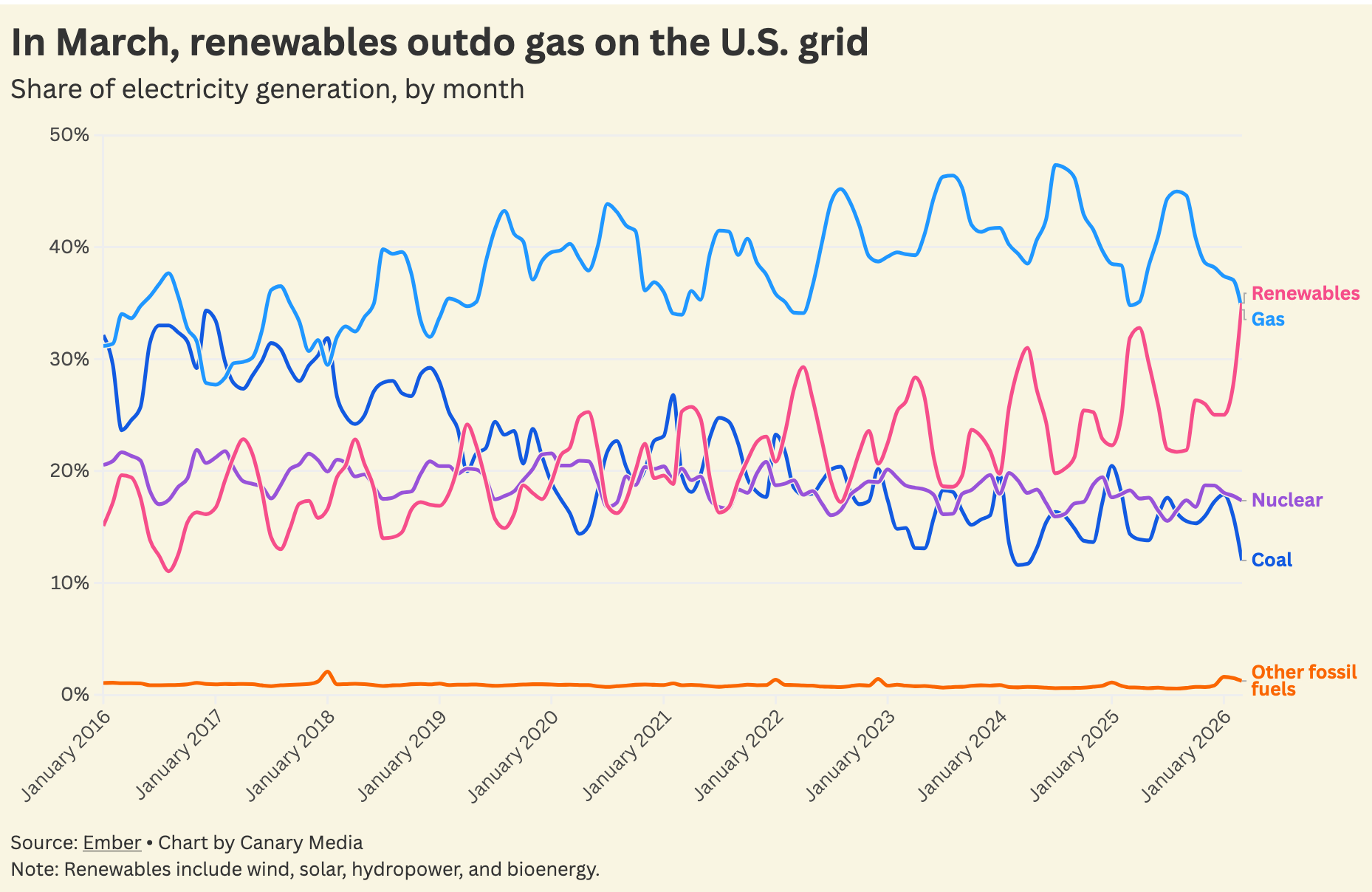
🚏☀️ Renewables beat natural gas on the American grid for the first time last month
For the first month in history, the US grid generated more power from renewable sources than natural gas, the longtime leader. If you include nuclear (which has been treading water for the past decade), these carbon-free power sources accounted for over half the nation’s electricity. The “shoulder season” of March tends to be good for renewables, since electricity demand has fallen from winter highs and solar and wind perform well with the blend of winter’s windy days and spring’s stronger sunshine. So while this summer may not see renewables maintain their pole position, the overall trend has been in the right direction for the past decade-plus.
🚏🐕 Robot dogs worth up to $300,000 are guarding data centers
In a story that seems straight out of our recurring ‘postcard from the future’ section, robotics firm Boston Dynamics reported a “huge, huge uptick in interest” from large data centers for their four-legged security robot, which can autonomously patrol a region and alert authorities if they notice security risks. The dog-like bot, named Spot, sells for $175,000 to $300,000 a pop. Besides security, it can reportedly also help with monitoring construction sites or factory floors for potential safety hazards.

🚏🌊 The ocean current that powers the Gulf Stream is >50% likely to collapse, say scientists
In a new paper, climatologists warn that the Atlantic Meridional Overturning Circulation (AMOC), an ocean current that circulates warm water from the tropics to the North Atlantic and cold water back down, has a “more than 50% chance” of collapsing, up from their previous predictions of just 5%. In fact, the AMOC is already the weakest it’s been in 1600 years. As usual, the culprit is climate change: global warming and Greenland meltwater is making the North Atlantic warmer and less salty, which weakens the north–south oceanic gradient that powers this ‘conveyor belt’ of water. If the AMOC keeps slowing, it’ll reach a tipping point and trigger a feedback loop that leads to total collapse, which in turn could weaken the famous Gulf Stream and make Europe significantly colder, dry out the mid-latitudes, strengthen hurricanes, drive sea level rise on North America’s eastern seaboard, and more.
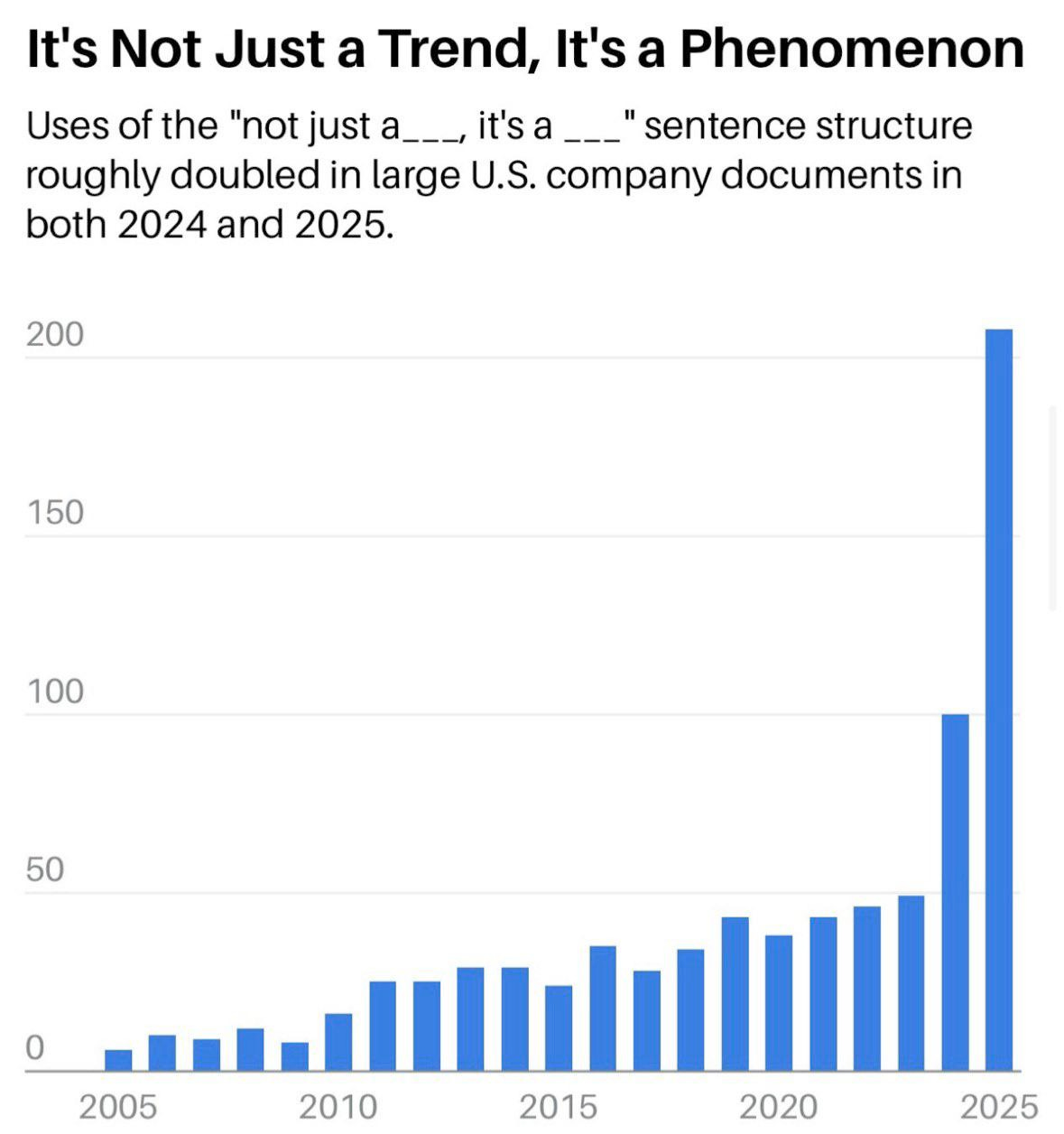
🚏📃 The infamous “it’s not just X, it’s Y” pattern is exploding in company docs
A new analysis of documents published by large American corporations found a recent surge in the “it’s not just X, it’s Y” pattern, a dead giveaway of AI writing. The use of the ChatGPT-ism more than quadrupled between 2023 and 2025, though it had been growing slowly since 2005. Linguists don’t appear to have an academic name for the pattern, though it blends antithesis with parallel structure.
📖⏳ Worth your time
Some especially insightful pieces we’ve read, watched, and listened to recently.
File Over App (Steph Ango) — Develops a philosophy for creating digital artifacts that will last: “if you want your writing to still be readable on a computer from the 2060s or 2160s, it’s important that your notes can be read on a computer from the 1960s.” Apps are ephemeral and use proprietary formats, but humble plain-text files should hopefully long outlast whatever specific app was used to create them.
PPE Lecture: The Interpretation of Signals (University of Michigan) — The Santa Fe Institute’s Rajiv Sethi lectures on how we send and perceive signals, contrasting forced signals (those we can’t help but send, such as our physical appearance) from defensive signals (those we intentionally send to soften or alter the forced signals). Prices are another good example of signals, serving as very “compact forms” of communication by summarizing supply and demand without requiring market participants to know the underlying causes.
Climate Explorations: Planet Size (Worldbuilding Pasta) — Applies concepts from climatology, oceanography, and atmospheric science to simulate the climate on hypothetical smaller or larger versions of Earth. Climate is too complex a system to simply predict from first principles, so the author does a good job of using computer modeling to uncover unusual or emergent behavior while also identifying general patterns to help build our intuition. Part of a great series where he also explores the impact of planetary tilt, eccentricity, temperature, day length, and more.
How Bad Linguistics Sends People to Jail (Language Jones) — A sociolinguist explores how the unique phonetics, syntax, and lexicon of African American English are often misinterpreted (accidentally or intentionally) by police and judges. He also shares some interesting observations from his time as an expert witness on criminal slang and communication in legal trials.
🔮📬 Postcard from the future
A ‘what if’ piece of speculative fiction about a possible future that could result from the systemic forces changing our world.
// September 2028
// The video resumes. A man in his 40s stares back, tears on his cheeks.
“Doc, I’ve always been a hard worker. Learned to weld in high school. Worked at the local plant for a decade before they offshored it, and half the town went down with it.”
“So I went back to community college, what was left of it, and slogged through classes on typing, networking, programming. Snagged one of the jobs outsourced from California. Some benefit to the Rust Belt, right? Got promoted. Twice.”
“Then they laid off the entire site. Replaced us with some AI-thing. Turns out we’d been training it to outsource ourselves. Right-to-work state, so we got a mass email and our access shut off. And now this…” He points at the screen. “A freakin’ AI video bot to help us with ‘our next stage.’ Bet it’s training on me right now, buried in a hundred pages of Terms and Conditions.”
He stares hard into the webcam.
“I work hard. I want to work. But I’m just so angry.”
The image freezes. An executive gestures at the man’s face on the boardroom monitor.
“Our AI guidance counselors give us insights on over 200,000 recently laid-off people. One signal has spiked: rage. Over 30% of them, deep and persistent, at AI. Doesn’t matter the race, gender, income, region, all the same emotion.”
“Fifty million Americans laid off in the past two years. Fifteen million of them furious at AI. That’s over 4% of the country.”
“It’s going to explode on us unless we do something.
Chat, are we cooked?”
© 2026 The FLUX Collective. All rights reserved. Questions? Contact flux-collective@googlegroups.com.