

Episode 228 — March 26th, 2026 — Available at read.fluxcollective.org/p/228
Contributors to this issue: Erika Rice Scherpelz, Neel Mehta, Boris Smus, MK
Additional insights from: Ade Oshineye, Ben Mathes, Dart Lindsley, Jasen Robillard, Jon Lebensold, Justin Quimby, Lisie Lillianfeld, Robinson Eaton, Spencer Pitman, Stefano Mazzocchi, Wesley Beary, and the rest of the FLUX Collective
We’re a ragtag band of systems thinkers who have been dedicating our early mornings to finding new lenses to help you make sense of the complex world we live in. This newsletter is a collection of patterns we’ve noticed in recent weeks.
“Baseball is almost the only orderly thing in a very unorderly world. If you get three strikes, even the best lawyer in the world can’t get you off.”
— Bill Veeck
🗝️🌫️ The model dissolves the mystery
To compute horsepower from force (pounds) and velocity (feet per second), you use HP = F × v / 550. The 550 in that equation is a puzzling, seemingly arbitrary toll booth in the middle of an otherwise sensible calculation.
Switch to a coherent set of units and the constant disappears. If you take power (watts), force (Newtons), and velocity (meters per second), you end up with P = F × v. No scaling factor or mysterious magical number. It’s the same physical reality expressed in mutually compatible units. The 550 in the former equation wasn’t some esoteric detail in physics; it was simply a translation tax.
This idea of having the right model simplifying perception also appears outside of physics. When a team seems to accomplish nothing quarter after quarter, the easy interpretation is that they are low performers. But if you learn their strategic priorities were reassigned every couple of months, the picture shifts. What looked like inertia from within was actually disorientation from above.
This isn’t an argument that every behavior has a benign explanation. Someone who wanders between conversations at a party might be genuinely curious — or might be quietly looking for a victim. The same observable surface admits multiple underlying models. Knowing that a frame exists doesn’t tell you which frame is operating.
And sometimes the right frame doesn’t simplify. The formula to convert Fahrenheit to Celsius — F = 9/5 × C + 32 — has two awkward constants because the scales were never designed to agree. No model makes this equation elegant.
The takeaway isn’t that all complexity has elegance hidden beneath. It isn’t that there’s always a benign explanation waiting to be found. It’s that the frame you’re using shapes what looks inevitable and what looks arbitrary.
So before deciding that something is random, irrational, or broken, it may be worth asking: is there a model that would make this outcome obvious?
🛣️🚩 Signposts
Clues that point to where our changing world might lead us.
🚏📈 Traders made $2 billion in stock market & oil bets right before an Iran war announcement
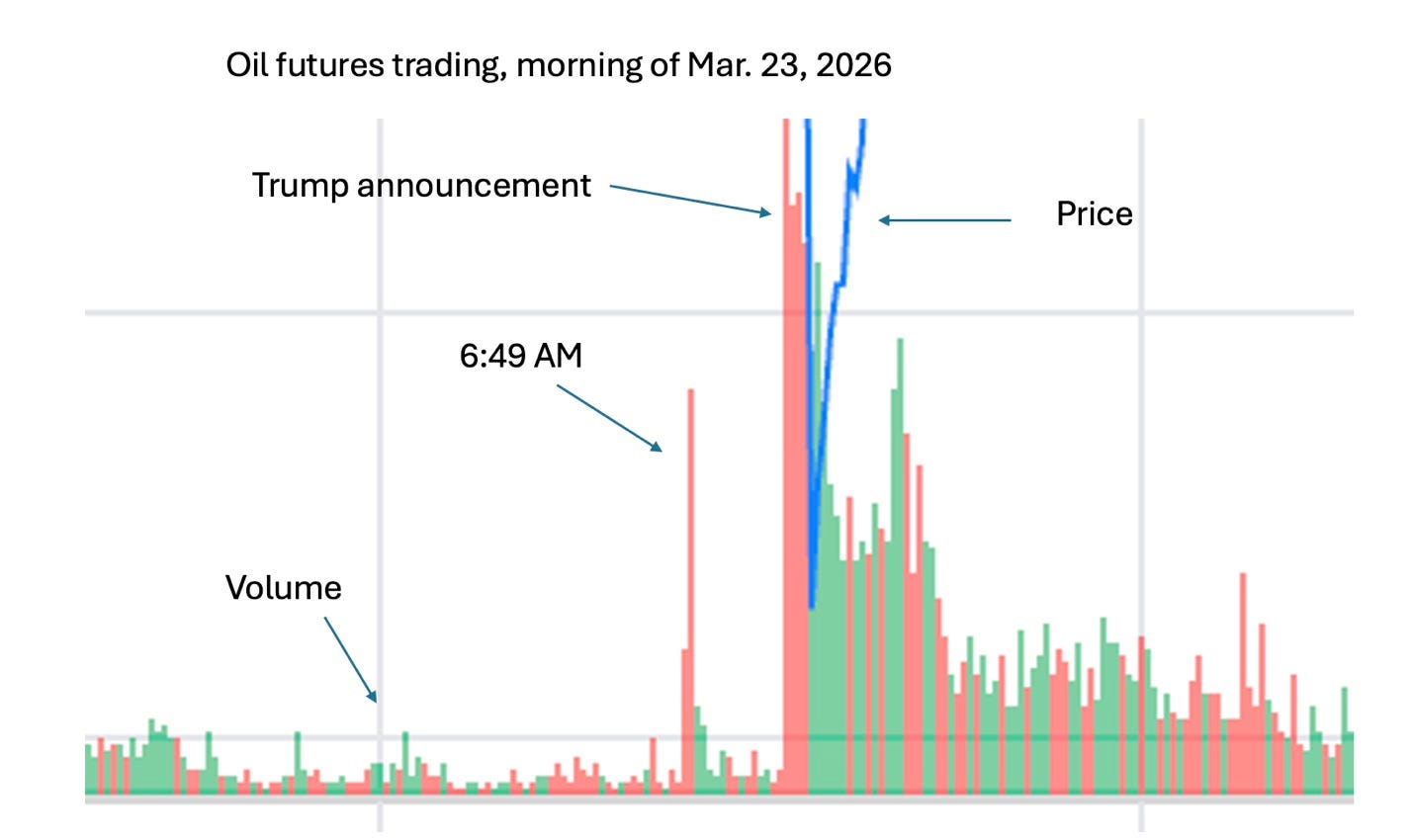
US Senator Chris Murphy observed that $1.5 billion in S&P stock market futures were sold just five minutes before the US President announced he was looking to de-escalate the war, which led to a massive jump in stock market prices. Similarly, oil market futures saw $580 million in volume—a massive spike from the usually sleepy market at that time of day—just 15 minutes before Trump’s announcement. There was no public news in advance of the announcement, which led observers to conclude that someone knew about Trump’s upcoming social media posts and was cashing in on the massive insider trading opportunity.
🚏👩💻 Demand for engineers, PMs, and even recruiters is rising, despite AI concerns
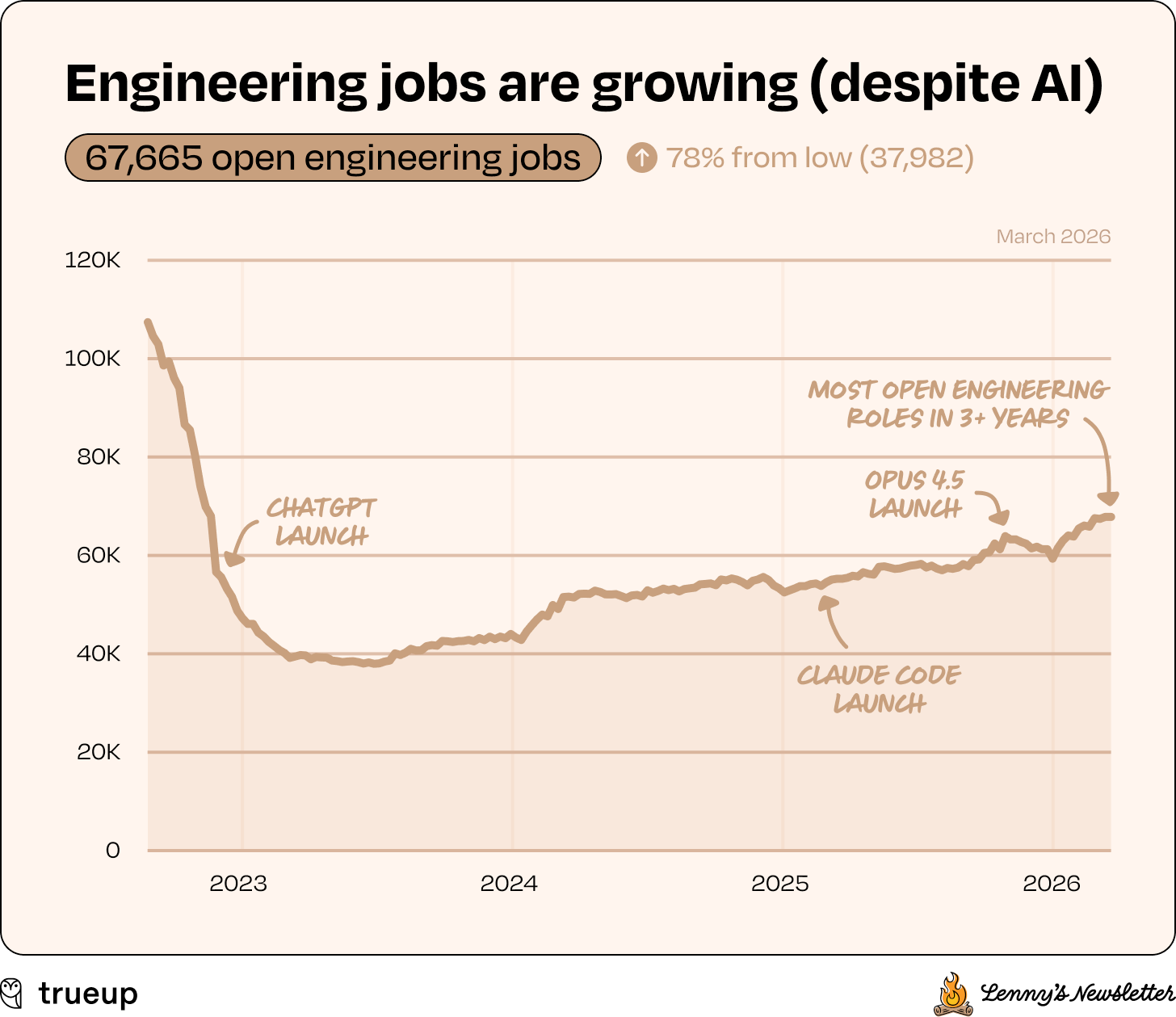
Many companies have cited AI when laying off large portions of their technical workforces, but overall, the fears of broad AI-driven job loss seem not to be panning out (at least, not yet). A new report found that the number of open engineering, product management, and recruiting jobs has been rising steadily since 2023, and most of the post-COVID drop in demand for these fields happened well before ChatGPT showed up. Interestingly, demand for designers has remained mostly stagnant.
🚏🛢️ Qatar Energy may declare force majeure on LNG contracts for up to five years
Iranian bombings have destroyed an estimated 17% of Qatar’s liquefied natural gas (LNG) export capacity, a $20 billion blow to the world’s second-largest LNG exporter. The country’s state-owned energy company announced that it “needs to declare force majeure” on some of its long-term LNG contracts with customers across Europe and Asia up to five years out, because this damage is expected to take three to five years to repair. (Force majeure is a contract clause that allows parties to escape obligations due to wars, natural disasters, and other exceptional ‘acts of God.’) It’s just the latest evidence that, even if the war were to stop today, getting back to normal would take a long time.
🚏🛂 The US is seeing its worst airport wait times in history as travel officers go unpaid
The USA is currently snarled in a partial government shutdown that’s left the country’s airport security agency, TSA, unfunded; the sticking point in Congress is funding for TSA’s parent department, DHS (of immigration infamy). The TSA has missed over $1 billion in payroll as agents have been working unpaid for weeks, leading many to face eviction or have their utilities shut off. The result is a wave of agents quitting or calling out sick—40% of agents in Houston aren’t showing up on an average day—that has led to the longest airport wait times in the TSA’s 24-year history. Images of four-hour waits across the country, with lines spilling out the door at 4:30 am, have gone viral on social media.

🚏🏃♂️ A French naval officer revealed his ship’s movement by tracking his exercise
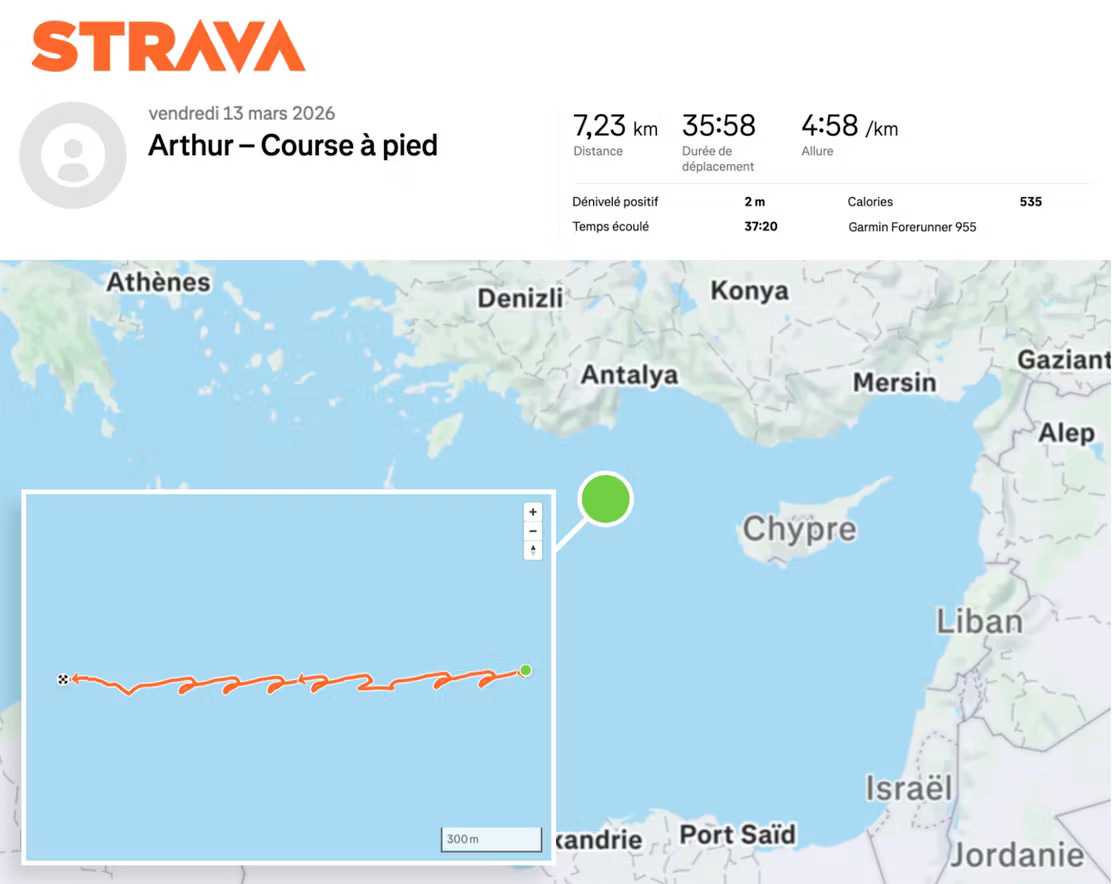
In the latest entry to a famous genre, a French naval officer aboard an aircraft carrier took a 7-kilometer run and logged his run on the Strava app. But because all Strava accounts are public by default, his route—with spirals revealing someone running in circles on a moving ship—was publicly viewable. This revealed the location and movement of the nuclear-powered aircraft carrier, which was moving across the Mediterranean, presumably to protect French interests in the Middle East amidst the war in Iran. It ultimately wasn’t that big a security breach in this case, because France had previously announced the deployment and the ship was visible on satellites, but it highlights how this Strava leaking pattern—which has been happening for almost a decade—remains a serious security threat.
📖⏳ Worth your time
Some especially insightful pieces we’ve read, watched, and listened to recently.
I Made a Network of Every Home Run in MLB History (adumb / YouTube) — Creates a beautiful network graph visualization to trace the history of America’s pastime. You can see distinct periods of baseball history through the shape of the network, such as the largely disconnected graph component representing the segregated Negro Leagues. The video also teaches concepts in graph theory such as degree centrality, edge betweenness centrality, and the shortest path problem.
Jevons Paradox for Knowledge Work (Aaron Levie) — Applies the idea that making something cheaper and more efficient leads to us using more of it, not less, to the ongoing AI revolution. Newfound efficiency will explode the volume of tasks rather than reduce labor, but will this far greater supply of previously unwritten software and unlaunched campaigns provide real value?
Why China Is Becoming the World’s First Electrostate (ABC Australia) — Traces the history of China’s renewable energy boom and its resulting economic boom: 10% of Chinese GDP is now driven by green energy. What’s more, China’s pivot to renewables has greatly increased its energy security, since it was previously heavily dependent on oil and gas imports. The report concludes that energy-focused economies like Australia and various petrostates could learn a lot about how to drive green transformations of their own.
Monte Verde Fieldwork Resets Age of Famous South American Archaeological Site (Phys.org) — Examines a potentially bombshell new study in Native American archaeology. The historically dominant Clovis theory posits that the first Americans came from Siberia via an ‘ice-free corridor’ in Canada around 13,000 years ago, but findings at Monte Verde upended that theory by providing evidence of people in Chile well before that date, giving rise to alternate theories of people boating down the Pacific coast. But new analysis of Monte Verde data may pull the date far forward, weakening (but not destroying) the pre-Clovis theory—showing how small advancements in methods can lead to large swings in our understanding of history.
🔍📆 Lens of the week
Introducing new ways to see the world and new tools to add to your mental arsenal.
This week’s lens: accidental and essential complexity.
Three hours into a strategy meeting, the whiteboard is covered in arrows, boxes, exceptions, and footnotes-to-the-exceptions. Someone asks, “Does it have to be this hard?” One camp says, “Yes, we have seventeen product lines across four regulatory jurisdictions.” The other camp suspects much of the complexity exists because every team wants a piece of the pie. They’re likely both somewhat right.
In his 1986 paper, “No Silver Bullet”, Fred Brooks gave us the vocabulary of accidental and essential complexity.
Essential complexity is the irreducible difficulty baked into the problem itself. Scheduling a hospital’s operating rooms is genuinely hard. There are real constraints (rooms, staff, equipment), real tradeoffs (the emergency that bumps the scheduled procedure, the recovery bay that becomes the bottleneck), and real patients whose health is on the line. We can’t think our way to a simpler version without changing what we’re trying to do.
Accidental complexity is everything else. It is the five approval layers that grew up around a single bad decision. It is the three databases that do the same thing. It is the exception to the exception.
We can often reduce accidental complexity. But first, we have to identify it. This is hard because the two can feel identical from the inside. The trick is to get clear on the problem we actually want to solve: not the process we’ve inherited, but the underlying goal. Then, catalogue and ask: if this part of the system were to disappear, would we still be solving the same problem?
Even when we lack the power to remove accidental complexity, knowing what is what still matters. We can focus our problem-solving efforts on the real problem while we aim to isolate and minimize the impact of the accidental.
We become trapped when we treat accidental complexity as if it were essential. Naming it clearly is the first step out of the trap. So: what’s the underlying problem your organization is trying to solve? And what can you throw away?
© 2026 The FLUX Collective. All rights reserved. Questions? Contact flux-collective@googlegroups.com.