

“FCP-226” // Photo: MK with Midjourney
Episode 226 — March 12th, 2026 — Available at read.fluxcollective.org/p/226
Contributors to this issue: Neel Mehta, Boris Smus, MK, Ade Oshineye, Erika Rice Scherpelz, Ben Mathes
Additional insights from: Anthea Roberts, Dart Lindsley, Jasen Robillard, Justin Quimby, Lisie Lillianfeld, Robinson Eaton, Spencer Pitman, Stefano Mazzocchi, Wesley Beary, and the rest of the FLUX Collective
We’re a ragtag band of systems thinkers who have been dedicating our early mornings to finding new lenses to help you make sense of the complex world we live in. This newsletter is a collection of patterns we’ve noticed in recent weeks.
“It occurs to me that our survival may depend upon our talking to one another.”
— Dan Simmons, Hyperion
🎁 The gift of the real problem
As we progress through life, sometimes the map seems to match the territory. We make plans; they happen. We follow the prescribed steps; we get a good outcome. Progress compounds, and each win becomes a platform for the next. After a while, it might feel like it’s personal: we simply see more clearly, move more intelligently, operate at a higher level.
Other times, nothing responds. The same instincts that once paid off fall flat. A well-founded decision leads to problematic outcomes. The project that looked promising unravels in ways we didn’t see coming. Sometimes, it is bad luck. But often, it’s more interesting.
This resistance can mean that we’ve found a real, fundamental problem. Real problems don’t yield to cleverness or extra effort. They expose trade-offs we didn’t know existed. They force us to stop using strategies that have always worked… we’re exploring new terrain now.
When the map matches the territory for too long, it’s easy to start believing we are flawless navigators. Our progress starts to look like a direct readout of our own good judgment. Success feels self-generated. Others who aren’t getting traction start to look like they’re just making worse choices.
Real problems puncture that story. They drag the invisible dynamics into view: timing, privilege, tailwinds, accumulated trust, lucky entry points. Not to shame, but to reorient.
People who’ve never collided with a real problem often assume that anyone who’s struggling is simply underperforming. People who have encountered these problems know better. They stop flattening complexity into personal virtue or personal failure. They start asking about structure instead: compounding constraints, misaligned incentives, missing capabilities, delayed feedback. They trade some confidence for discernment.
Empathy grows—not as a moral stance, but as a tool for effectiveness. Once we’ve seen how much had to go right for our earlier success to stack, it gets harder to write off someone else’s struggle as a character flaw. We start to look for the shape of the problem they’re caught in.
This is also where coaching stops being cosmetic and becomes transformative. Not because a coach hands us better answers, but because they help us see the real contour of the problem. They reflect the gaps between how we think we’re operating and how we actually are.
The gift of the real problem isn’t the rewards for solving it. It is what it reveals. It shows us how we show up when the map no longer matches the territory.
🛣️🚩 Signposts
Clues that point to where our changing world might lead us.
🚏⛽ Asia is already suffering from gas lines, industrial shutdowns, and restaurant menu cuts
As the war in Iran and the associated blockage of the Strait of Hormuz continue, Asia—which buys 90% of the oil and 85% of the liquefied natural gas passing through the Hormuz—is already feeling the strain. Huge lines are forming at gasoline and diesel stations in Thailand, Pakistan, Bangladesh, and beyond. Textile manufacturers in Pakistan and fertilizer producers in India are warning that production could shut down; the latter could lead to a spike in food prices in a region where customers are already facing price rises for cooking gas (and restaurants are shrinking menus or even shutting down entirely). And as summer approaches in South and Southeast Asia, experts worry there may not be enough gas to supply the electrical grid with the extra power it needs to cool homes and businesses.
🚏🇵🇭 The Philippines is shifting gov’t agencies to a four-day work week to save fuel
The Philippines is considered highly vulnerable to rising fuel prices, so it’s perhaps no surprise that the country’s president ordered most government agencies to work in the office only four days a week, with Fridays off. Agencies will also need to cancel non-essential travel and use video calls as the “default mode” for inter-agency meetings; even minor tweaks like riding the elevator less and turning up the thermostat. The government’s announcement also urged local governments, state universities, and the private sector to adopt these measures to reduce energy use.
🚏🚢 Saudi Arabia is shifting millions of barrels of oil to the Red Sea to avoid the Hormuz blockade
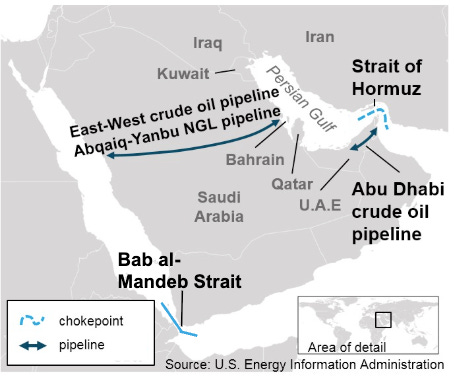
While most of the oil-producing Gulf states have only one way to reach the world ocean (that being the Persian Gulf and Strait of Hormuz), Saudi Arabia has a few ports on the Red Sea, and it’s built pipelines from its oil-producing eastern regions to its Red Sea ports in the west—likely to protect against the current scenario of the Hormuz being blockaded. Oil loadings on Saudi Arabia’s major western port, Yanbu, have skyrocketed to several million barrels per day, enough to offset a good chunk (but not nearly all!) of the oil exports being lost from the Hormuz chokepoint. However, the Red Sea is still a tough place to export from, with the Suez Canal chokepoint in the north and Iranian-backed Houthi rebels in Yemen still threatening to shut down the Bab al-Mandeb strait in the south. (Plus, oil pipelines across the desert are single points of failure that bombers can attack.)
🚏🛒 Amazon won a court order to stop an AI shopping agent from accessing its site
“Agentic commerce”—LLMs shopping on your behalf—is a hot new trend in the AI space, and a lucrative one considering how many dollars change hands online. But while Amazon is the obvious platform for AI agents to shop on, it’s been cracking down: after blocking ChatGPT’s bots last year, Amazon recently got a judge to block AI startup Perplexity from scraping and shopping on Amazon. Besides the oft-cited risks to customer data, Amazon argued that AI bots messed up Amazon’s advertising business, because they have to identify and disregard bot traffic when deciding how much to charge advertisers for impressions. (While Amazon has blocked many third-party AI bots, they have a first-party shopping bot named Rufus.)
📖⏳ Worth your time
Some especially insightful pieces we’ve read, watched, and listened to recently.
Tacit Knowledge and the SaaSpocalypse (Publication) — Observes that, even though software-as-a-service may be getting disrupted by general-purpose AI tools, demand for “forward-deployed engineers” is skyrocketing. These engineers who sit in customer offices can gather the unspoken, unwritten context about how the organization operates and what it needs in software products; this unrecorded information is, by definition, not legible to AI. “When AI handles the commodity work, tacit-knowledge-intensive problems go from being 20 percent of someone’s day to being 80 percent of it.”
Bombing Because You Can: Iran (Secretary of Defense Rock) — Applies lessons from Robert Pape’s seminal book Bombing to Win to the US’s war on Iran: America’s stated objectives (which change rapidly but currently appear to include regime change and nuclear non-proliferation) cannot be achieved by simply bombing things. For instance, preventing nuclear acquisition is about managing supply chains and timelines, and regime change “is an open-ended social political process that depends on the behavior of millions of people.” So while the American military is indeed highly adept at destroying targets, it’s a category error to believe that “technological superiority… can solve problems that are fundamentally political in nature.”
Context Widows (Kevin Baker / Artificial Bureaucracy) — Argues that when science became too large to read, citation metrics offered legibility—but flattened all citations into “votes,” making publish-or-perish inevitable. LLMs arrive not as disruptors but accelerants, optimizing faster for a broken game. Consider AI-generated anatomy diagrams passing peer review because they look sufficiently scientific to count.
The Carrier Bag Theory of Fiction (Ursula K. Le Guin) — Referencing the Carrier Bag Theory of Evolution, in which Fisher suggests the primacy of the bag over the knife, Le Guin questions the idea that the proper shape of a narrative involves conflict. Instead, Le Guin argues that “reduction of narrative to conflict is absurd;” instead, the natural shape of a novel is one of a bag of words carrying meanings, far less prescriptive than the hero’s journey.
🔮📬 Postcard from the future
A ‘what if’ piece of speculative fiction about a possible future that could result from the systemic forces changing our world.
The 8:00 AM email is the only time the office goes silent. Screens flicker to life across forty desks in my local office, casting a pale, uniform glow on everyone’s faces. We don’t speak until we’ve read our “suggestions”.
The “What’s Next” (WN) arrives with its usual clinical chime. Each night, Teledynotech’s workforce optimization platform scans all of my work, compares it against my job description, and recommends what I should work on next. Usually, it’s a list of chores: Approve Jakarta logistics; review the server requisition. It’s the copilot brain of the company, and we’re the hands.
Today’s email contains one line that stands out: “File a Critical Incident Report on the Sentinel core logic.”
My pulse quickens. Sure, I did some preliminary work last Tuesday on Sentinel risks. I had found a logic leak while digging through some old directories, but I hadn’t logged it yet. I wanted time to see if I could patch it quietly. But WN scans every file I open. It knows I saw the risk.
But Sentinel is the CEO’s pride. We’ve spent three billion dollars telling the board it’s the future. Reporting it is the right thing to do—if that leak hits production, the whole network collapses. But the person who flags it will be the one they blame for the delay. And anyone with experience in large corporations knows that flagging potential risks can be risky. You don’t get much credit for preventing issues that only might have happened.
I look over the glass partition. Miller leans against his desk, staring right at me. He’s the Lead Architect for the WN engine. He doesn’t just maintain the machine; he adjusts the weights that tune what the algorithm considers “most important.” He knows I’m probably the only one who can verify that specific bug. Did he tilt my WN report today?
He’s a sharp, hard worker. He’s probably thinking his role as head of AI systems is a ticket up the corporate ladder… but only if Sentinel succeeds. Does he see me as potential competition? By nudging this task to the top of my list, is he forcing me to choose between lying to the system and risking setting my own career on fire to save the firm?
He tips his coffee mug toward me, a sharp, silent salute.
Probably just politeness, right?
… right?
© 2026 The FLUX Collective. All rights reserved. Questions? Contact flux-collective@googlegroups.com.