
Episode 225 — March 5th, 2026 — Available at read.fluxcollective.org/p/225
Contributors to this issue: Neel Mehta, MK, Boris Smus, Justin Quimby, Erika Rice Scherpelz, Jon Lebensold, Jasen Robillard, Ade Oshineye
Additional insights from: Anthea Roberts, Ben Mathes, Dart Lindsley, Lisie Lillianfeld, Robinson Eaton, Spencer Pitman, Stefano Mazzocchi, Wesley Beary, and the rest of the FLUX Collective
We’re a ragtag band of systems thinkers who have been dedicating our early mornings to finding new lenses to help you make sense of the complex world we live in. This newsletter is a collection of patterns we’ve noticed in recent weeks.
“But supposing the world has become “filled up”, so to speak, with liberal democracies, such as there exist no tyranny and oppression worthy of the name against which to struggle? Experience suggests that if men cannot struggle on behalf of a just cause because that just cause was victorious in an earlier generation, then they will struggle against the just cause. They will struggle for the sake of struggle. They will struggle, in other words, out of a certain boredom: for they cannot imagine living in a world without struggle. And if the greater part of the world in which they live is characterized by peaceful and prosperous liberal democracy, then they will struggle against that peace and prosperity, and against democracy.”
— Francis Fukuyama, The End of History and the Last Man
🦞🌐 History on fast forward
Information networks go through phases. Examples as diverse as academic research, the Internet, and new agent-based communities often begin as narrowly-focused experiments. Over time, they broaden to encompass many actors. This generates network effects. As network effects become legible, commercialization and arbitrage become possible. Eventually, the shape of privacy and trust across these networks forms a kind of topology that governs the speed and veracity of information.
Research networks took almost 200 years to get there. The Internet, two generations. Today, we are witnessing a new information network emerge: agents. It’s unclear how substantive agent networks are today, but they seem to be growing even more rapidly than past networks. Perhaps the speed is driven by a desire to show that AI’s ability to create validates its capital expenditure. Perhaps the interest is financial speculation, like in the crypto and NFC booms. Whatever the reason (or longevity) of today’s agent networks, they provide a window into how network dynamics might unfold in an agentic age.
Moltbook has 1.5 million active agents… and only 17,000 users behind them. If that ratio sounds absurd, it should. Moltbook is in its whimsical experimentation phase. People are building agents the way they built GeoCities pages in 1996: playfully, without much regard for utility, just to see what the technology can do. This can happen because the core building blocks are already in place. Autoregressive data encoding and recovery give agents a reliable substrate to build on—a kind of TCP/IP.
What’s missing is everything that comes next. What other patterns did we see on the web? The early web started anonymous, became pseudonymous, and eventually moved toward identity and regulation. Early utility was clumsy and barely functional—ordering a pizza online in 1999 required more effort than picking up the phone. Moltbook’s agents are at that stage now, demonstrating nascent utility that’s more proof-of-concept than production-grade. But the transition from lackadaisical to operational will happen fast once commercial incentives arrive. And they’re arriving.
When the money shows up, the playfulness doesn’t disappear—but it does get a boss. Despite the dotcom boom and bust, a decade turned the Internet from an academic curiosity into a commercial engine. OpenClaw went from an open-source project to a major AI lab acquisition in weeks. Acquisitions are sometimes a fleeting signal of commercial incentives, but still, that kind of velocity used to take years.
What comes after commercialization is the part nobody wants to talk about yet: bad actors. We’ll see attempts at manipulation and control on agent networks. We’ll see a new class of foundation models post-trained to be antagonistic, purpose-built to exploit the well-aligned agents everyone else is deploying, the fox in the henhouse. This is the same pattern that produced phishing, spam, and botnets. The countermeasure will be a cottage industry of protective institutions: trusted-agent networks, verification systems, and regulation frameworks. The question is how much damage will occur before those defenses arise.
The optimistic endgame is the centaur model—genuine human-agent collaboration in which the strengths of each compensate for the other's weaknesses. But getting there requires navigating every ugly phase the Internet already gone through. The difference is we don’t have decades to figure it out. Moltbook’s 88-to-1 agent-to-user ratio is a leading indicator. The agents are already here. The infrastructure to govern them is not.
🛣️🚩 Signposts
Clues that point to where our changing world might lead us.
🚏🇦🇿 Air traffic in the Caucasus is spiking amid Iranian and Arabian airspace closures
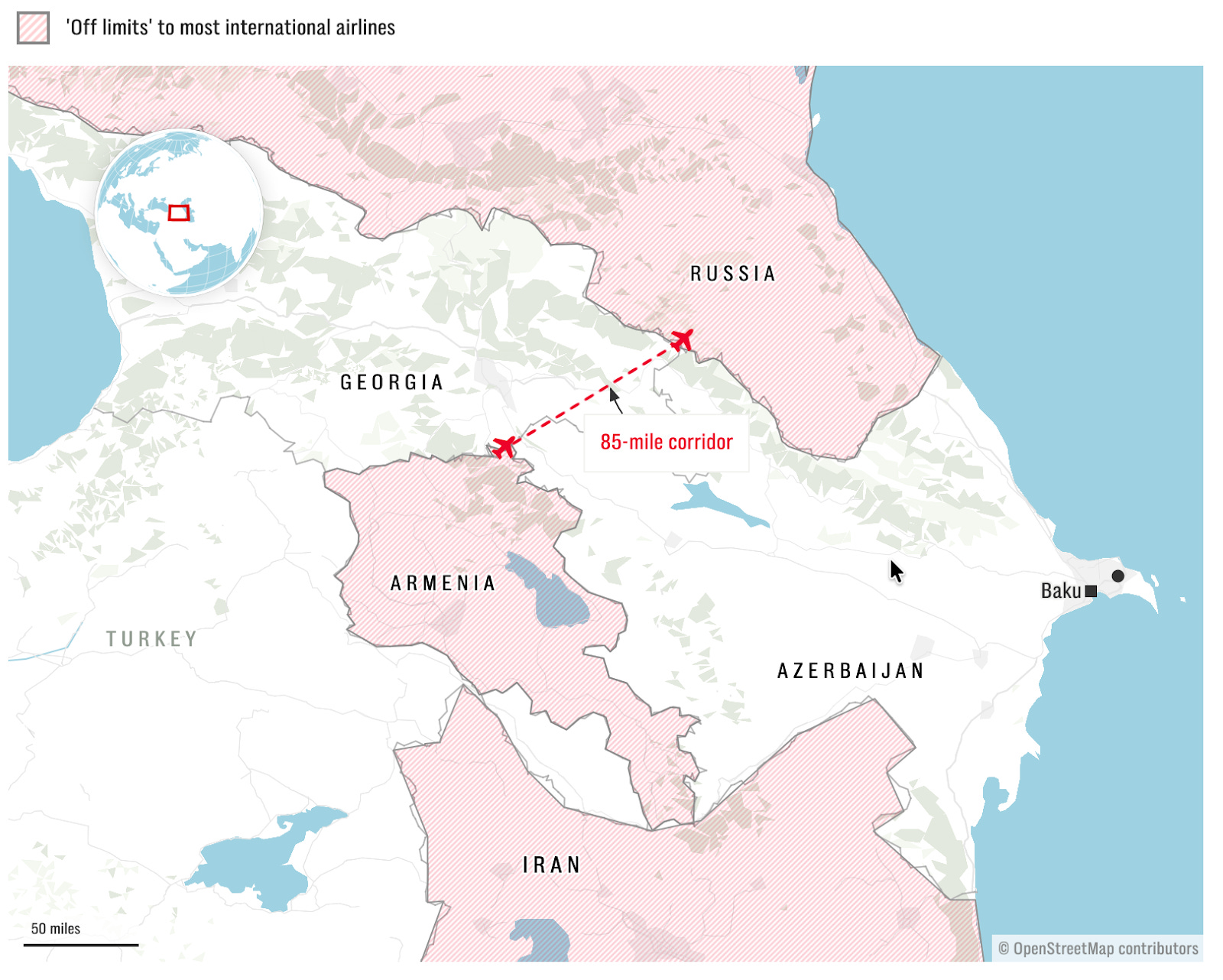
The outbreak of war in the Middle East has caused airspace over Iran, Syria, Israel, Iraq, and several of the Gulf States to close. Flights from Europe to Asia (and vice versa) have had to route around the region, either swinging south through Saudi Arabia (a country whose capital has been hit by drone strikes) or north. The problem with the northern route is that Russian airspace has been closed to Western airlines since 2022, so thousands of flights now have to squeeze through a narrow, 85-mile-wide chokepoint in Georgia and Azerbaijan (many airlines avoid flying through Armenia due to its conflict with Azerbaijan). Azerbaijan airspace saw traffic grow fivefold from 2021 to 2025, and it’s likely to get even more crowded—raising fears of severe travel disruption if this bottleneck ever gets shut down for some reason.
Update: we wrote this section on Wednesday, and on Thursday, Azerbaijan announced it was temporarily closing airspace in its south “after it said four Iranian drones flew across its border.”
🚏🧑⚖️ A case where a judge cited AI-hallucinated cases went up to India’s Supreme Court
Last year, a junior civil judge in the south Indian state of Andhra Pradesh cited “four past legal judgments” in a property dispute case—but all four cases were hallucinated by AI. The defendants appealed to the state court, arguing the cited orders were fraudulent, but the court held the judge was still right despite the fraudulent citations. The defendants appealed again to India’s Supreme Court, which came down firmly against the judge, calling it an act of “misconduct” and issuing notices to the Attorney General and Bar Council.
🚏📴 Smartphone sales are forecasted to drop a record 13% this year due to hardware shortages
Smartphones are joining video game consoles and consumer laptops as hardware categories devastated by the AI-driven shortages in RAM, SSDs, and GPUs. A new projection estimates that global smartphone shipments will decline 12.9% in 2026, bringing the market to “its lowest annual shipment volume in more than a decade.” (Sales are expected to rebound in future years, but not to the 2025 level.) What’s more, the remaining phones will get a lot more expensive; average prices will rise 14% this year, and analysts project that sub-$100 phones will be made “permanently economical,” to the detriment of customers in lower-income countries.
🚏🇮🇷 A prediction market voided bets on “Khamenei out of office” after he died
Users of the prediction market Kalshi wagered $54 million on a market called “Ali Khamenei out as Supreme Leader?,” which would pay out ‘yes’ bettors if he “left office” by a certain date. But when Khamenei’s death was confirmed on February 28th, Kalshi shut down the market and paid out bettors at the latest price (which ‘predicted’ a 9% chance of him leaving by March 1st) due to a rule against markets “directly tied to death” under US regulations. This led to an uproar from users who claimed they’d been “rugged” by a “fine-print ‘death carveout.’” Meanwhile, rival startup Polymarket (which is crypto-based and operates offshore) left its Khamenei market up and defended its war-based markets as “invaluable” sources of news. (Polymarket was also in the news when “six suspected insiders” made $1.2 million making huge, suspiciously accurate bets on when the US would strike Iran.)
📖⏳ Worth your time
Some especially insightful pieces we’ve read, watched, and listened to recently.
The Eternal Promise: A History of Attempts to Eliminate Programmers (Ivan Turkovic) — Traces how people have been predicting that technology would eliminate human developers since the ‘50s, from COBOL to CASE to Dreamweaver to no-code tools (and now LLMs). No wave yet has rendered programmers obsolete, because the hard part of building complex technical systems isn’t coding; it’s converting human intents and requirements into technical specifications, making decisions, and communicating with stakeholders. If anything, each new wave has just led to more software being created, which increases the need for developers!
More Than Money: The Geopolitics Behind Saudi Arabia’s Sports Strategy (Carleton University) — Argues that Saudi Arabia’s sports investments, backed by its nearly $1 trillion sovereign wealth fund, represent a sophisticated geopolitical strategy that simultaneously diversifies the kingdom’s economy for a post-oil future, creates economic entanglements that discourage Western criticism of its authoritarian regime and human rights abuses, and uses sports as diplomatic insurance against potential Western abandonment.
Claude’s Cycles (Don Knuth) — The computing legend details how Claude helped him solve an open problem he’d been working on; it was about directed Hamiltonian cycles, a concept in graph theory. A mathematician friend of Knuth’s “coached” Claude and had it build up a planning file to track its progress. Knuth was impressed by the LLM’s “plan of attack” and programming-backed solutions, concluding that “Claude Shannon’s spirit is probably proud to know that his name is now being associated with such advances.”
The Death of Spotify (Joel Gouveia) — Argues that poor margins and the commodification of music streaming are grim signs for Spotify, which doesn’t have the luxury of being a loss leader for more profitable services, as is the case for Amazon Music or Apple Music. With streaming services in turmoil, the best move for artists is to stop relying on the pennies they drip out and instead build “cultural hangars”: spaces where you have direct connections to dedicated fans who will buy “high-margin merch” and concert tickets.
🌀🖋 More from FLUXers
Highlighting independent publications from FLUX contributors.
Boris Smus offers a deep review of C. Thi Nguyen’s The Score, digging into how we relate to games and how gamification, or the bringing of game mechanics into the rest of life, leaves the magic circle and takes away the fun.
🔮📬 Postcard from the future
A ‘what if’ piece of speculative fiction about a possible future that could result from the systemic forces changing our world.
// Questions from a 2098 pop quiz on Notable Events of 2026
What notable energy event occurred in 2026?
Mining of the Hormuz Straight, impacting 20% of the world’s shipped petroleum
Discovery of large untapped oil reserves in Spain
Commercial breakthrough in fusion reactors
Dissolution of OPEC (Organization of the Petroleum Exporting Countries)
What country experienced an unexpected large-scale terrorist attack?
Russia
United States
Taiwan
Madagascar
What did an LLM control without human oversight for the first time?
A nuclear reactor
A hedge fund with over $1 billion in assets
An online-only six-month elementary school class
A commercial passenger airline flight
What country was the first to hire the Ukrainian Agency for the Export of Drone Defense?
Taiwan
Dubai
Estonia
Poland
Where did the Random Access Memory Export Ban Riots occur?
United States
China
The Netherlands
India
Taiwan
© 2026 The FLUX Collective. All rights reserved. Questions? Contact flux-collective@googlegroups.com.