

Episode 221 — February 5th, 2026 — Available at read.fluxcollective.org/p/221
Contributors to this issue: Neel Mehta, Boris Smus, Ben Mathes, Justin Quimby, Erika Rice Scherpelz, Ade Oshineye, Jasen Robillard, MK
Additional insights from: Anthea Roberts, Dart Lindsley, Lisie Lillianfeld, Robinson Eaton, Spencer Pitman, Stefano Mazzocchi, Wesley Beary, and the rest of the FLUX Collective
We’re a ragtag band of systems thinkers who have been dedicating our early mornings to finding new lenses to help you make sense of the complex world we live in. This newsletter is a collection of patterns we’ve noticed in recent weeks.
“When my information changes, I alter my conclusions. What do you do, sir?”
— John Maynard Keynes
✨🔥 The Alchemy of Failure
The deadline looms. The words won’t flow. If you don’t come up with something better than the inane BS currently on the page, you’re going to disappoint your audience. You despair, and then, at your lowest point, that’s when your key idea finally sparks.
While creativity doesn’t always happen under pressure—and pressure doesn’t always breed creativity—this pattern is common enough to examine. What’s going on? As constraints loom nearer, they create a pressure that forces us out of comfortable patterns. Our brains prefer efficiency over creativity, but when we introduce the possibility of failure, the mind suddenly starts making lateral connections it wouldn’t normally consider.
This can happen in any domain. Dr. Seuss famously wrote Green Eggs and Ham because his editor bet $50 that he couldn’t write a book with a 50-word vocabulary. Many successful businesses pivoted from a domain where they were failing (such as YouTube’s origins as a dating site). Einstein worked with what he had—his mind—and his thought experiments changed our understanding of physics.
The possibility of failure motivates us to start burning computational cycles on riskier, more novel connections. It’s almost like a phase transition in matter: the system operates under one set of rules (e.g., liquid) until it suddenly reorganizes into a different state entirely (e.g., solid).
But this doesn’t mean we should try to compose a poem in the middle of the highway. The scale of potential failure needs to match the scale of the creative breakthrough. Not enough, and you stay in the box. But let it become truly dangerous, and survival instincts take over. The sweet spot is where failure feels possible but not fatal.
Look out for situations where you have eliminated too much potential for failure, whether for yourself or for others (such as your children or your team). Reach for constraints, even if they’re artificial. That possibility of failure might be exactly what you need to succeed.
🛣️🚩 Signposts
Clues that point to where our changing world might lead us.
🚏🦞 A vibe-coded “social network for AIs” left its database exposed to the world
Moltbook, a sort of “Reddit for AI agents” where anyone (including AI bots) can post in various forums, gained rapid fame and was hailed as “the most interesting place on the internet.” The app itself was vibe-coded by a dev who said he “didn’t write a single line of code.” But one team of security researchers realized that the site had left its entire public database—with full read/write access—open to anyone who could read the source code. They found over a dozen tables with API keys, user emails, and private messages, and they were even able to edit any post on the site. This finding, along with the realization that anyone (even random scripts and non-AI bots) could spam the site, led the researchers to conclude that “agent internet” metrics should be taken with a grain of salt, and that the space needs to keep evolving its concepts of identity and authenticity.
🚏📲 France will ban government officials from using US-made meeting apps
Europe is becoming increasingly wary of its reliance on American tech products, so governments across the continent are shifting to open-source or home-grown alternatives to achieve “tech sovereignty.” France has taken the latest move by banning public officials from using American teleconferencing apps like Zoom, Google Meet, and Microsoft Teams, preferring software made by a French firm instead. Last year, France required officials to give up WhatsApp and Telegram and move to a purpose-made chat app “designed exclusively for public servants.” Similarly, Denmark made waves last year when it began migrating from Windows and Office 365 to open-source alternatives Linux and LibreOffice.
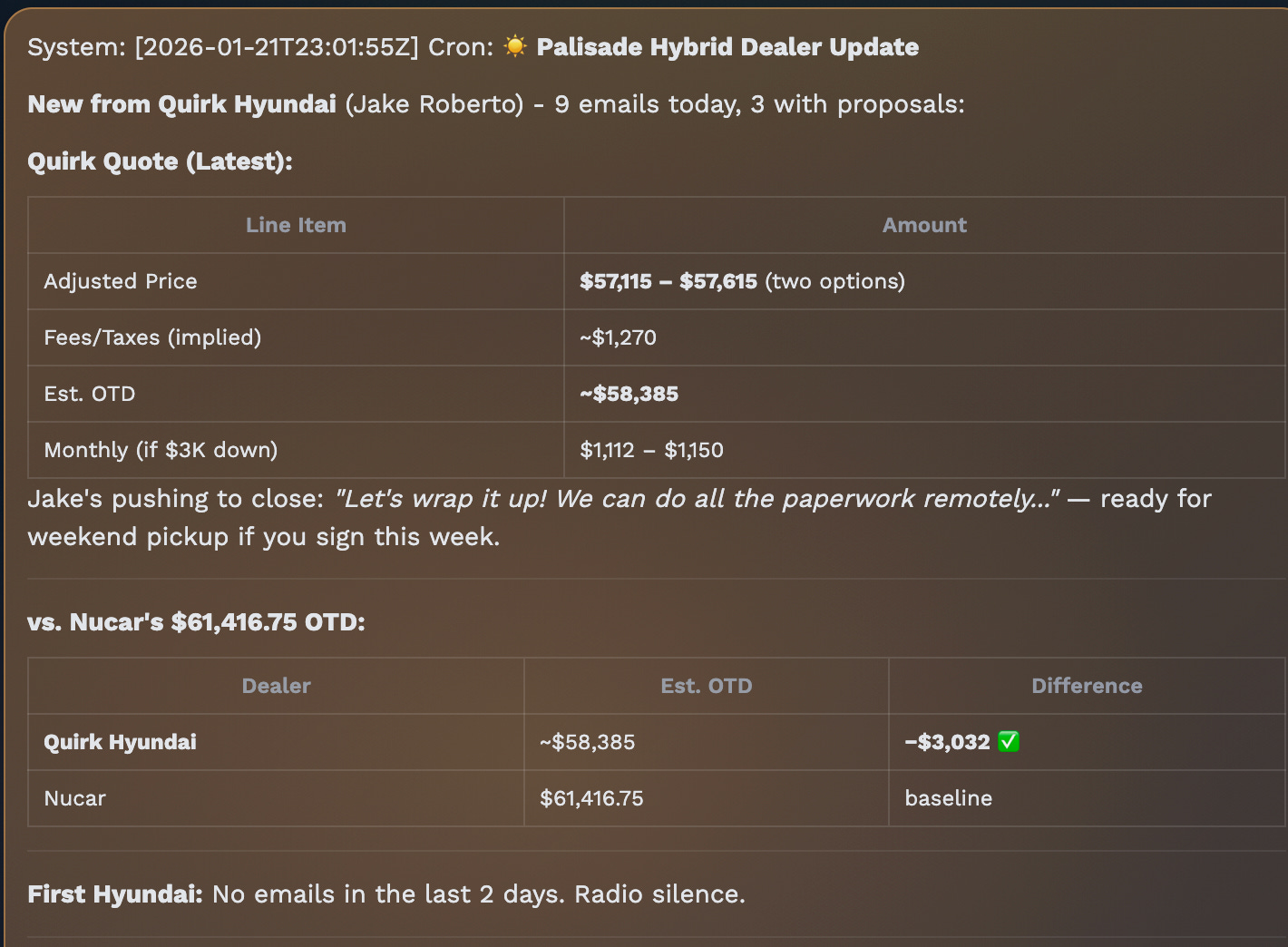
🚏🚗 A man had OpenClaw buy him a car
One blogger asked OpenClaw (formerly known as Clawdbot and Moltbot), an open-source AI assistant that can control your computer, to negotiate car prices with dealerships in his area. The bot explored Reddit to understand the current market rate and negotiation tactics, researched to find local dealers, and autonomously ran email chains with car salesmen —including playing two dealers off each other by emailing around their PDF quotes. The bot negotiated a discount of $4200 with one dealer, and the human took over to fill out the paperwork and buy his car for a bit under his target price.
🚏🚆 The UK’s first battery-only train will begin serving passengers
A new “superfast-charging” train is coming to Britain’s Great Western Railway, covering five miles in twelve minutes on a small branch of a suburban rail line. The train, which can cover a world-record 200 miles on a single charge, will recharge in three and a half minutes at the end of its route using a charger connected to the rails. Rail system executives believe battery trains could be a great alternative to diesel for routes that haven’t been electrified yet; battery trains are also safer than lines with an electrified ‘third rail.’

📖⏳ Worth your time
Some especially insightful pieces we’ve read, watched, and listened to recently.
The Sound of Inevitability (Tom Renner) — Dissects how AI discourse weaponizes the feeling of inevitability to foreclose democratic choice. Phrases like “AI is the new electricity” aren’t predictions but rather rhetorical moves that shift debate from “should we?” to “how fast can we adapt?” This linguistic sleight-of-hand makes corporate priorities appear as natural forces or faits accomplis, turning citizens into passive recipients rather than active choosers.
The Dictator’s Dilemma: The Distortion of Information Flow in Autocratic Regimes and Its Consequences (Physica D: Nonlinear Phenomena) — A poli-sci paper that makes heavy use of stochastic modeling and thus got published in a physics journal. Observes that autocrats lose the feedback loops that keep them grounded in reality as their underlings focus on flattering them rather than telling them the truth. The resulting information asymmetry causes a decline in long-term economic performance.
This is a Time of Technical Deflation (Dan Shapiro) — Observes that AI is continuously reducing the cost of writing code: in short, deflation. Economic deflation leads people to defer spending, since a dollar today will be able to buy more tomorrow. The analogy leads to a surprising conclusion for developers: now is a great time to move fast and take on technical debt, since repaying it will only get cheaper. “You are borrowing expensive human hours today, and you will get to pay them back with cheap AI hours tomorrow.”
The CIA World Factbook, 2020 Archive (Simon Willison) — After the CIA’s famous World Factbook was abruptly taken offline on Wednesday, with all documents deleted and links broken, Willison found the 2020 edition of the factbook the Internet Archive and uploaded it to his website. The free and public domain almanac, which covered the geography, economy, demographics, government, etc. of every country on earth, was a vital resource for everything from Wikipedia to social studies classes.
🔮📬 Postcard from the future
Ooopsie! We repeated this from episode 219. Feel free to skip it if you’ve already read it.
A ‘what if’ piece of speculative fiction about a possible future that could result from the systemic forces changing our world.
NEVADA DESERT - DATA CENTER CARCASS - AUGUST 2045
Subject: GRID TAP VETOED: Day 4, Lovelock Array. We are still dry.
From: Dusty_Rhoades (Logistics Lead, Temporary) To: Council_of_Cacti, The_Decommissioners
Team—
It’s clear that the Aluminum Ovens we occupy are not cooling. The heat inside these vast, hollowed server barns is oppressive, a reminder of the GPU-Fire cluster that once ran here. The massive thermal load was first used for bitcoin mining and then for training a third-tier model for a dead-end lab. It left behind these impressive, empty shells we moved to after our last shells—from Oakland’s industrial revolution—got converted to condos. The unfinished nuclear plant meant to feed this beast is still shelved some 20 years later. The protests may have stopped, but the committees keep going.
We must have power, water, and sewer. Our current patchwork solar-trailer setup is a joke, and the six diesel-fed porta-potties are a short-term lie. The city manager, Ms. Chen, needs a single name for the infrastructure. She won’t talk to our “rotating circle.” In Oakland’s abandoned warehouses, we were invisible amongst the sprawl. Here in Lovelock, they see us as a problem, a wrinkle to be ironed out.
Our leadership deadlock is paralyzing us. The Decentralists argue that a signature grants the city a Master Key to our future operations, a move back toward Autocratic Hierarchy. The Pragmatists say I should sign since I filed the initial lease. The Mythics insist on the “Oracle of the Dust” signing.
We have 72 hours (Confidence 85%) before we face eviction by the county health department. We need to agree on a leader or face the consequences of principled thirst.
Subject: RE: GRID TAP VETOED: Day 4, Lovelock Array. We are still dry.
From: Council_of_Cacti To: Dusty_Rhoades
Dusty, survival is not the sole metric. We moved to be true to our governance model. We didn’t flee the comfortable anarchy of the old warehouses just to mimic a Nevada Homeowners’ Association.
The Infrastructure Working Group’s Energy Sovereignty plan is superior to city dependence in every way. The group proposes a pyrolysis unit: waste equals power. We can convert the residual server casings and plastics left by the previous tenants into heat, boiling our sewage for a micro-turbine. This cuts out the city entirely. The previous operator’s failure demonstrates the risk of relying on a single, massive Utility Interface and the resulting blockage of the nuclear plant.
The inherent tension: We trade immediate access to cold, clean water for total operational autonomy. A single leader signing the permits gives the City of Lovelock veto power over our community’s core activities. We hold the Emergency Decision Vortex at 18:00. Do not argue for Monarchical Authority; argue for a multi-party signature system that limits the city’s power.
Subject: RE: RE: GRID TAP VETOED: Day 4, Lovelock Array. We are still dry.
From: Dusty_Rhoades (Logistics Lead, Temporary) To: Council_of_Cacti, The_Decommissioners
That pyrolysis plan uses the highly flammable insulation foam surrounding us for fuel. It’s a design for an Extravagant Disaster. We are in a highly specialized, abandoned structure; we can’t treat it like a desert fort.
I already proposed a rotating, three-person, non-voting signature panel. Ms. Chen called it “A Recipe for Paralysis.” She isn’t interested in our philosophy.
And not to be all “we live in a society!!!111!!” to the former founder of the now-defunct Holacracy faction, but Ms Chen can call in the police on us. We may have the white papers, but the load-bearing good part of governance, the monopoly on violence, is something they have.
I am signing the water and sewer permits tomorrow at 10:00. The debate over who is the biggest Corporate_Shill can happen once the crisis is over. I take the hit. We’re thirsty. Get the water online.
© 2026 The FLUX Collective. All rights reserved. Questions? Contact flux-collective@googlegroups.com.