

Episode 220 — January 29th, 2026 — Available at read.fluxcollective.org/p/220
Contributors to this issue: Neel Mehta, Boris Smus, MK, Erika Rice Scherpelz, Justin Quimby, Ben Mathes
Additional insights from: Ade Oshineye, Anthea Roberts, Dart Lindsley, Jasen Robillard, Lisie Lillianfeld, Robinson Eaton, Spencer Pitman, Stefano Mazzocchi, Wesley Beary, and the rest of the FLUX Collective
We’re a ragtag band of systems thinkers who have been dedicating our early mornings to finding new lenses to help you make sense of the complex world we live in. This newsletter is a collection of patterns we’ve noticed in recent weeks.
“One of the many major problems with governing people is that of whom you get to do it; or rather of who manages to get people to let them do it to them. To summarize: it is a well-known fact that those people who must want to rule people are, ipso facto, those least suited to do it.”
— Douglas Adams
💓🌍 A tale of two tragedies
After a fire destroys a home, neighbors organize meals, and local news follows the family’s story for weeks as they rebuild. That same month, drought-driven crop failures pushed 2.3 million East Africans toward famine, generating a two-paragraph wire story buried on page 18 of the business section.
The imbalance seems absurd. We’re quick to judge this as a moral failing, evidence of our parochial hearts. In some ways, it is, but there’s also something amazing here: that we feel driven to action in the first place.
When we encounter an individual story, something remarkable occurs in our cognitive architecture. The person enters our adjacent possible. You see someone hurt, and your mind immediately begins running simulations: “What happens next? How could I help?” A family displaced by fire generates concrete scenarios your mind can work with.
Anonymous statistics resist this model-building. “Millions at risk” provides no simulation parameters. Your cognitive system can’t run scenarios because there are no specific variables you can manipulate.
Although often presented as a moral failure, at the scale of everyday life, this tendency to react more strongly to the specific is a feature, not a bug. Imagine if your mind attempted detailed simulations for every tragedy it encountered. The cognitive load would be paralyzing. Instead, your caring system acts as a selective amplifier, dramatically increasing your engagement in situations where you can make a difference.
The challenge comes when we confuse what captures our attention with how important the problem is. It’s fine to have more emotional resonance for the family whose house was burnt down, but it becomes problematic when we think that family is more important than millions facing drought.
Our constant news consumption amplifies this problem. Every breaking story arrives with the same urgency, signaling once genuine opportunities to help: a school shooting in another state; a wildfire displacing families three time zones away. Your caring system activates and begins running simulations… but there’s no actual role for you to play.
Yet these reactions also have power. A specific tragedy can catalyze collective action. One family’s hunger can empower a community food bank. Successful change initiatives focus on winning over specific individuals rather than abstract groups. User stories can convey the “why” better than detailed feature specifications.
When this pattern works well, the individual case enables progress in a broader pattern.
But this mechanism creates vulnerabilities. The scam email from a “stranded traveler” who needs exactly $347 works because it provides simulation parameters. Political movements exploit this as well, using individual cases as weapons to steer voters.
It’s not that we should care equally about everyone. We benefit when we understand how our caring system works: it’s a pattern-matching, simulation-running mechanism evolved for small-group dynamics... now operating in a globally connected information environment. In this world, we can still look at individual stories, but we should see them as crystallization points that enable collective action on broader patterns.
🛣️🚩 Signposts
Clues that point to where our changing world might lead us.
🚏🛍️ eBay is banning third-party AI shopping bots
Shopping has become a major use case for LLMs: ChatGPT added shopping features in 2025, Amazon now lets you buy from external sites using AI, and Google launched the “Universal Commerce Protocol” to make it easier for AI agents to buy from online merchants. But while eBay is adding some first-party agentic shopping features, it recently updated its user agreement to ban “buy-for-me agents,” and LLM bots that “attempt to place orders without human review.” That’s on top of their existing prohibitions on scrapers and automated browsers. However, the company left the door open for potential official partnerships that would allow select AI bots to buy on eBay.
🚏🚽 A toilet company is seeing huge profits and stock gains from the AI boom
Toto, the Japanese toilet maker famous for its heated seats, has also been using its ceramics expertise in an unexpected domain: silicon microchip manufacturing. Since 1988, it’s sold “electrostatic chucks,” ceramic devices that hold semiconductors in place during chipmaking. Financial analysts recently noted that this product line could drive “significant profit growth” thanks to the AI-driven datacenter and memory boom, both of which require ample silicon chips. The company’s stock has soared accordingly; at the time of writing, it’s up over 25% in the last six months. Toto isn’t the only unusual Japanese company contributing to the semiconductor supply chain: a company that makes MSG seasoning produces chip-insulating films thanks to its mastery of amino acids, and a cosmetics firm that sells facial cleansers also has a “chip wafer cleaning business.”
🚏🚘 Electric cars outsold gas cars in the EU for the first time
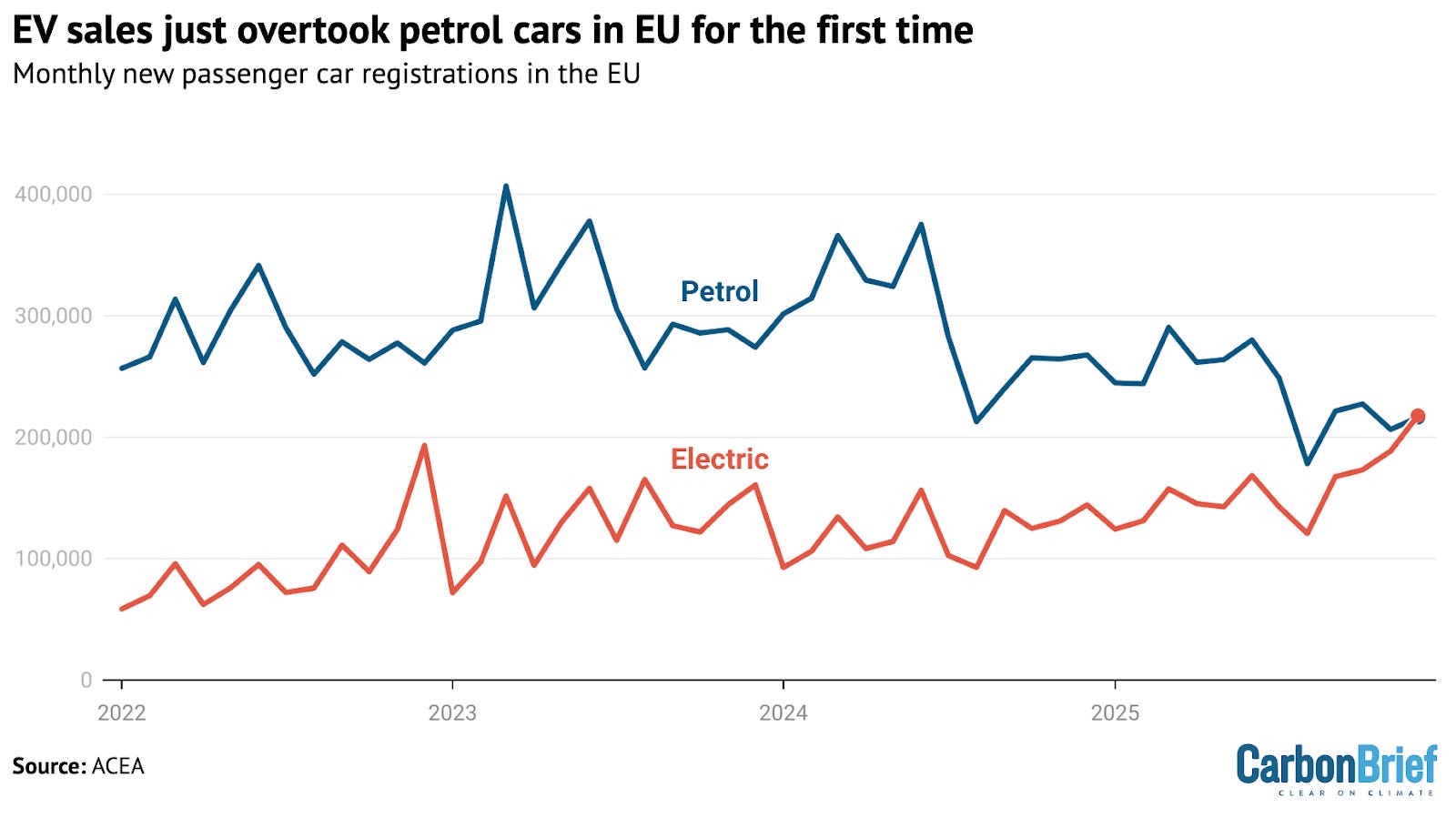
Last December, about 218,000 fully battery-powered cars were registered across the EU, compared with 216,000 gas-powered cars (hybrids were not counted in either category), marking the first time in EU history that EVs outsold internal-combustion cars. EVs narrowed the gap quickly over the last year, with a 51% year-over-year increase in registrations, compared with a 19% drop in gas car sales. Non-plug-in hybrids (which only take gas but power a small battery through their engine or regenerative braking) are still the EU’s most-sold cars, but fully electric vehicles (now the 2nd most common) and plug-in hybrids (4th) are narrowing the gap.
🚏🐮 Researchers found a cow that can flexibly use tools
An Austrian cow named Veronika has been observed using brooms and sticks to scratch parts of her body she can’t normally reach, marking the first known instance of “flexible use of a multi-purpose tool by a cow.” She used the bristled end of a broom most of the time, but switched to the stick end “when targeting softer lower-body areas.” Cows, like most non-primate animals, are usually not considered capable of using tools (consider The Far Side’s famous “cow tools” comic), so scientists believe this may force us to revisit our understanding of animal cognition.

📖⏳ Worth your time
Some especially insightful pieces we’ve read, watched, and listened to recently.
Polybius: The Authoritarian Consolidation Index (John Ganz) — An interactive poli-sci app that uses Claude to evaluate recent news against theoretical models like Linz’s “Perils of Presidentialism”, Gramsci’s hegemony, and de Tocqueville’s civil society to compute a score that measures the health of a given democracy. The app is pre-loaded with the USA’s “authoritarian consolidation index” score, but with your own API keys, you can run the analysis on any country of interest.
The Complicator’s Gloves (The Daily WTF) — A classic parable about avoiding overcomplicated solutions when simple, cheap, and perhaps boring options are available. Engineers at one company dreamed up a fancy handlebar-heating system for bikes, only to realize that nobody had ever built such a feature because gloves already exist.
I Should Have Loved Biology (James Somers) — Recalls how little the author enjoyed learning biology in school; despite its interestingness as a field, biology felt like a “lifeless recitation of names.” What if, instead of focusing on seemingly arbitrary facts, biology was taught historically by acquainting students with real biological questions and the scientific processes biologists used to answer them, giving students an opportunity to put themselves in the scientists’ shoes and wonder? What if it involved more inspiring and beautiful illustrations and explorable explanations?
Yes, We’re in the Seventh Party System (Mr. Beat / YouTube) — Traces the history of the commonly agreed upon eras of American political history, each of which featured unique issues and coalitions. Most historians agree that FDR’s New Deal Coalition formed the Fifth Party System, and most believe the late 20th century saw the rise of the Sixth, but few agree on anything after that. Mr. Beat makes a compelling case that 2016 ushered in a Seventh Party System, noting that if you zoom out, today’s two major parties look quite different from what they did in Obama’s days.
🌀🖋 More from FLUXers
Highlighting independent publications from FLUX contributors.
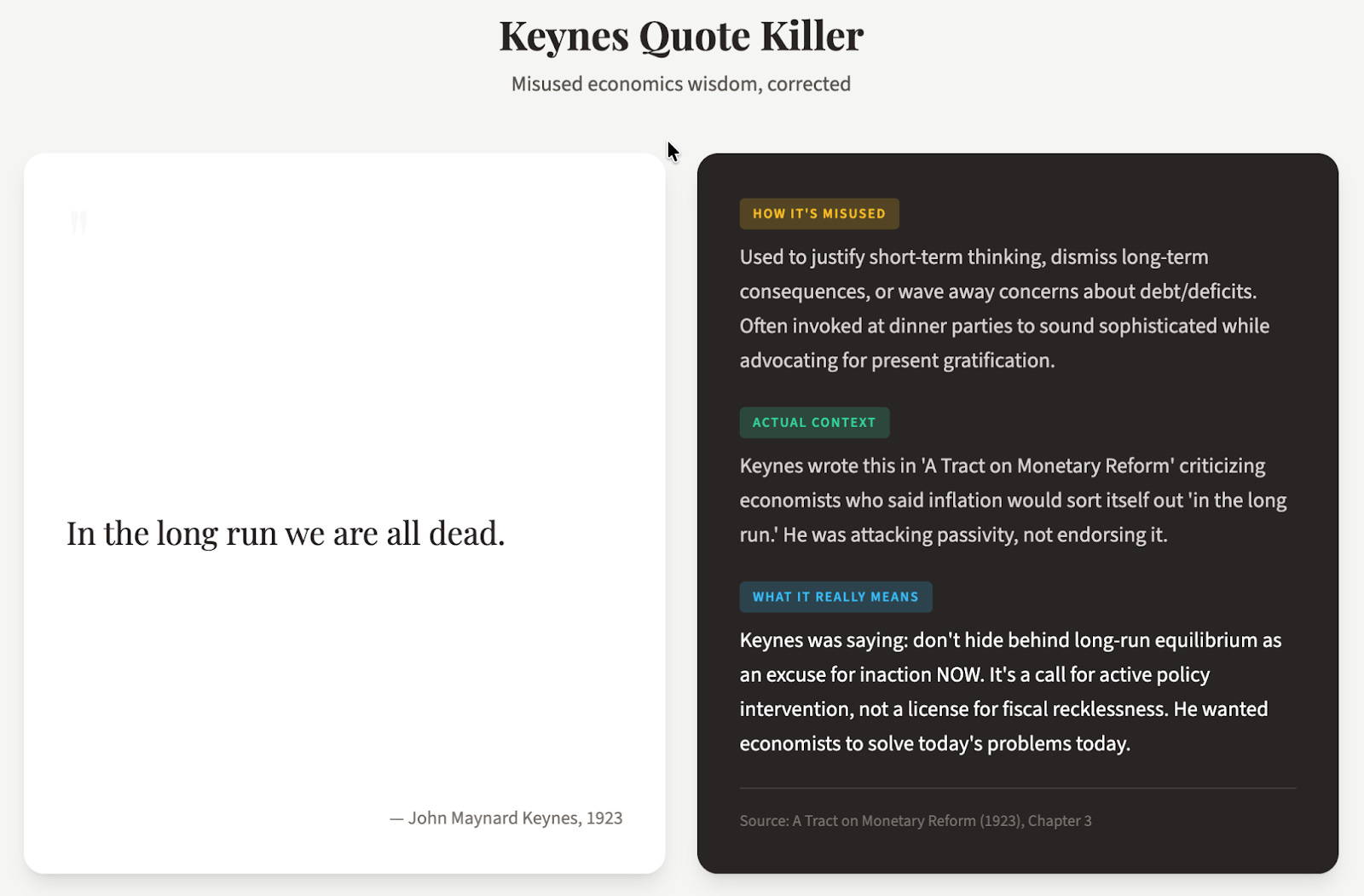
The Keynes Quote Killer is an interactive mini-app from FLUX’s own Ben Mathes that examines popular economic quotes misunderstood in the public imagination, from Friedman’s “no such thing as a free lunch” to Schumpeter’s “creative destruction.” Oftentimes, the commonly understood meaning of the quote is the exact opposite of what the speaker actually meant in context!
© 2026 The FLUX Collective. All rights reserved. Questions? Contact flux-collective@googlegroups.com.