

Episode 218 — January 15th, 2026 — Available at read.fluxcollective.org/p/218
Contributors to this issue: Erika Rice Scherpelz, Neel Mehta, Boris Smus, MK,
Additional insights from: Ade Oshineye, Anthea Roberts, Ben Mathes, Dart Lindsley, Jasen Robillard, Justin Quimby, Lisie Lillianfeld, Robinson Eaton, Spencer Pitman, Stefano Mazzocchi, Wesley Beary, and the rest of the FLUX Collective
We’re a ragtag band of systems thinkers who have been dedicating our early mornings to finding new lenses to help you make sense of the complex world we live in. This newsletter is a collection of patterns we’ve noticed in recent weeks.
“A library doesn’t need windows. A library is a window.”
― Stewart Brand
🏢🫂 Creative spaces must be owned by their inhabitants
MIT’s Building 20 is a great case study in accidentally creating a good place for incubating weird ideas. And it was largely accidental: the building was created as temporary construction for WW2 radar experiments. Since it wasn’t precious, people could change it. They demolished walls. The wiring/plumbing was visible and easy to change. The space was editable to a degree that even the most flexible modern office space can only imagine.
Contrast this with the office of the ad agency Chiat/Day in Los Angeles (case study; Wired article). Workers were forced to work in a “virtual office” — no fixed desks, no paper, and most critically, no real control over their space. This was a folly of high modernism: the image of what a modern creative organization “should” look like was blind to how work really got done in all its messy, embedded glory.
The mistake with the Chiat/Day office wasn’t that it was sterile. It was that it was imposed. A space full of color and knick-knacks and whimsy is just as sterile if its inhabitants are unable to adapt it to their needs.
If you want innovation, you need to give people the freedom to modify their space. And allowing desk photos is not enough. They need to be able to extend their mind into the space around them, whether that’s by shifting desks, putting up stickies, building physical models… or rerouting the power.
When inhabitants own their space, they can think more clearly as individuals, but this extension of the mind into the physical world is even more critical when we work together. When we can point at an artifact and say, “like that!” it can align us more than a verbal description ever can.
There’s a parallel in the digital world. As we rethink business processes and operations through the lens of AI automation, we must consider where we still need the flexibility to add meaning-making. In these spaces, we need to ensure that the human “inhabitant” of the process has the authority to change things.
In the meantime, knock down a wall. It might spur your next brilliant innovation!
🛣️🚩 Signposts
Clues that point to where our changing world might lead us.
🚏🚢 China’s trade surplus hit a record $1.2 trillion last year
China exported $3.77 trillion in goods last year, compared to $2.58 in imports for an overall trade surplus of nearly $1.2 trillion—an all-time-high and a 20% jump from last year. The US’s trade war with China (which led to a 20% decline in Chinese exports to the US) has hardly put a damper on Chinese exports, as the country has quickly pivoted to emerging markets such as Latin America, Africa, and Southeast Asia. High tech has been a major contributor to China’s export boom, including electric vehicles, computer chips, lithium batteries, solar panels, and industrial robots.
🚏👔 McKinsey is adding an AI round to its consulting interviews
The management consulting firm is reportedly incorporating AI into some of its final-round interviews. Candidates are required to “carry out practical consulting tasks” with the help of McKinsey’s internal AI tool: “you are expected to prompt the AI, review its output, and apply judgment to produce a clear and structured response.” Indeed, McKinsey has gone all-in on AI as of late: the company’s CEO recently quipped that his firm’s workforce numbers 60,000, split between “40,000 humans and 20,000 agents.” (Meanwhile, rival consulting firm BCG now has “forward-deployed consultants” who ‘vibe-code’ to build out client projects.)
🚏🌏 Coal power generation fell in China and India for the first time since the ‘70s
A new analysis found that China generated 1.6% less electricity from coal compared to a year ago, while India saw a similar drop of 3%. This marked the first time that both countries saw simultaneous drops in coal power generation since 1973. A major driver of the drop is that clean energy has been booming in the world’s two most populous countries: China added 300GW of solar power and 100GW of wind power last year, and India added 35GW of solar power and 6GW of wind power. It’s a welcome turnaround, since the two countries accounted for over 90% of the increase in global carbon emissions between 2015 and 2024.
🚏🤠 Matthew McConaughey is trademarking himself to stop AI fakes
The movie star has filed eight trademark applications with the US Patent and Trademark Office covering his voice and likeness, including several videos of him and an audio clip of him reciting his famous line, “alright, alright, alright,” from a 1993 movie. His attorneys said the move was an attempt to stop AI apps from “simulating his voice or likeness without permission,” such as in deepfakes.
📖⏳ Worth your time
Some especially insightful pieces we’ve read, watched, and listened to recently.
The Cult of the Founders (Crooked Timber) — Frames the well-known distinction between visionary-founder and operator-CEO in terms of prophets who rip up the rulebooks and create an ecstatic cult, versus priests who are rule-following administrators skilled in the “routinization of charisma.”
Landholder vs Stockholder (Aeon Magazine) — Argues that the political theory with the most predictive power over modern political divides isn’t Marx’s divide of the bourgeoisie versus the proletariat nor the French Revolution’s three estates, but rather David Hume’s split of landholders (those with agrarian, family-oriented, and rent-seeking interests) and stockholders (upwardly mobile industrialists and financiers with fewer ties to the land). The former aligns more with the modern right and the latter with the left, which explains “how the Left can be both the party of finance, and the party that tries to overthrow capitalism.”
Where Americans Choose to Move and Where They Leave (John D. Johnson) — Investigates domestic migration patterns in the US, finding that “the patterns often correspond better to ecoregions than political boundaries.” For instance, there’s a sharp population drop in the narrow band between 100º and 103º W, a region that covers seven states from North Dakota to Texas. Meanwhile, the southeastern Piedmont region (which spans parts of seven states) saw significant growth, even as other parts of those states experienced population loss.
The Unstable Queen (Matthew Mason) — A veteran robotics and AI professor observes that, in both human and robot affairs, sensing and action are deeply interlinked: “sometimes the eye leads the hand, and sometimes the hand leads the eye.” For instance, if a robot is trying to repeatedly move a chess piece around a board without letting it fall over, it can use visual sensing to track the piece’s position, or it can use contact with the board (i.e., action) to keep the piece straight, such as by sliding it around instead of picking it up.
📚🛋️ Book for your shelf
A book that will help you dip your toes into systems thinking or explore its broader applications.
This week, we recommend How Buildings Learn: What Happens After They’re Built by Stewart Brand (1995, 256 pages).
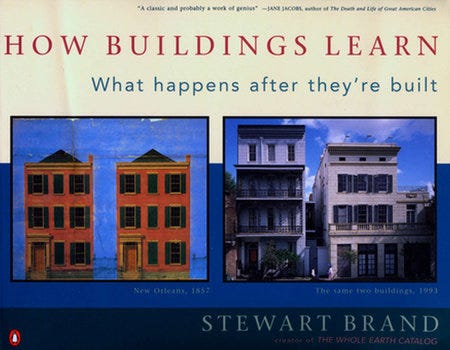
Stewart Brand’s How Buildings Learn delves into the fascinating idea that buildings are not static structures but entities that evolve and transform over time. Brand argues that the structures most successful in the long term are those designed with flexibility at their core. This adaptability allows them to be continually modified, repurposed, and improved by their users to match their needs as they change.
A critical dimension is which layers of a building evolve, and at what rate: your furniture arrangement will change more often than the building foundation!
For a building, these layers generally include the “stuff”, the space plan, services, skin, structure, and site.
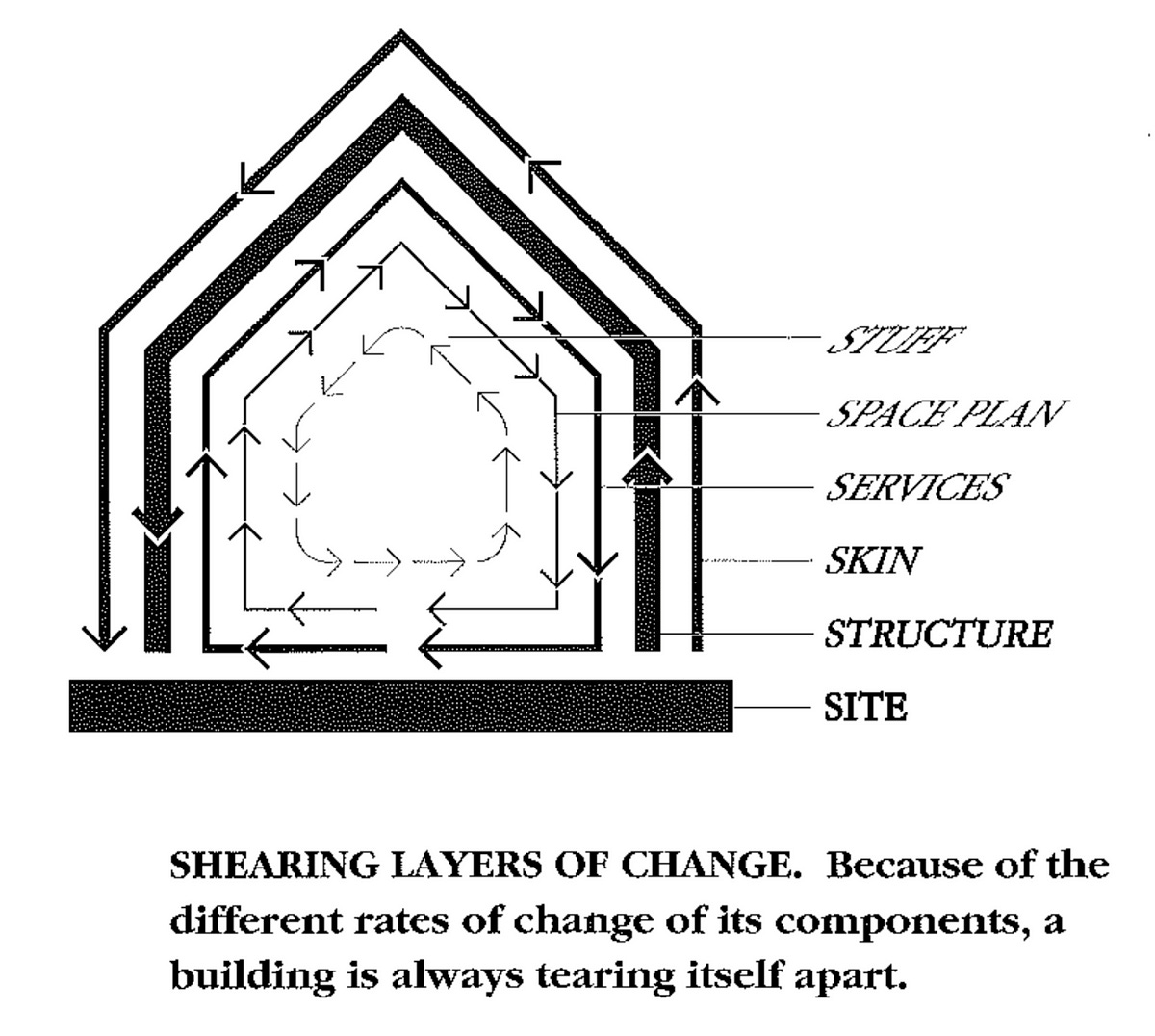
This idea of shearing layers can be applied beyond buildings, as in this example from Gratus Devansen, which applies it to software systems. Opinions may differ on the accuracy of each layer, but the key is to have clear opinions about your shearing layers when building software that needs to evolve.
And the same holds for other domains. Whether physical, organizational, or social, any system that needs to evolve will have layers. Instead of rigid, monolithic structures, Brand’s work inspires us to create platforms that encourage adaptation and customization at the right layers by providing well-defined interfaces, modular components, and opportunities for extension.
And metaphorical applications aside, it’s a cool book about buildings!
© 2025 The FLUX Collective. All rights reserved. Questions? Contact flux-collective@googlegroups.com.