

Episode 248 — August 20th, 2026 — Available at read.fluxcollective.org/p/248
Contributors to this issue: Neel Mehta, Boris Smus, MK, Erika Rice Scherpelz
Additional insights from: Ade Oshineye, Ben Mathes, Dart Lindsley, Jasen Robillard, Jon Lebensold, Justin Quimby, Lisie Lillianfeld, Robinson Eaton, Spencer Pitman, Stefano Mazzocchi, Wesley Beary, and the rest of the FLUX Collective
We’re a ragtag band of systems thinkers who have been dedicating our early mornings to finding new lenses to help you make sense of the complex world we live in. This newsletter is a collection of patterns we’ve noticed in recent weeks.
“The only thing that makes life possible is permanent, intolerable uncertainty.”
— Urusla K. LeGuin
🌀🔵 The shape of confusion
The chaos of a roomful of preschoolers can be overwhelming. It can also be a place of immense creativity… admittedly often of the “what can go up a nose” variety.
But what do we mean by “chaos”? In the colloquial sense, chaos means disorder. But in the mathematical sense, which Cynefin pulls from, it means a system that is unpredictable because it’s highly sensitive to initial conditions, one where dramatically different outcomes sit quite close to one another in the outcome space. Consequently, chaos contains patterns that are unstable and often only visible at the macro level.

Chaos often requires action, observation, and response rather than predictive planning. Those preschoolers look like the peak of disorder at first, but as you observe them, you can see that there is a system to their actions, an act-sense-response pattern that is representative of the Cynefin chaotic domain. This is what makes it creative.
It is also what makes it dangerous.
The realm of confusion is interesting because it sits in the center of the Cynefin diagram and yet is often left out completely in conversation and consideration. This is because confusion is a bit different from other domains: while the clear, complicated, complex, and even chaotic domains all reflect how we describe the problem itself, confusion is about our state of knowledge of the underlying problem.
Confusion is the realm of Eris, the goddess of discord and strife. One person may see a problem as simple because their analysis assumes a cause-and-effect relationship while another may see it as a chaotic mess due to getting caught up in patterns they don’t have the models to comprehend. Or it’s a multitude of challenges with different properties that may all be tied up together, waiting to be separated. Understandably, confusion can breed disagreement.
But also, confusion opens up the possibility of change. It reveals that our understanding of the problem can change the shape of the problem. And once we see that possibility, we realize that we can change the nature of problems even when we think we know what shape they take.
For example, weather is the epitome of a chaotic system, but it can be reduced to what most individuals experience as a complicated system when we realize that we can collapse a broad swath of states into a temperature range and a probability of rain. (Or, perhaps, a simple system, if you’re in San Diego, where “about 70°F and sunny” is almost always the right answer. 😉) Another transformative move is the addition of rules or guardrails: a complex system of human interactions gets simplified into abstractions of teams and organizations.
Transformations can also go the other direction. The historically simple choice of what to eat — whatever we can get our hands on — moved to complicated as choices increase. And it can move to complex once we start accounting for individual dietary needs.
This doesn’t mean transformation is arbitrarily possible. We always have to check framing against the underlying reality. But it’s worth recognizing that chaos, like other states, has an element of perspective to it.
🛣️🚩 Signposts
Clues that point to where our changing world might lead us.
🚏📊 People in many countries now view China more positively than the US
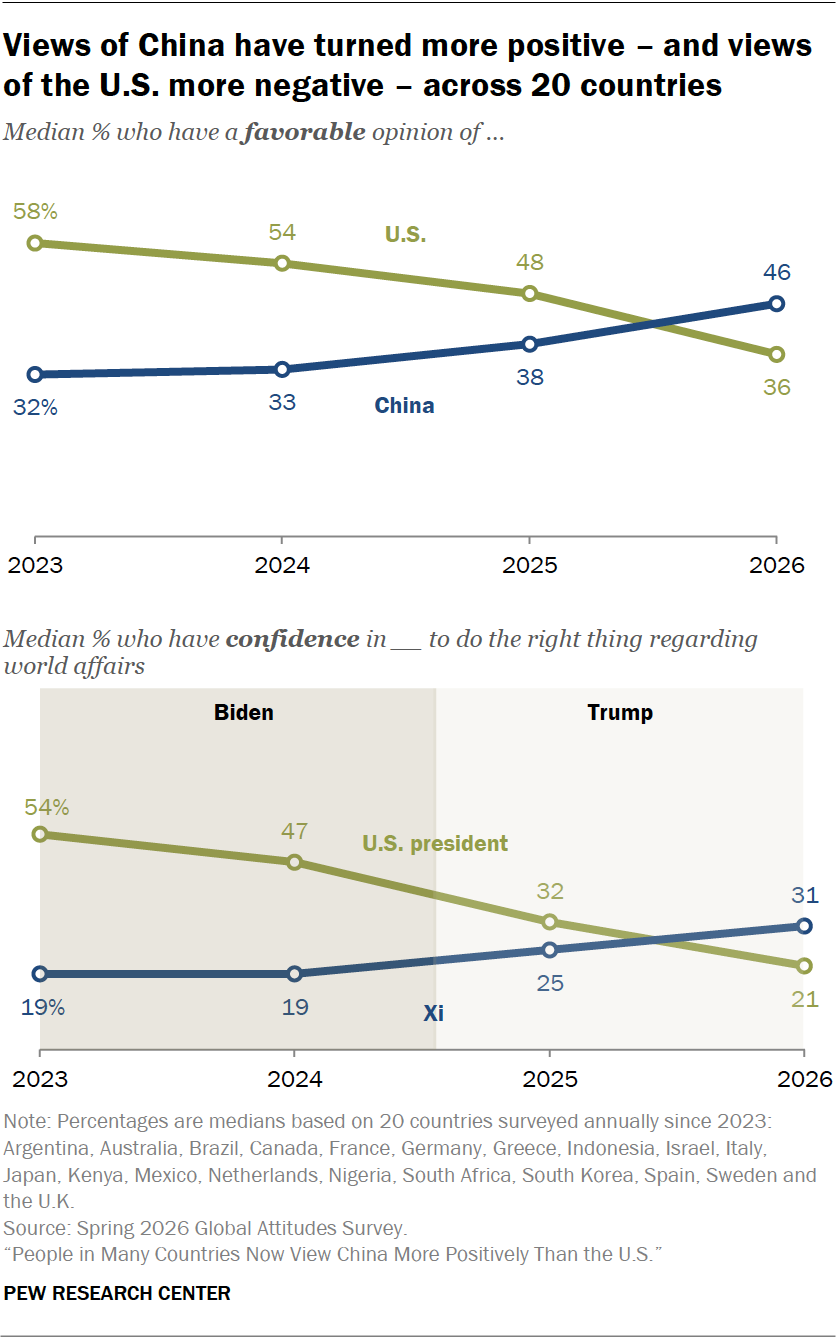
Pew Research polled people from 36 countries and found that their opinions of China have steadily improved since 2023, while their feelings about the US have soured, to the point where China is now viewed more favorably than the US, on average. Similarly, people have more confidence in China than the US to “do the right thing regarding world affairs.” China’s favorability lead is strongest in South and Southeast Asia, while enjoying a modest lead in Europe and Africa, while the US retains a favorability edge in Israel, Japan, India, South Korea, and not many other places.
🚏🌡️ Solar panels helped Europe meet power demand during recent heat waves
During this summer’s heat waves, European electricity demand rose by about 25% due to increased A/C use. Low river levels meant that hydropower and even coal plants (which need water for cooling) had to reduce energy generation during the heat waves, while solar installations actually got 17% more productive during this span – the only power source to do “better than usual.” Increased solar radiation is probably to credit for the increased solar output, although high temperatures are known to slightly reduce solar panels’ efficiency.
🚏🦦 Otters were spotted in NYC’s Bronx River for the first time in 100 years
This summer, a river otter was captured on camera in the Bronx River, the only freshwater river in New York City, marking the first documented sighting of a river otter in this waterway since the early 1900s. The Bronx River was “treated as an open sewer and dumping ground” during NYC’s industrial boom in the 19th and 20th centuries, so the return of otters (a few decades after beavers returned after 200 years) suggests that long-running cleanup operations have been successful.

🚏🛬 AI companies bid millions of dollars for Spirit Airlines’ internal data
After Spirit Airlines went out of business a few months ago, Google paid $10 million for its internal data, including “email and internal communications, spreadsheets, transactions… as well as human resources information,” presumably to help train Google’s AI models. Mercor, a company that provides human expertise to AI labs, submitted the second-highest bid at $7.5 million. It’s an unusual outcome because defunct US airlines are typically sold wholesale – data, planes, and all – to other airlines, rather than ceasing operations and being sold off for parts.
📖⏳ Worth your time
Some especially insightful pieces we’ve read, watched, and listened to recently.
Hard Is Not Defensible (Alex Crompton) — Differentiates between two kinds of “hard” in building startups: “math hard,” where innovations are hard to come up with but easy to copy, and “bodybuilding hard,” where everyone knows the method for success but few can actually stick it out. But either way, they don’t give you a sustainable moat; they just get you started and buy you time until you can find a real advantage, which relies on “unique resource accumulation.” Thus, the key to success: “you need to snowball.”
What Really Happened on Easter Island? (Scientific American) — Argues that the popular story of ecocide – that the indigenous people of Rapa Nui destroyed their own environment, which led to their downfall – was actually a myth perpetrated by the pop-sci book Collapse, which was trying to weave a cautionary tale about preserving natural resources. In truth, Easter Islanders maintained a stable population and economy for centuries, using clever hydro-engineering and agriculture techniques to scratch out a living on an inhospitable rock. It was only after European colonizers arrived, along with diseases and economic exploitation, that the island fell into ecological ruin.
The Last Useful Man (Metropolitan Review) — A review of the final installment of Mission Impossible, where the heroes are fundamentally useful and self-sufficient, while the villains have to Google things all the time, and in Tom Cruise’s words “spend too much time on the internet.” The distinction between usefulness and convenience is a powerful mental model and helps articulate why some AI use feels “wrong” (like atrophy) while other use feels “right” (like an exoskeleton).
Why Is So Much of Linguistics Math? (Language Jones) — A professional linguist explains how practitioners in his field use fast Fourier transforms, multivariate regression, automata theory, linear algebra, differential equations, constraint satisfaction, and more. Heavy math use isn’t limited to NLP; historical linguistics, phonology, and the author’s own subfield of sociophonetics, to name a few subfields, all require advanced math knowledge.
📚🛋️ Book for your shelf
A book that will help you dip your toes into systems thinking or explore its broader applications.
This week, we recommend The Liberating Structures Fieldbook: Flipping the Script on Meetings, Planning, and Progress by Keith McCandless and Nancy White (2026, 312 pages).
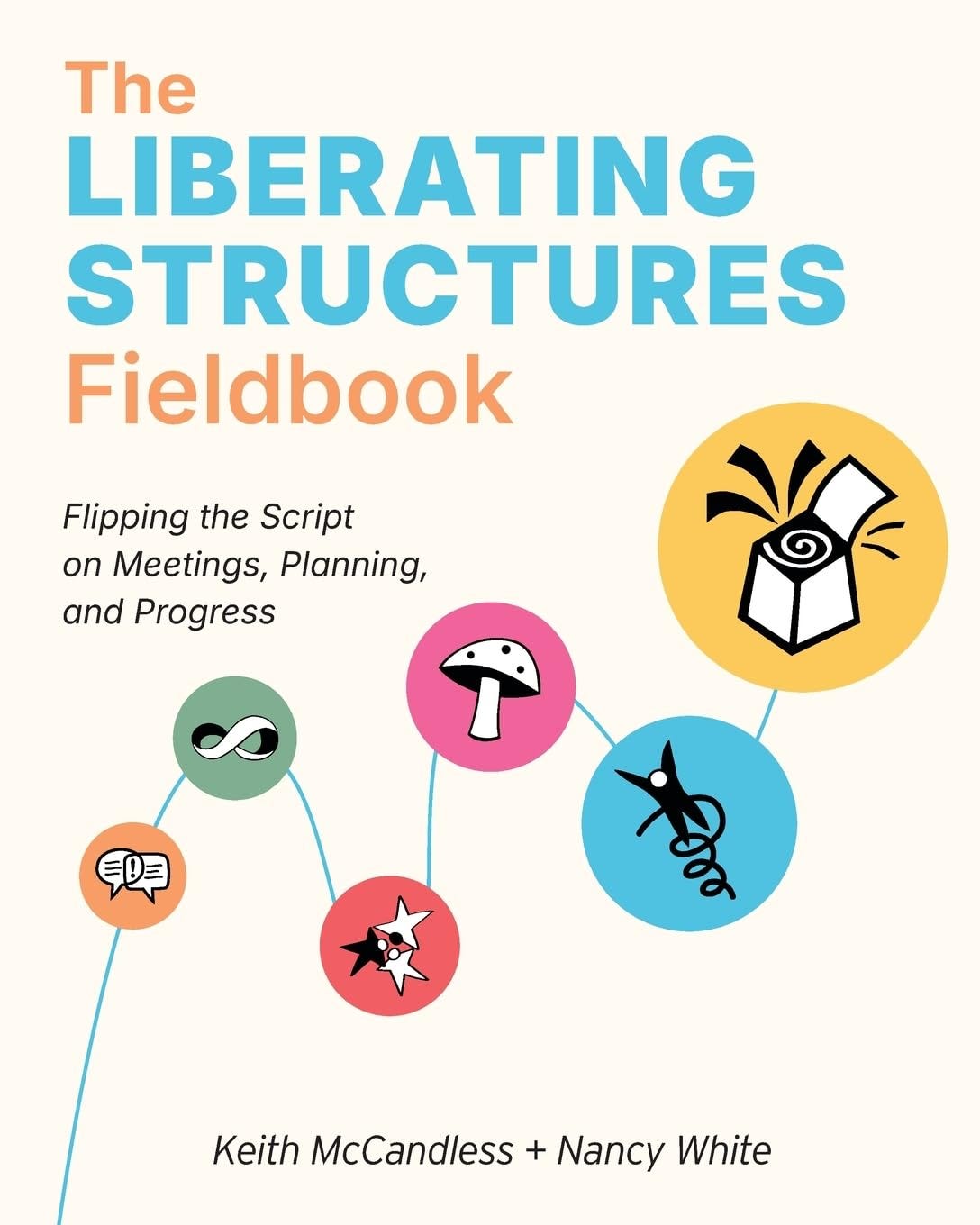
Liberating Structures builds on a simple idea: all of the framework and philosophy in the world won’t go very far without a structure of day-to-day interactions to build it on. But when it comes to large group interactions, the “big 5” approaches of interaction are limiting: the presentation, the managed discussion, the status report,the open discussion, and the brainstorm all tend to favor limited participation and they often focus more on the status quo than on tapping the collective intelligence and motivation of the larger group.
The Surprising Power of LIberating Structures presents 33 different alternate patterns for pulling on broader sensemaking. This ranges from structures like “1-2-4-All” which encourages a tiered discussion to get more participation to using improv inspired techniques to find solutions to problems to using liberating structures to design sessions that themselves utilize liberating structures (how meta!). The first parts of the book rather sells past the close in terms of motivating the structures, but you can easily skim it and jump straight to the patterns.
One note: the book we actually recommend (despite having it on order and not having read it yet!), is The Liberating Structures Fieldbook, the successor to the above two. We are provisionally recommending the fieldbook because it adds 10 new patterns and, critically, updates the patterns for online interactions.
© 2026 The FLUX Collective. All rights reserved. Questions? Contact flux-collective@googlegroups.com.