

Episode 252 — September 24th, 2026 — Available at read.fluxcollective.org/p/252
Contributors to this issue: Justin Quimby, Erika Rice Scherpelz, Neel Mehta, Boris Smus, MK
Additional insights from: Ade Oshineye, Ben Mathes, Dart Lindsley, Jasen Robillard, Jon Lebensold, Laura Eberly, Lisie Lillianfeld, Robinson Eaton, Spencer Pitman, Stefano Mazzocchi, Wesley Beary, and the rest of the FLUX Collective
We’re a ragtag band of systems thinkers who have been dedicating our early mornings to finding new lenses to help you make sense of the complex world we live in. This newsletter is a collection of patterns we’ve noticed in recent weeks.
“The mind was dreaming. The world was its dream.”
— Jorge Luis Borges
🔎🔨 Forced lens swaps
At FLUX, we write a lot about Lenses. “Lens of the week” is one of our regular features! We are often asked why we focus so much on Lenses. Well, all views are limited. There’s no such thing as a “true” view of reality; there’s no view from nowhere. Sometimes consciously, but usually not, our views are shaped by our Lenses. Individuals have Lenses, and so do organizations.
After all, what is the innovator’s dilemma but an exploration of different Lenses newcomers and incumbents bring?
Whether individual or organizational, when we look through Lenses, we perceive the same situation in different ways, sometimes radically so. These Lenses may come from formal education. They may come from religious or cultural processes. They may come from organizational principles (both stated and implied) and individual lived experiences.
Regardless of origin, we all see the world through Lenses. We also see ourselves and others through Lenses; the actor–observer asymmetry is the meta-lens of why “I” am misunderstood and deserve grace but “they” are a jerk and deserve scorn.
Now, that’s all well and good, but still, why do we focus so much on Lenses? Well, when we become aware of our own Lenses, we can make a conscious choice to change the Lenses we are using. And naming a lens allows us to recognize it. It allows us to consciously take it on and off, to examine it and understand where it’s best used (and best set aside).
But we do not always have the luxury of choosing to change our Lenses. Sometimes, change is forced upon us or our organizations. This often takes the form of ground-truthing. The overwhelming accumulation of evidence and new facts shows the cracks in a currently used Lens. Kodak eventually had to accept that digital camera sales disproved the idea that its future lay in film. The machine guns and artillery barrages of World War 1 changed the worldview of European generals who expected short wars won by bold offensives.
The voluntary changing of Lenses can be a playful activity. However, forced Lens swaps often involve a massive and sustained avalanche of concrete, yet contrary facts. The more deeply entrenched the Lens, the deeper the blow to ego and self-esteem (individually and/or collectively) when we’re forced to abandon it.
In today’s world of shifting global power, LLM-mania, improving medicines, and changing climates, what Lenses might we be forced to change?
🛣️🚩 Signposts
Clues that point to where our changing world might lead us.
🚏⚔️ “Intelligence” from an AI chatbot almost started a US–China military incident
An intelligence report circulated this spring, during the war with Iran, “set off alarm bells” for the US military when it ‘found’ that a Chinese ship in the Middle East was “transporting components of a nuclear weapons program.” The American military had planes in the air and armed personnel were reportedly preparing to forcibly board the ship. But when officials looked more closely, they realized that the report had been made by an analyst who used a generative AI chatbot, and the report itself was “entirely false.” The AI had apparently misidentified the materials the ship was carrying, and yet, according to a source, it had “almost started a war.”
🚏🛬 China took stealth aircraft parts after a plane was diverted to Hong Kong
An intermediary working on Lockheed Martin’s behalf was transporting components from an F-35 stealth fighter jet from Australia to the US for inspection and sent them via a UPS flight. But the plane unexpectedly stopped in South Korea and got diverted to Hong Kong, at which point the Chinese government seized the sensitive parts and “so far hasn’t returned them.” It’s unclear whether the diversion was accidental or intentional. (China has long shown interest in getting data and parts for the F-35, including through electronic espionage.)
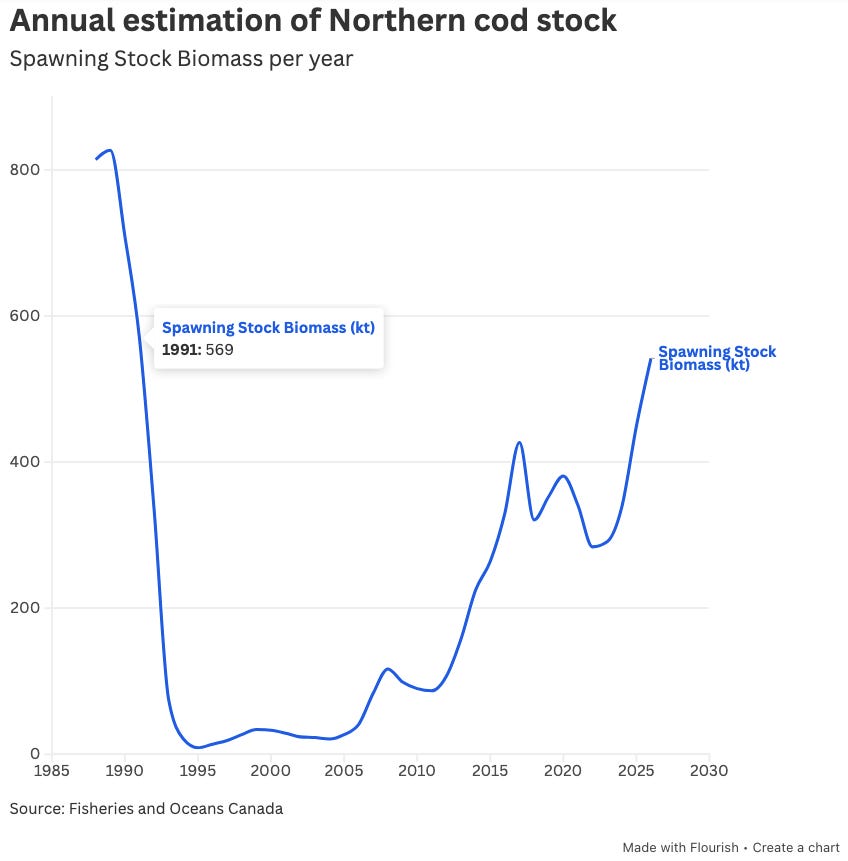
🚏🎣 Newfoundland’s cod stock has recovered, 34 years after its infamous collapse
Decades of overfishing near Newfoundland made cod populations collapse by 99%, leading to the devastating 1992 moratorium on cod fishing in Atlantic Canada, which was the “largest industrial closure in Canadian history” and led over 30,000 people in Newfoundland and Labrador to lose their jobs. Many towns were abandoned, and the economy was depressed for decades. But a generation later, cod populations have rebounded, and NL’s cod stock has been deemed “healthy” for the first time since ‘92. The moratorium was lifted two years ago (with a quota that was raised by 55% this year), and fisheries and processing plants are hiring and expanding again.
🚏🧑⚖️ A ChatGPT-using lawyer cited fake quotes from fake witnesses
In a recent criminal case, a defense attorney from New Mexico used ChatGPT to generate a legal brief that included “false testimony from wholly fabricated witnesses,” fabricated quotes from real witnesses, and “inaccurately described [legal] precedents.” He admitted to feeding the trial transcript (which was itself generated by an AI transcription service) into ChatGPT, after which it outputted the fake quotes. The judge raked the lawyer over the coals, hitting him with a fine and referring him to a disciplinary board. In a statement, the lawyer said he “didn’t know that AI could hallucinate facts” and asked the disciplinary board to take that into account. This marks yet another entry into the common genre of lawyers getting busted for using AI to generate fake information.
📖⏳ Worth your time
Some especially insightful pieces we’ve read, watched, and listened to recently.
Do You Know Your Default Shape? (Useful Fictions) — Presents a theory that many people (everyone?) tend to have a default lens through which they initially see the world, whether it’s marriage or politics. It’s a cogent reminder to learn your default lens but try to hold it more loosely, since even the most useful frame eventually blocks light you need.
The Road to Epsilon-Zero: Ordinals as Nim-Heaps (The Universe of Disclosure) — A mathematician uses a children’s game about moving beans to spin an impressively accessible introduction to ordinals, which in set theory are extensions of natural numbers to varying levels of infinity. Read the whole (in-progress) series for such gems as, “in at most 17 moves, we will be able to say, not how long the game will take to finish, but how long it will be before we can say how long the game will take to finish.”
Why Buffets Suddenly Disappeared (Modern MBA / YouTube) — Argues that all-you-can-eat buffet chains, a staple of the ‘80s and ‘90s, were a product of a peculiar time in American history where incomes were low and land, labor, and food were cheap. Their inexorable decline in the 2000s was an interesting case study for how no number of margin-boosting tweaks can compensate for declining demand in the category, and how cash-cow businesses in managed decline are a perfect target for private equity.
Meet the Sad Wives of AI (Wired) — Examines the domestic strain of the AI gold rush, where the obsessive, all-consuming race to build alienates partners and hollows out local social circles. Though the piece leans heavily on gendered tropes, the underlying dynamic is a classic “pioneer” FOMO: the crushing panic that stepping away from the machine for even five minutes means losing your edge.
🔍📆 Lens of the week
Introducing new ways to see the world and new tools to add to your mental arsenal.
This week’s lens: fit for purpose.
The Mercator projection is infamous for distorting the real sizes of landmasses. It introduces size distortions that are quite extreme the further a point is from the equator. It’s a bad map, right? Well, it depends on what you’re using it for. If you’re a sailor trying to chart a constant bearing, it can be quite valuable. Whether or not a map is “correct” depends on what you’re using it for.
Maps are a particularly clear example of being fit for purpose. An object is fit for purpose if it works well for the job it is put to. This feels obvious, but in practice, it can be anything but.
Sometimes an object is not fit for purpose because it’s the wrong tool for the job. Maybe it’s, unironically, 10,000 spoons when all you need is a knife. Other times, the right tool does not exist. Lego, founded in 1932, introduced its modern brick in 1958, but the brick separator wasn’t introduced until 1990. Sometimes a tool is not fit for purpose because it’s trying to be too much. It’s the 3-in-1 shampoo+conditioner+bodywash that doesn’t really do any of its jobs well.
But see what we did there? We assumed a purpose! If our purpose is to save space in our luggage, perhaps the 3-in-1 is exactly what we need. The deeper insight of fit for purpose isn’t that some things are better than others, but that the purpose of these things is plural.
So the next time you find yourself wondering why something is the way it is, try to see if there is some purpose it may be fit for… even if that purpose is a far cry from yours.
© 2026 The FLUX Collective. All rights reserved. Questions? Contact flux-collective@googlegroups.com.