

Episode 246 — August 6th, 2026 — Available at read.fluxcollective.org/p/246
Contributors to this issue: Dart Lindsley, Ade Oshineye, Jasen Robillard, Boris Smus, Justin Quimby, Erika Rice Scherpelz, Neel Mehta, MK
Additional insights from: Ben Mathes, Jon Lebensold, Lisie Lillianfeld, Robinson Eaton, Spencer Pitman, Stefano Mazzocchi, Wesley Beary, and the rest of the FLUX Collective
We’re a ragtag band of systems thinkers who have been dedicating our early mornings to finding new lenses to help you make sense of the complex world we live in. This newsletter is a collection of patterns we’ve noticed in recent weeks.
“We know they lie, they know we know they lie, they don’t care. We say we care, but we do nothing. And nothing ever changes. It’s normal.”
— Adam Curtis, Hypernormalization
👉👈 I know you know I know
Look at that chart. The numbers are baaaaaddd. We all know it. But no one says so. It’s not ignorance. It’s a failure of our shared reality. We all know the project is in trouble... but until someone (or, perhaps, the right someone) says it aloud, the status quo is frozen.
If I know something, it’s individual knowledge. If everyone knows, it’s mutual knowledge. If we all know we know, it’s common knowledge. These layers of knowing seem academic, but our social lives depend on our deep and often intuitive knowledge of them. (Here’s a useful video on these topics.)
When something becomes common knowledge, such as through a public announcement, it changes what people can safely assume. It can create a Schelling point, where we not only can make a decision, but can generally expect people to reliably do the same thing, such as exiting a building when an alarm goes off.
Mutual knowledge can still be valuable. If we all know the goal we’re pursuing, then we can row in the same direction. Yet it is also the realm of kayfabe, where we all act as if something is true even though we know it’s not. That’s our bad chart example. Kayfabe isn’t exactly a lie. It’s more a coordinated agreement about which truths are allowed to have power.
When the shared fiction becomes common knowledge, its nature can change. Sometimes that’s a positive. Imaginative play is fun because we’re all buying into the “lie” that the couch is a submarine or the floor is lava. In organizational settings, though, it can drift toward an open secret. Everyone knows that (nearly) everyone knows... but they lack permission or power to change it.
Systems built on open secrets can look stable... but only because everyone is avoiding conflict to keep the machinery moving. At small scales, this can be functional. We all know that some processes are low value but not worth the effort to change. The trouble begins when the shared fiction prevents the group from updating its knowledge or actions as circumstances change. People begin optimizing for what wins them success in the game rather than what creates success in reality.
This can become costly, even more than a falsehood. A falsehood can be corrected. An open secret recruits everyone to its maintenance. And the more people who are involved in the maintenance, the harder it becomes to be the person who speaks up.
When coordinating people, it’s not enough to think about what you know or even what we know. We need to understand what’s common knowledge—and notice when that shared understanding gives us room to act. Which facts in your world are merely known? Once something becomes sayable, the group gains more choices about what to do next.
🛣️🚩 Signposts
Clues that point to where our changing world might lead us.
🚏😈 Japan made “cruelly hot day” an official weather category
The Japan Meteorological Agency uses memorable terms for warm days to encourage residents to protect themselves: days above 25° C are “summer days” (natsubi), 30° C days are “midsummer days” (manatsubi), and 35° C days are “extremely hot days” (mōshobi). But with temperatures above 40° C (104° F) becoming common in Japan—the country topped 40° C on nine days last year – the JMA has introduced a new word for days above 40° C: “cruelly hot day” (kokushobi). The term is already coming in handy as Japan suffers under another heat wave: the country reported five straight kokushobi in July, and nearly 11,000 people were hospitalized due to heat-related illnesses in a single week.
🚏📝 An AI-proctored entrance exam had so much cheating that 58k students have to retake it
This May and June, nearly 160,000 students took the entrance exam for UNAM, Mexico’s largest and arguably most prestigious university. This year’s exam was administered remotely (the first time ever) and required students to install “lockdown” software on their computers that would prevent them from visiting other sites or apps along with an AI system that monitored test-takers’ faces via their webcams. Despite these safeguards, top scores were far more common than usual: 16.3% of students scored 100+ on the 120-question test (vs. 3.5% in 2021-2025), and 5.5% got 110+ (vs. 0.9% in 2021-2025). The rise in high scores led to widespread allegations of cheating; AI researcher Raúl Rojas suggested that “almost half of the students” were cheating. So, UNAM is requiring everyone who “passed” the original test – a full 58,000 students – to retake the exam in person.
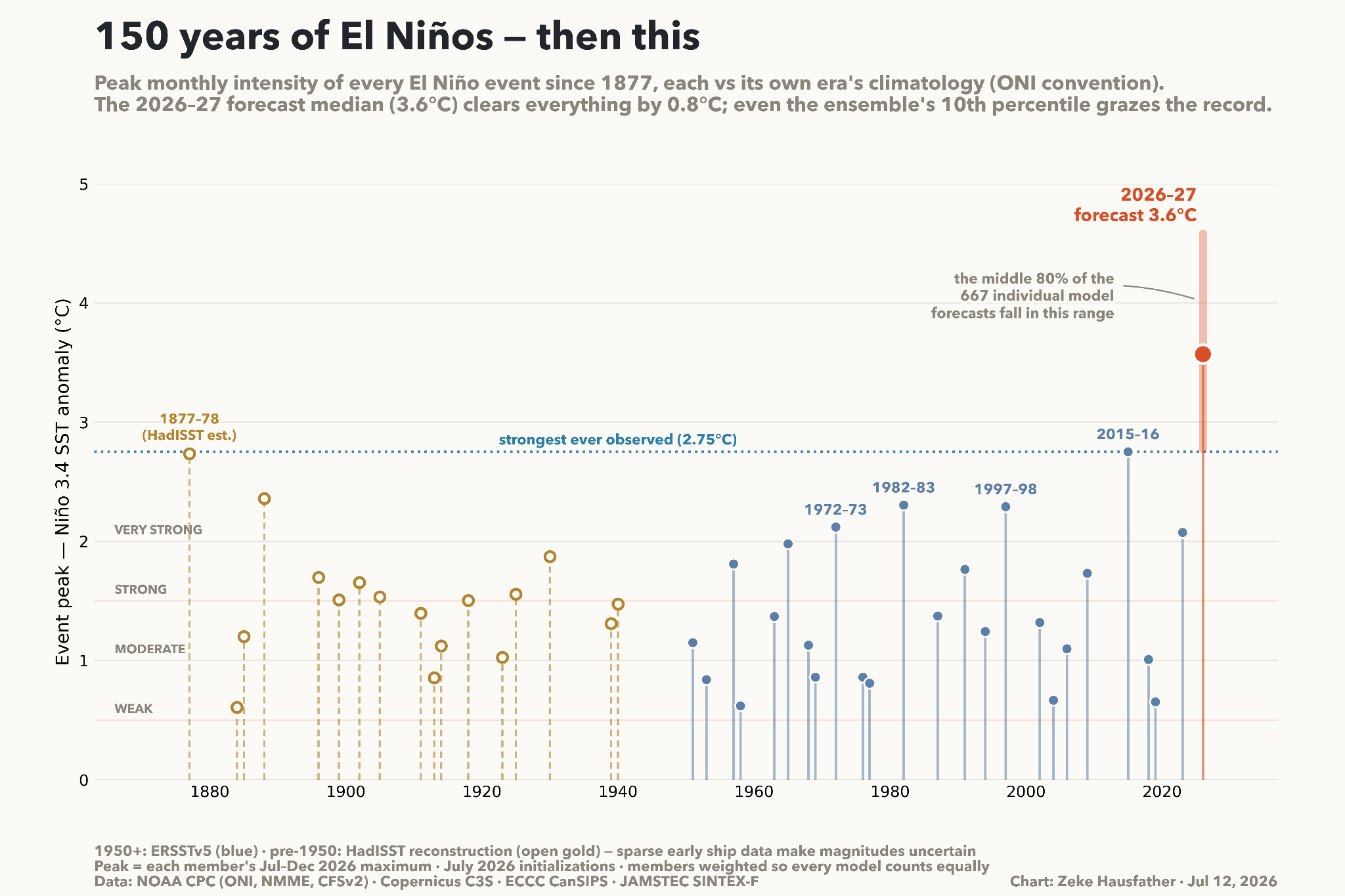
🚏🌀 We may experience the strongest El Niño ever recorded
The El Niño–Southern Oscillation (ENSO) is a recurring meteorological event driven by complex feedback loops originating from weaker trade winds across the Pacific that leads to varying patterns of droughts, flooding, and extreme temperatures in different parts of the globe. The strength of an El Niño event, which tends to happen every few years, is often measured by Pacific sea surface temperature (SST) anomalies. The strongest ENSOs ever recorded hit SST anomalies of +2.75° C, but weather models predict that this year’s event (which is just heating up) will peak at +3.6° C, blowing past the record; one meteorologist wrote that it could “perhaps be the strongest in 500 to 1,000 years.”
🚏🐷 LinkedIn added a “seems like AI slop” button
A few years ago, LinkedIn introduced buttons to let users draft or edit posts with AI. The AI slop epidemic has apparently gone bad enough, though, because the social network is dumping that feature and instead rolling out a new button that lets users report posts as potential AI slop. LinkedIn also says it’s introducing classifiers (trained, in part, on these button presses) to automatically identify and downrank potential AI-generated content.

📖⏳ Worth your time
Some especially insightful pieces we’ve read, watched, and listened to recently.
Damming the Big Ocean (NY Review of Books) [Archived] — A review of a political economy book on chokepoints’ role in economic warfare. It argues that the US’s “economic arsenal” of tariffs, sanctions, embargoes, export controls, etc., originally used to combat the USSR and later terrorists, has been refashioned into crude weapons against economic rivals like China. The problem is that the US has lost its leadership in free trade and globalization as erstwhile allies have turned elsewhere, “leaving [the US] more isolated and in control of a shrinking share of the global economy—reliant on undependable policy tools to preserve its edge.”
Beware Software Brain (The Verge) — Coins the term “software brain”: the tech-industry delusion that messy human reality can be reduced to structured data and executable rules, and that AI can then automate it. Editor-in-chief Nilay Patel argues the AI backlash isn’t a marketing problem, but rather downstream of the lived experience of being flattened into a record in someone else’s database.
ENSO Essentials (Columbia Climate School) — Examines the complex climatic systems that give rise to the El Niño–Southern Oscillation and its inverse, La Niña: the ‘default’ state of the Pacific Ocean includes a positive feedback loop between the ocean and atmosphere (a “coupled system”), while El Niño and La Niña are also positive feedback loops, but they temporarily disrupt the original loop. So the system can be thought of as transitioning among three different positive feedback states.
The Inner Robot (Matt Mason) — By examining the human ulnar grasp, one of many complex manipulations our hands are capable of, the author observes that we seem to have two distinct modes of operation. The first is “in our heads,” where we are operating deliberately and in complete control, good for planning and learning but weak at performing tasks. The second is our “inner robot,” an autopilot run by the subconscious that excels at repetitive, often physical tasks like object manipulation.
🔍📆 Lens of the week
Introducing new ways to see the world and new tools to add to your mental arsenal.
This week’s lens: repugnant transactions.
A shop down the street sells medication 24/7. A customer arrives late at night to buy medicine for their sick child. The catch: the shopkeeper is selling prescription medications without requiring a prescription. On one level, this sale is compassionate and practical.
But it’s also the sort of sale that authorities restrict. And for good reason: The medicine could be counterfeit. The buyer could misuse it (intentionally or through misdiagnosis). The restrictions protect in aggregate even if many particular cases can be justified.
Repugnant transactions are transactions wanted by the parties involved but restricted by a third party. There are many reasons for such restrictions, including mitigating externalities, enforcing moral norms, and preserving political power. Whatever the reason, those directly involved don’t have the final say. Such transactions will often move underground, giving rise to a repugnant market.
There is a mirror version, where two parties may dislike an activity but a third party forces it upon them. We might call these conscripted transactions. A doctor and a patient may both think an annual exam to renew a medication the patient has been safely using for years a waste of time, but if insurance requires it, they’ll do it. It’s the same pattern of third-party involvement, in the opposite direction.
If your goal is to disrupt a space that seems oddly ripe for it, understanding what transactions might be repugnant or conscripted will help highlight if the problem is a lack of product-market fit… or if it’s the shape of the market. When the market seems to be underinvesting or overinvesting in certain types of transactions, look for a third party to see if there might be an external reason why.
© 2026 The FLUX Collective. All rights reserved. Questions? Contact flux-collective@googlegroups.com.