
Episode 245 — July 30th, 2026 — Available at read.fluxcollective.org/p/245
Contributors to this issue: Justin Quimby, Erika Rice Scherpelz, Neel Mehta, Boris Smus, MK
Additional insights from: Ade Oshineye, Ben Mathes, Dart Lindsley, Jasen Robillard, Jon Lebensold, Lisie Lillianfeld, Robinson Eaton, Spencer Pitman, Stefano Mazzocchi, Wesley Beary, and the rest of the FLUX Collective
We’re a ragtag band of systems thinkers who have been dedicating our early mornings to finding new lenses to help you make sense of the complex world we live in. This newsletter is a collection of patterns we’ve noticed in recent weeks.
“For our house is our corner of the world.”
— Gaston Bachelard, The Poetics of Space (1958)
💸📍 No cheaper way out
It’s time for a nice relaxing weekend at your vacation home. You settle into your remote sanctuary, watch the sunset over the water, feeling grateful for such an immense privilege... and then reflect on how an AirBnb would cost a fraction of the vacation home’s mortgage and upkeep.
But that’s not how it actually goes.
While a vacation home can become a burden, we think of owning and renting differently. The house you own is a home with memories. It is what economic sociologist Lucien Karpik calls a singularity. Not in the black-hole sense. And not in the AI sense. A singularity, in his sense, is a good whose value is tied to its particular, hard-to-reproduce characteristics. A rental may be cheaper, but it’s not the porch where your son took his first steps. It doesn’t have that mark on the wall where your daughter crashed her tricycle.
Singularities are one of the many sources behind price inelasticity. Price elasticity tells you how much demand responds to price, but not why some goods resist that pressure... or what might cause that to change.
For singularities, price inelasticity is fairly substitution-proof. The existence of AirBnbs may reduce the demand for vacation homes generally, but it doesn’t affect personal demand for the place your grandparents built before you were born. Luxury goods can also generate inelasticity. For these and other status items, inaccessibility (including price) is part of the point.
Other scenarios aren’t so sticky, and demand can change quickly if a viable alternative appears. A necessity like healthcare or education is subject to price inelasticity because the human capacity that provides it is limited. On the other hand, few people kept horses once cars and tractors became available. Other less-sticky sources of price inelasticity are system constraints (like insurance networks, accreditation rules, licensing), switching costs, and urgency.
Sometimes sticky and non-sticky cases overlap. “A doctor” may be a necessity, but “my doctor” adds history and trust. And we sure want our doctors to have those credentials.
This variety of factors is why Baumol’s cost disease lands as a crisis when it comes to healthcare or education, and as the price of luxury when it comes to fine dining or a live show. In the first category, prices are stuck but we would switch given a viable alternative. In the second, our willingness to pay is driven by what we find personally meaningful.
These two paths look similar on the balance sheet, but they feel very different when you’re paying the bill.
🛣️🚩 Signposts
Clues that point to where our changing world might lead us.
🚏🧯 More than half of England is in drought conditions amid “climate whiplash”
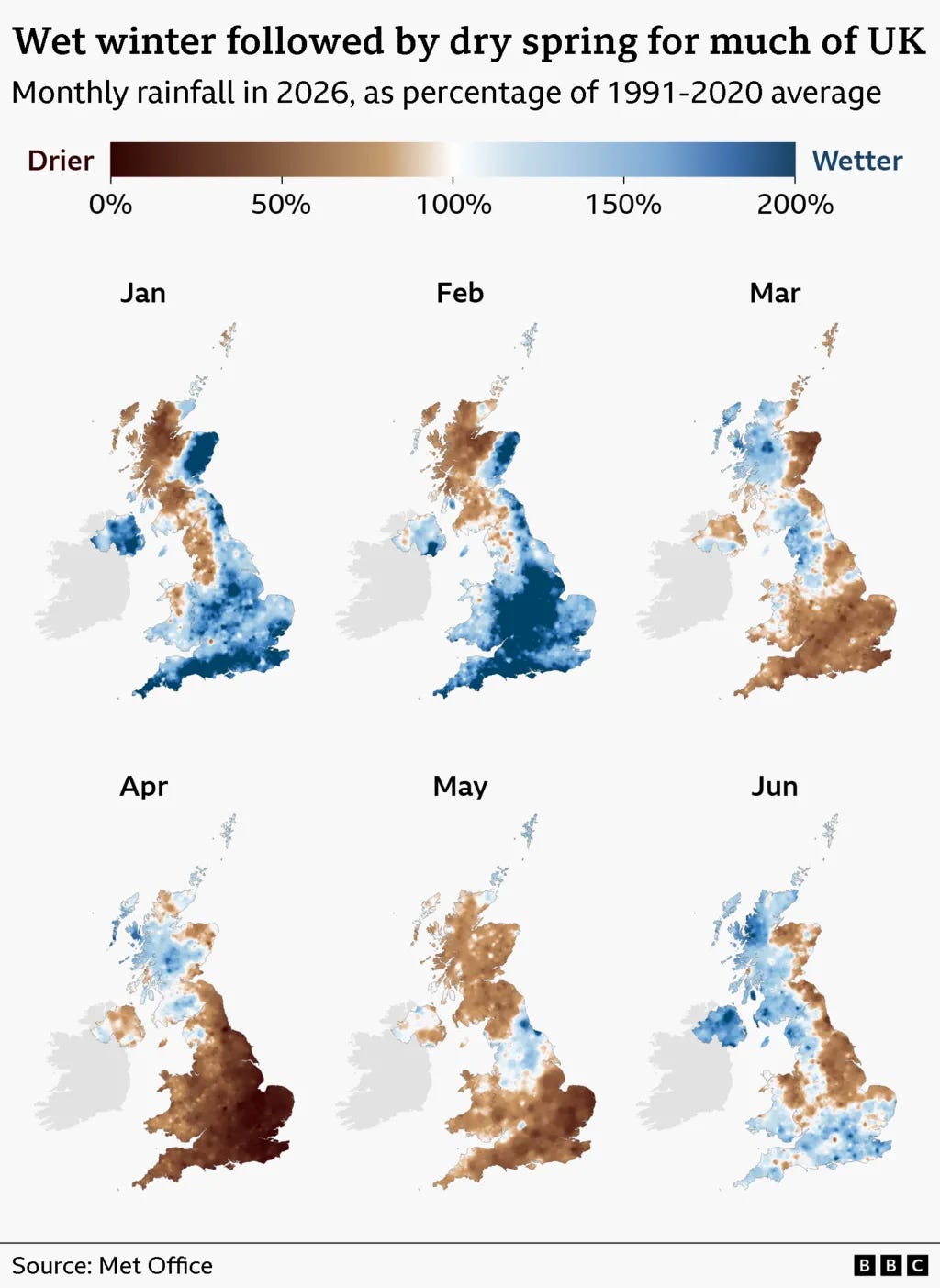
The UK is currently struggling under its fourth heatwave of the year; July 2026 has been the country’s second-warmest month on record. Relatedly, most of central, eastern, and southern England, as well as northern Wales and eastern Scotland, are in a state of drought or extreme water scarcity. This comes just a few months after a very wet British winter where much of England saw twice as much rainfall as usual in February — this “climate whiplash” has led to dozens of wildfires across the country, as a wet winter drives the growth of vegetation that becomes a tinderbox in a dry summer. Scientists note that this pattern is consistent with a warming atmosphere, which can hold more moisture: it’s like a big “sponge” that absorbs a lot of water from the ground (leading to droughts) but then releases large amounts at once (leading to floods).
🚏🎰 Americans lose more to sportsbooks than they spend at the movies
Last year, Americans placed $166 billion in bets on sporting events, which is more than double what they spent on movie tickets ($8.9 billion), recorded music ($11.5 billion, a record figure), live music ($18.5 billion), books ($14.6 billion), and museums ($16.4 billion) combined. Economists believe the $166 billion figure may still be an undercount, as it excludes betting at tribal casinos (which could tack on another $5 to $10 billion) and on prediction markets (which could add $50 to $100 billion). Added up, it means that the average American adult bets almost $1000 a year on sports, though the market is dominated by big spenders, with 5% of bettors taking 95% of the losses.
🚏🔋 Indian car companies are making more energy-efficient EVs than BYD or Tesla
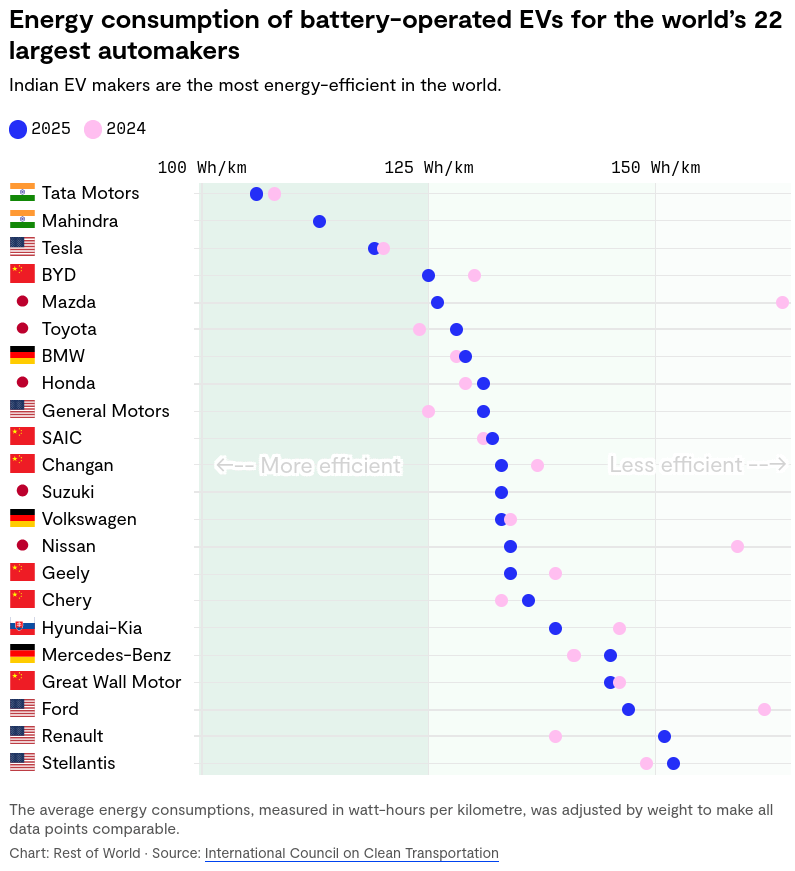
Chinese EV maker BYD is frequently in the news for its rapid growth and cheap electric cars, but Indian automakers have been doing quite well under the radar. Two of the largest Indian car manufacturers, Tata Motors and Mahindra, topped a recent leaderboard for EV energy efficiency, measured as the number of watt-hours needed to travel one kilometer across a company’s entire battery-electric fleet. They beat out Tesla (3rd), BYD (4th), and a slew of legacy manufacturers. Electric cars account for under 5% of new car sales in India, a far cry from the global average of 25%, but the country is reportedly working on new emission standards that may boost EV sales in the 2030s.
🚏🎙️ Arizona State is launching a bachelor’s degree in being an influencer
ASU’s journalism school has started a new BA in Content Creation, which will prepare students to become “an influencer and strategic storyteller.” The curriculum includes courses on videography, editing, podcasting, on-camera presence, personal branding, audience analytics, and social media strategy, and the program’s capstone project will require students to create a social media account and grow their follower count.
📖⏳ Worth your time
Some especially insightful pieces we’ve read, watched, and listened to recently.
How Funerals Keep Africa Poor (David Oks) — Uses Africa’s ruinously lavish funerals, which can cost more than a year’s salary, as a lens into the political economy of kinship networks. These tribal groups are a sort of “mutual aid society that you’re born into and can’t leave”: productive and high-earning members are expected to financially support the less productive. If anyone gets too wealthy, they may leave the network, which threatens everyone else, so these societies have developed intentional wealth-destroying traditions like fancy funerals or the Pacific Northwest’s famous potlatches to ensure that nobody accumulates too much surplus. However, this stifles ambition and innovation and makes economic growth all but impossible.
Engineering Management After the Cost of Code Collapsed (Karim Jedda) — Argues that many of our foundational assumptions about business hierarchy, KPIs, and management need to be revisited now that code is nearly free to produce. A general pattern is that “when generation is abundant, verification is the constraint.” On the engineering side, it means that we can get great benefits from investing in machine-checkable correctness such as automated tests; for management, our old roles as information routers and presentation makers are obsolete and the job boils down to spending all day on decision-making and accountability, because that’s the part that LLMs can never do.
Intellectuals Are F*cking Idiots (Mark Manson) — Argues that smart people keep failing in public because they’re rewarded for elegant models, not for matching reality, and they forget the map isn’t the territory. Blue Zones with people living to 100+ are due to dodgy birth records, Ehrlich’s population doom never came, and Pol Pot killed the professor who lectured him. The real dividing line isn’t intelligence but whether you update your views when the evidence changes and hold your opinions lightly.
Supermarket Economics (Phenomenal World) — A deep-dive into the financials of supermarkets and grocery stores, including the history of and rationale for mega-mergers; the K-shaped bifurcation in the industry (with Whole Foods and Sprouts at the high end and Walmart and dollar stores at the bottom end); why grocery delivery and e-commerce haven’t panned out yet; and how the countercyclical nature of grocery stores makes them popular investments with very good return on equity.
🔮📬 Postcard from the future: Progress from Nihilism
A ‘what if’ piece of speculative fiction about a possible future that could result from the systemic forces changing our world.
// What might be the consequences of AI-accelerated engineers becoming the norm?
// September 2107
// A group of teenagers gather around a wizened lady in her rocking chair
“Grandma, can you tell us a story about the ‘American Troubled Times’?”
“Ah, yes. You’ve gotten to that part of your history class! I always wondered if you were going to ask.”
She gestures to the sprawling complex, housing several multi-generational families amidst vegetable gardens, solar arrays, local compute nodes, utility relays, and transit docking stations while a cargo airship drifts overhead.
“This space and environment is the result of many hard fought battles in the face of massive waves of change and trauma. Nod if you’ve heard these terms in your lessons: Warsaw Riots of ‘37, the Helium crunch of ‘42, Smokey Mountain Inferno of ‘29, Excel riots, Looting of Project Rainier, the MSCI bankruptcy, the Panama Canal dry out, Bankruptcy of Social Security? Each of these would have been considered a major world event in the second half of the twentieth century, but they all happened within 15 years of each other.
“So what were we, as a generation, supposed to think and believe in the face of such massive change? The short answer is that for a while, many of us embraced nihilism. Not in the form of Moral Nihilism where nothing is objectively right or wrong, and that moral truths do not exist, but instead a nihilism about the truths and beliefs of the 20th century.
“Many ‘Gods’ died in that period. Beliefs, Governments, Schools, Companies. And in some cases, the people who led those things died as well. Many of those who held to those belief structures too tightly were unable to surf the waves of chaos and uncertainty in the years that followed and drowned.
“Those of us who embraced the chaos and shed ourselves of attachments to the old ways were able to survive, and in time, thrive. We built new structures of governance and finance, trying to not repeat the mistakes of the past, but knowing that we would make new mistakes. Which led to this…
“I hope you can continue that change.”
© 2026 The FLUX Collective. All rights reserved. Questions? Contact flux-collective@googlegroups.com.