

Episode 229 — April 2nd, 2026 — Available at read.fluxcollective.org/p/229
Contributors to this issue: Ben Mathes, MK, Justin Quimby, Jasen Robillard, Erika Rice Scherpelz,
Additional insights from: Ade Oshineye, Boris Smus, Dart Lindsley,Jon Lebensold, Lisie Lillianfeld, Neel Mehta, Robinson Eaton, Spencer Pitman, Stefano Mazzocchi, Wesley Beary, and the rest of the FLUX Collective
We’re a ragtag band of systems thinkers who have been dedicating our early mornings to finding new lenses to help you make sense of the complex world we live in. This newsletter is a collection of patterns we’ve noticed in recent weeks.
“There are no passengers on spaceship Earth. We are all crew.”
— Marshall McLuhan
🤝🔬 Levers of legibility
…and like a city, it is not a tree, and it depends on the personas we, our families, our cities, and our nations wear. — Christopher Alexander
A city is not simple. Neither are our lives. Both have webs of overlapping authority (mathematically: a semilattice). We are governed by governments, local water boards, HOAs, bosses, etc. We may govern: teams at work, kids at home, clubs. As a partner in a committed relationship, you’re an equal. If your partner coaches your swimming, they are “governing” you. When the roles flip and you’re coaching them on a ski slope, the authority shifts again.
Who leads and who follows constantly changes.
Governance allows society to scale, but it comes with costs. When we make ourselves subject to an authority, we give them categorical control, even when we may resent specific instances of that control. I pay my water bill because I appreciate getting clean water, not because I like giving money to the water authority.
In Seeing Like a State, James C. Scott dissects this friction. The state desires legibility. The governed, operating via metis (local, practical knowledge), often benefit from illegibility. This gives rise to spaces of illegibility, spaces where the state’s eye cannot penetrate: private homes, shadow economies, unofficial borders.
The classic quote says, “Render unto Caesar what is Caesar’s.” We suggest a slight edit: “Make legible unto Caesar only that which you wish to render unto Caesar.“
Why? Because things that are legible to those who govern you are ultimately controlled. Sometimes that’s good. Sometimes those are roads, schools, and aqueducts. Sometimes that’s bad: a thieving mayor who takes a huge cut, leading you to hide your food to survive.
Scott wrote during the high-modernist governance era. He positioned his work as an intellectual shield for local knowledge and resistance. However, we must look beyond the binary toward a synthesis.
Legibility controls. It also scales fairness. Before the state “sees” you, your life is often at the mercy of the local loudmouth or a village bully. Legibility brings the Rule of Law.
It can bring needed assistance. We show our doctor the weird mole and let them send our blood to a lab. We render ourselves legible so that the doctor can access the data and address the problem.
Yet legibility is a kind of blindness. When you turn a forest into a “legible” grid of timber, the forest dies. When you turn a society into a spreadsheet, you kill the social ties and tacit knowledge that make it resilient. A savvy leader follows Frodo and says, “Alright then, keep your secrets.“

We’re looking for the efficient frontier in an iterated prisoner’s dilemma. If Caesar is a grifter, I hide my income. If Caesar builds roads, I pay my taxes. When trust is high, we move toward cooperation. When trust is low, we both defect. A healthy society arises when both sides decide that cooperating is more profitable than “winning” a single round.
In our nested lattices of authority, the “border” between being in charge and being led, being seen and being unseen is constantly moving. The goal isn’t to abolish the border, but to make sure it’s a happy one.
PS: This is what we think people mean when they say “We live in a society!”
PPS: We made a little explorable game version of this concept.
🛣️🚩 Signposts
Clues that point to where our changing world might lead us.
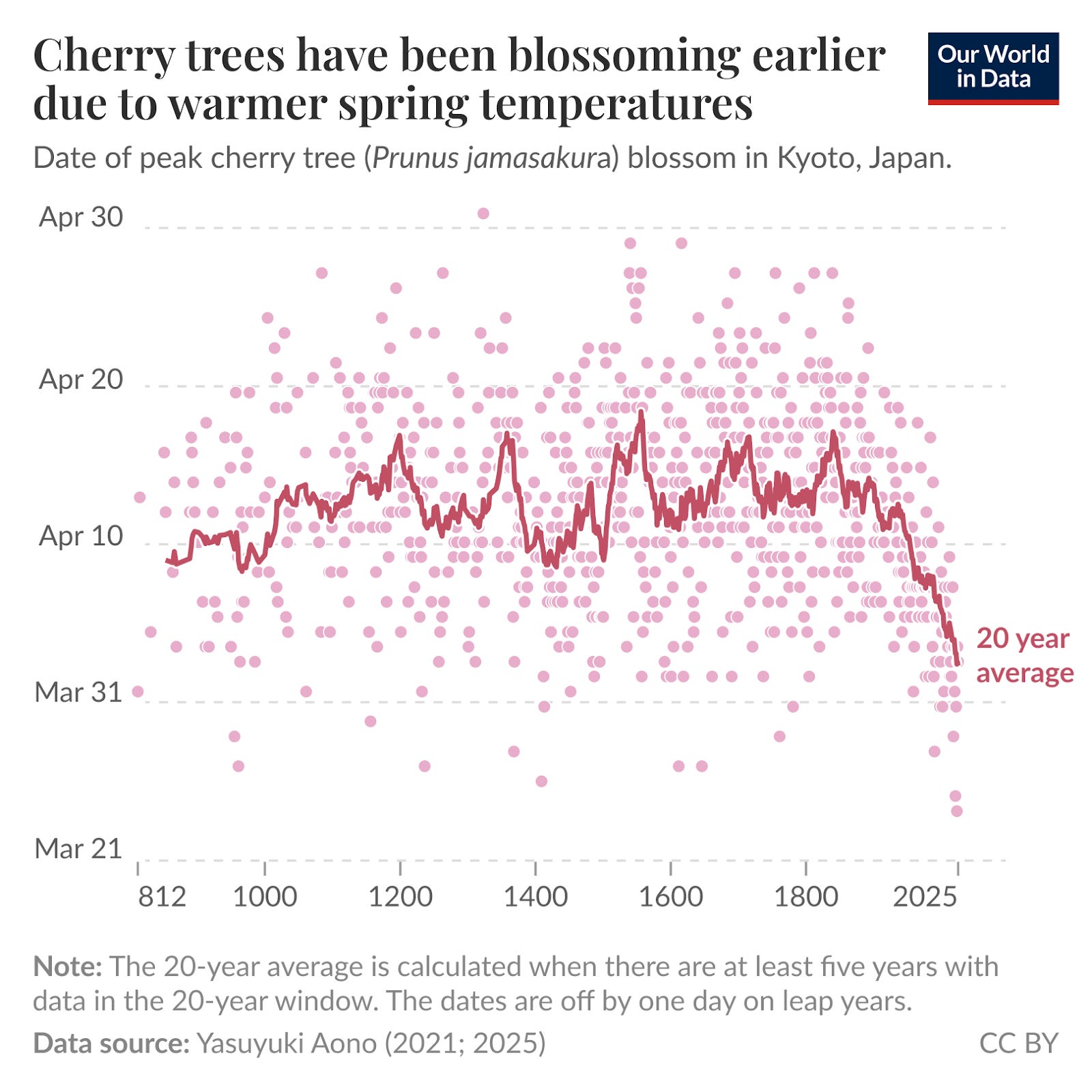
🚏🌸 Japan’s cherry trees are blooming almost two weeks earlier than they used to
Kyoto has been tracking the blooming dates of its famous cherry trees for over 1200 years, forming probably the world’s longest-running climate dataset. These ‘sakura’ trees historically bloomed in mid-April, but climate change has pulled that forward almost two weeks, and 2023 marked the earliest bloom in recorded history (March 25th).
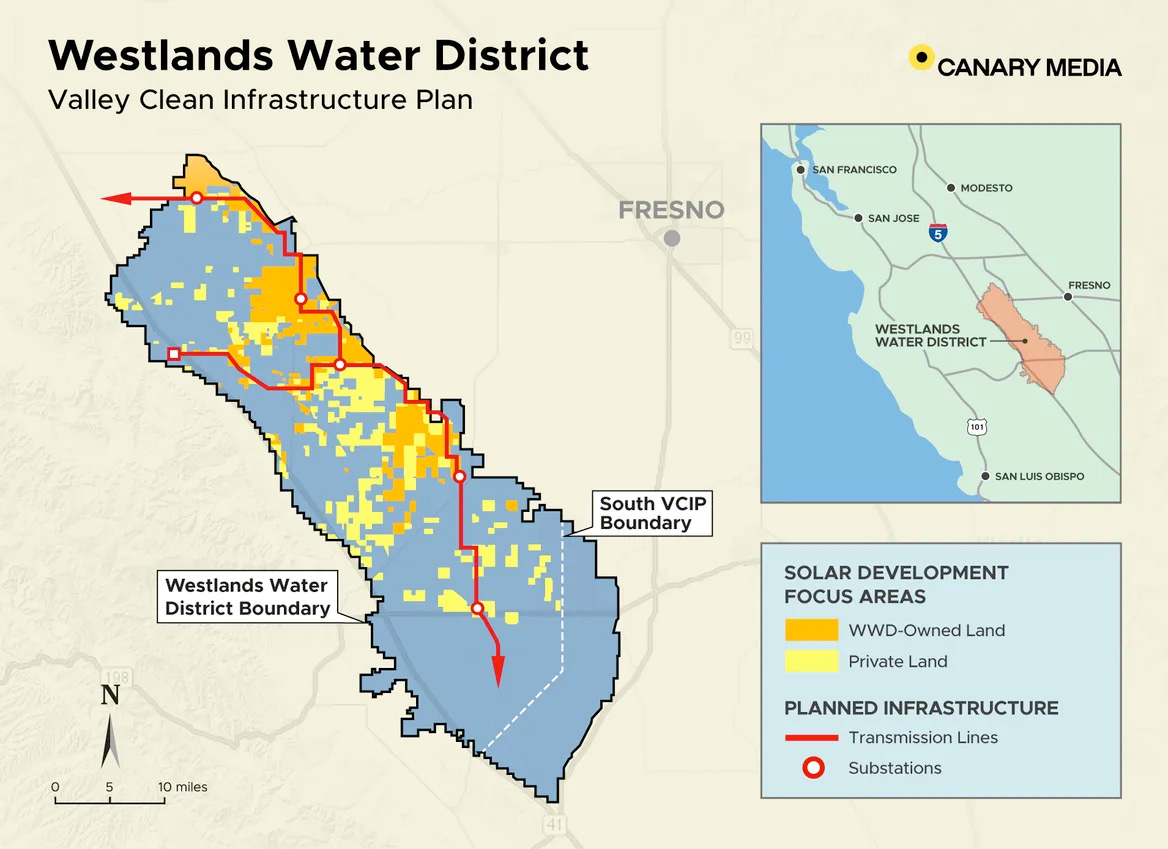
🚏🍅 California plans to build the world’s largest solar project
A project called the Valley Clean Infrastructure Plan (VCIP) would build 21 gigawatts of solar capacity over 136,000 acres (about the size of Chicago) in central California; those 21 GW are about equal to all the utility-scale solar that California has installed so far. This region east of Fresno grows billions of dollars’ worth of food crops such as onions, tomatoes, and garlic, but water in the region is drying up—so many farmers are eager to redirect the region’s ample sun to solar power. Under the plan, farmers will retain ownership of their land and its accompanying water rights, so they’ll be able to put up solar panels on some land and redirect its water allowances to their remaining farmland, helping them adapt to a drying region.
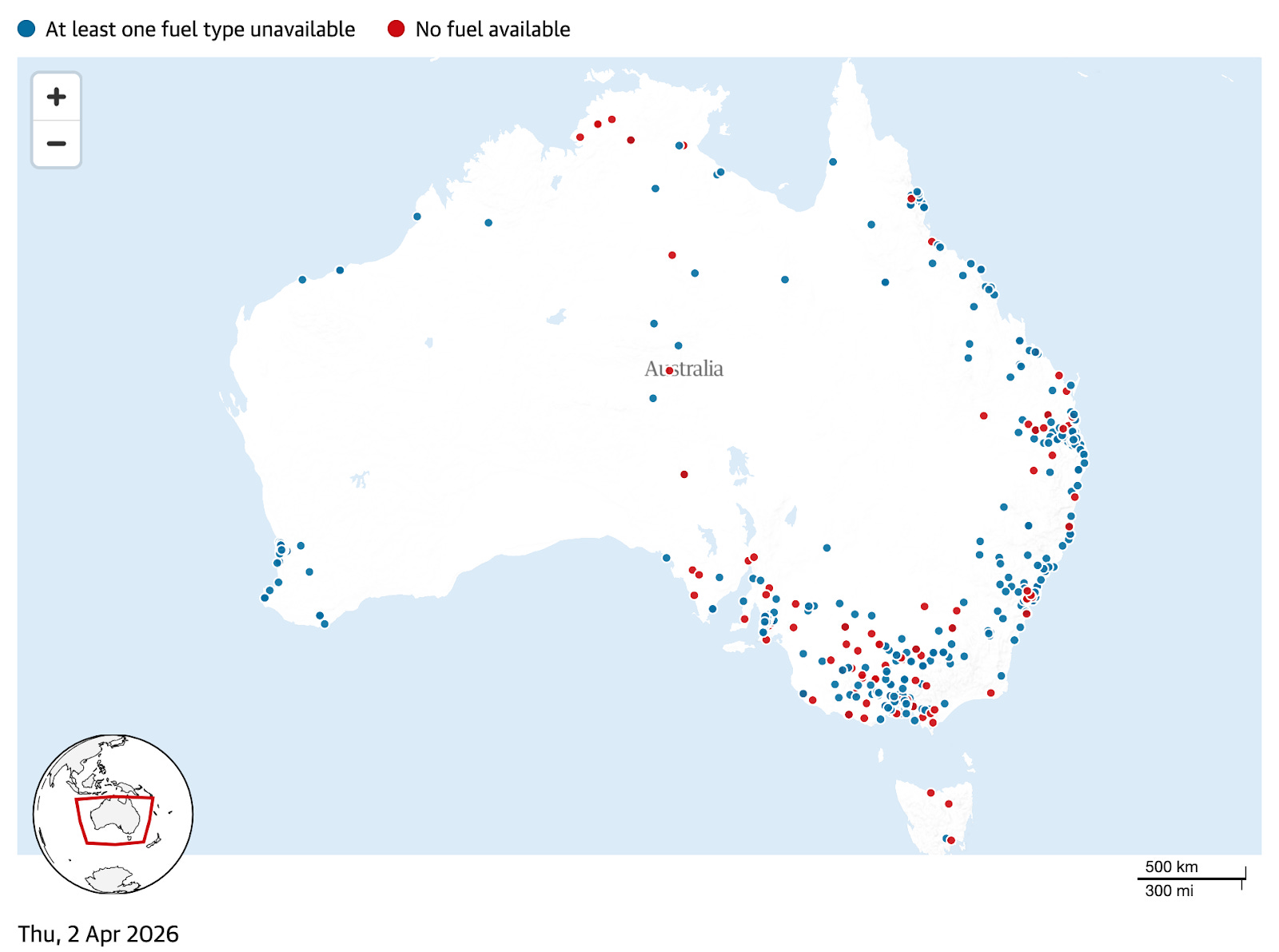
🚏⛽ Australian petrol stations are running out of fuel
The price of gasoline and diesel in Australia rose nearly 50% in March until the federal government halved gas taxes to provide relief (though economists generally believe gas tax holidays to be counterproductive, since they do nothing to ease supply constraints). Despite the price increases, hundreds of fuel stations across the country have reported outages. Several fuel shipments to Australia from the Persian Gulf have been cancelled, with more cancellations reportedly incoming, so the situation down under may continue to worsen.
🚏📚 Sweden is replacing screens with books in classrooms
Sweden was an early adopter of tech in the classroom, investing in tablets and digital textbooks, even in preschools. However, the country is now reversing course: it’s bringing back physical books, having students write with pencil and paper, and removing cell phones from classrooms. Sweden is allocating $54 million toward buying fiction and non-fiction books for students and $83 million toward textbooks and teacher’s guides, with a goal of giving “every student… a physical textbook for each subject.” When asked about the shift, a Swedish education expert explained that “concerns emerged about screen time, distraction, reduced deep reading, and the erosion of foundational skills such as sustained attention and handwriting.”
📖⏳ Worth your time
Some especially insightful pieces we’ve read, watched, and listened to recently.
There’s a Good Reason You Can’t Concentrate (Cal Newport / NYT) — Observes that we often turn to LLMs “not because they make us better at our jobs but because they help us to avoid moments of sustained concentration.” Having AI replace intense mental work is easier in the short run but causes our brain to atrophy in the long run. Instead, we should reserve AI for rote tasks like sifting through large amounts of data or formatting documents, which can actually reduce burnout and preserve our cognitive energy for hard problems.
The Lantern and the Flame (Exponential View) — A newsletter writer describes the massive AI ‘engine’ he’s created to help him write: it consumes vast amounts of information (“roughly 100 million tokens a day”) to surface the most important data points for his thesis, stress-tests his arguments, and applies “synthetic editors” to sharpen his prose. Still, he emphasizes that he “safeguards” free-thinking time, where he unplugs from computers and allows his thoughts to evolve in a “non-linear, messy and iterative” way. This is how he preserves the “interiority” (his unique experiences and beliefs) that makes him different.
Specialists Drive Biodiversity Scaling in Symbiotic Relationships (C. Carlson, J. Yoder, T. Poisot) — A challenging paper that applies graph theory to ecology, finding that most biodiversity among symbiont species comes from specialists (those who form symbiotic relationships with only one other species) rather than generalists. Specialists “constrain the architecture of ecological networks” (a very cool phrase!) and may explain the puzzling power law relationship between the species richness of hosts and symbionts. The lead author summarized the findings on Bluesky, which may be a good place to start.
The Great Entertainment (Kyla Scanlon) — Scanlon frames the current American administration as a reality TV show whose only real check is the bond market. As Treasury yields spike, the dollar sells off, gold surges, and China’s soft power grows, the infrastructure underpinning the circus (like the US dollar hegemony, hard-won alliances, and cheap debt) is at risk.
© 2026 The FLUX Collective. All rights reserved. Questions? Contact flux-collective@googlegroups.com.