
Episode 217 — January 9th, 2026 — Available at read.fluxcollective.org/p/217
Contributors to this issue: Justin Quimby, Erika Rice Scherpelz, Ade Oshineye, Neel Mehta, MK, Boris Smus
Additional insights from: Anthea Roberts, Ben Mathes, Dart Lindsley, Jasen Robillard, Lisie Lillianfeld, Robinson Eaton, Spencer Pitman, Stefano Mazzocchi, Wesley Beary, and the rest of the FLUX Collective
We’re a ragtag band of systems thinkers who have been dedicating our early mornings to finding new lenses to help you make sense of the complex world we live in. This newsletter is a collection of patterns we’ve noticed in recent weeks.
“The map had been the first form of misdirection, for what is a map but a way of emphasizing some things and making other things invisible?”
— Jeff VanderMeer, Annihilation
📃🐦🔥 The manifesto is death, the manifesto is life
As a format, the manifesto was built for a world of scarcity and permanence. From Marx and Engels to the Futurists, the form demanded a voice proclaiming unchanging truths, serving as a stake in the ground around which movements could coalesce. It presumed that ideas, once articulated with sufficient force, could hold their shape long enough to matter.
AI has dissolved these conditions. When anyone can generate infinite variations/refutations of any argument, the idea that a piece of text will endure and define becomes almost quaint.
Manifestos traffic in certainty, in the rhetorical power of the declarative sentence. We believe. We demand. We will. But the systems now reshaping our world are probabilistic, not prophetic. They operate in gradients and weights, not absolutes. The future isn’t being declared; it’s being negotiated in real time, across millions of prompts and outputs, in ways no single document can capture or constrain.
But there’s still value to saying, “This is not just slop for the sake of engagement. We believe in these ideas. And we earned these beliefs the hard way.”
In recent years, manifestos have emerged from a rock-tumbling process among small groups of practitioners, such as the Agile Manifesto and the Software Craftsmanship Manifesto. That process yields a compromise (and compromised) statement in order to include everyone with a seat at the table. Afterwards, the nascent community must aggressively defend the integrity of the founding statement to achieve the manifesto’s goals. This process can become a wall to keep out non-signatories. Yet this dedication to the original form is critical in storming/norming/forming the community of practice.
In that sense, manifestos are death. They preclude the possibility of better futures: signatories have already committed their signatures to a particular vision of the future… even if that future is obsolete. Growth and learning can look like a betrayal of the founding statement. The very form of the manifesto aims toward scissor statements rather than playful curiosity and exploration of unfolding possibilities. In defining what should be, they can restrict what is imagined. Manifestos are strong opinions, strongly—not weakly—held.
The manifesto isn’t dead, but like all information vehicles, it must evolve. With slop manifestos so easy to generate, words alone are not enough. Even if the manifesto is obsolete as a commitment device, it can still act as a coordination mechanism that births communities. Systemic change needs sustained momentum, attention to messy detail, and a community aligned through practice, not just words. In today’s clickbait, dopamine-fueled landscape of ideas and movements, momentum requires groups of people pushing change over long periods of time. The movement is the light; the founding statement is merely the shadow.
🛣️🚩 Signposts
Clues that point to where our changing world might lead us.
🚏🇻🇪 Polymarket is refusing to pay out bets on the Venezuela invasion amidst an insider trading scandal
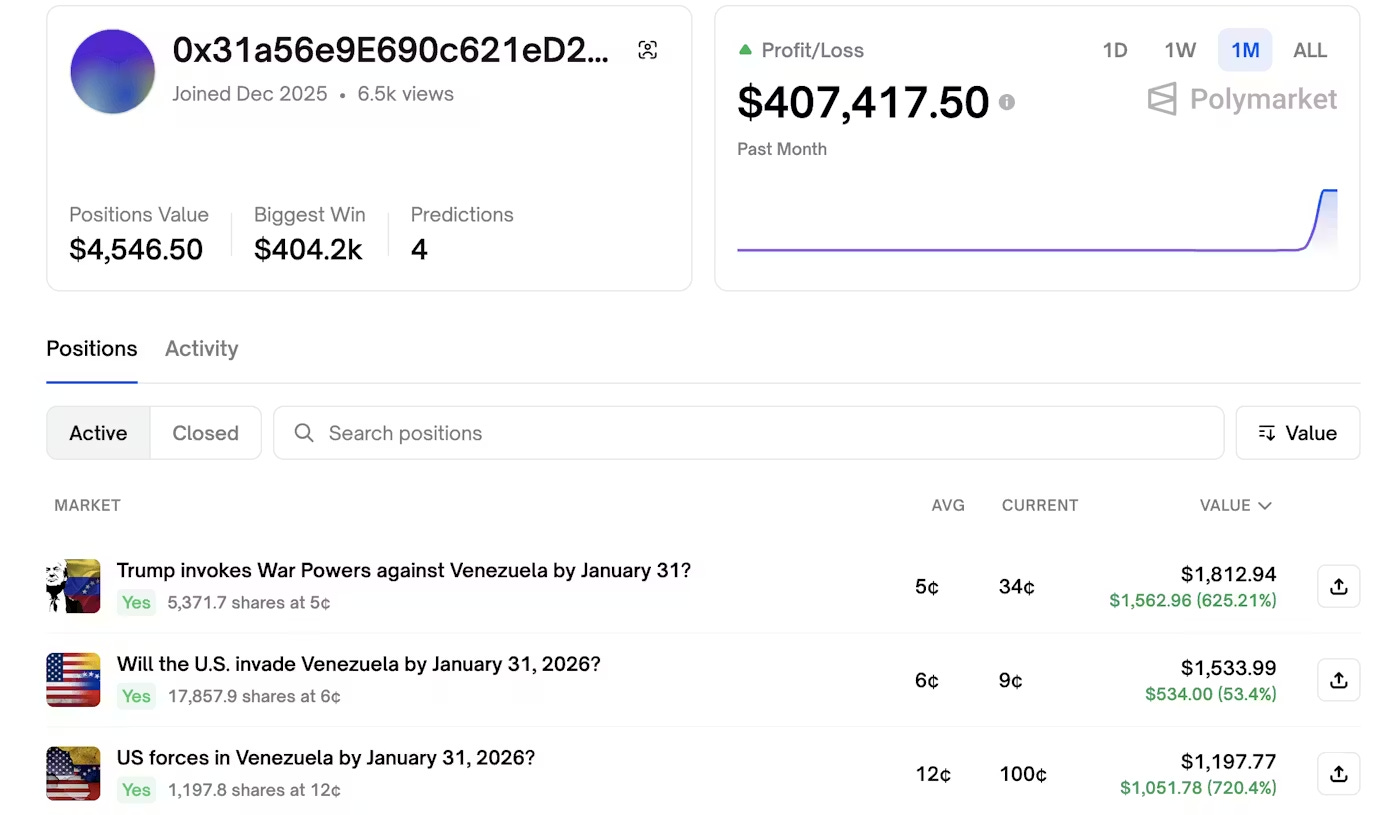
The prediction market startup Polymarket, which allows users to buy ‘shares’ in potential events and pays out if an event occurs, had a market on the question “Will the US invade Venezuela by [some date]?” The company said that it’d pay anyone who bought ‘yes’ if a “consensus of credible sources” agreed that the invasion had happened. The US did indeed attack Venezuela and abduct its president earlier this week, but Polymarket refused to pay out, saying that an invasion only counts if the US controls some part of Venezuelan territory. Military scholars may argue over the meaning of “invasion” vs. “occupation,” but the story became a scandal when it was revealed that a brand new Polymarket user made a trio of huge bets on the invasion just a day before the attack happened (when the market predicted a roughly 6% chance of invasion), netting over $400,000 in profit on $35,000 in bets. This raised suspicions of insider trading, a frequent concern for news-related wagering.
🚏🎓 A single Chinese university is dominating American schools in AI patents
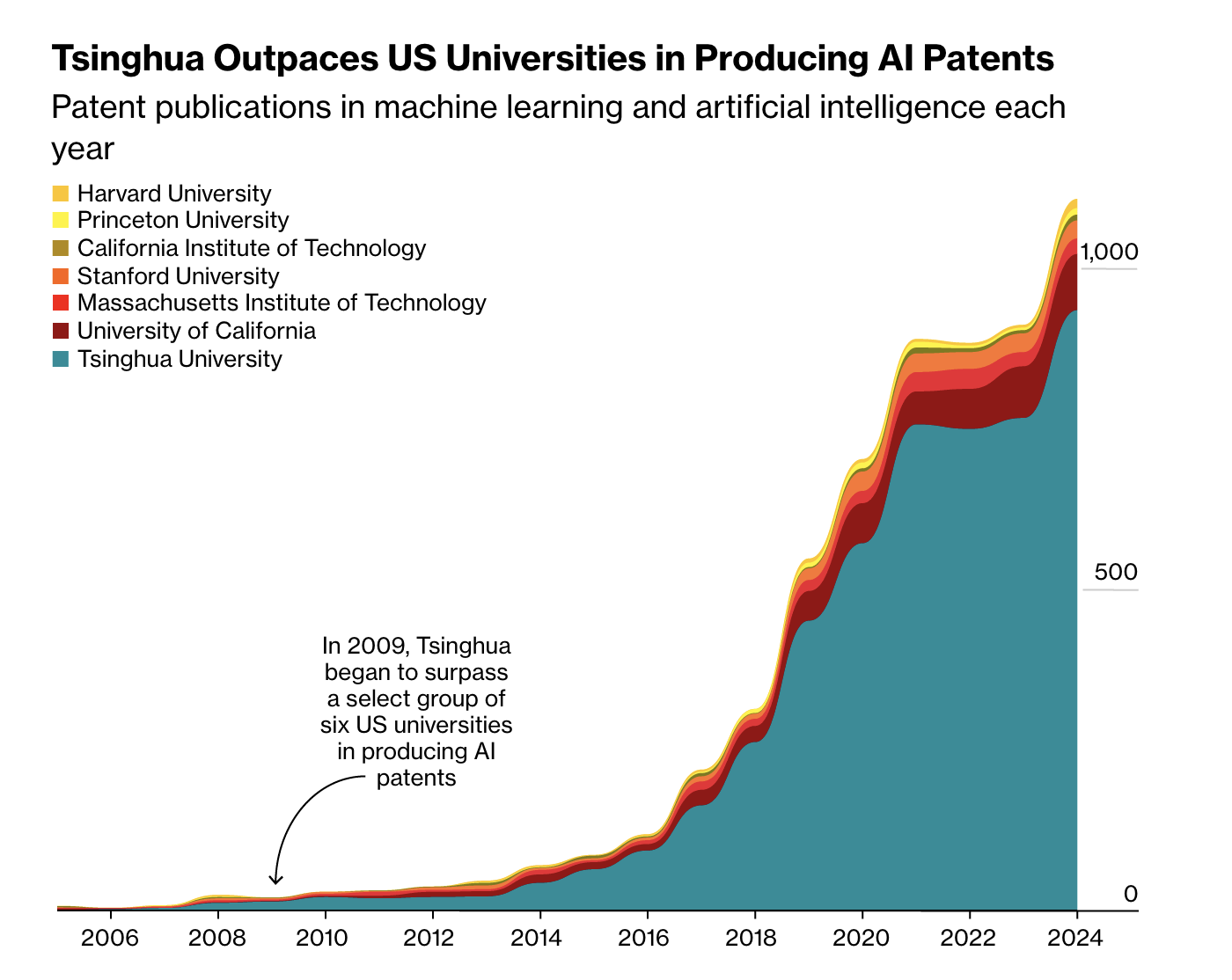
China’s prestigious Tsinghua University (sometimes called “Stanford, MIT, and Carnegie Mellon all rolled into one”) has become arguably the world’s leader in AI and ML, racking up almost 5,000 patents in those spaces since 2005—more than MIT, Stanford, Princeton, and Harvard combined. Tsinghua has more AI research papers among the 100 most cited than any other school; its only competition is Google and Microsoft. However, while Tsinghua churns out more AI patents, they’re not cited as often by future patents; Harvard and MIT, meanwhile, put out fewer but more ‘impactful’ patents.
🚏⚕️ Utah will allow an AI doctor to renew medical prescriptions
The Utah Department of Commerce announced a pilot program that will allow an AI doctor startup (which lets patients do a medical consultation with a bot and get diagnoses) to automatically renew medications on patients’ behalf, marking “the first state-approved program in the country that allows an AI system to legally participate in medical decision-making.” The startup says it’s put numerous guardrails in place, such as having human doctors validate “the first 250 prescriptions issued in each medication class,” securing a special malpractice insurance policy, and escalating to real physicians in borderline cases.
🚏👨🦲 Korea’s president wants the national healthcare system to cover baldness
South Korean President Lee Jae Myung asked the country’s healthcare minister if the Korean public healthcare system could start covering hair loss, a condition that’s normally considered aesthetic and thus not covered by health insurance. Lee insisted that many young people losing their hair see it as a “matter of survival,” and he may have a point: South Korea has an infamously “rigid definition of beauty,” and physical appearance is considered important for getting jobs. “Your appearance is also a credential” is a common saying, and almost all jobs require applicants to submit a photo of themselves. By this logic, reducing hair loss could help the Korean public improve their employment prospects (although one wonders if improving everyone’s attractiveness wouldn’t actually help, since you’d just be raising the level of competition in a fixed pool.)
📖⏳ Worth your time
Some especially insightful pieces we’ve read, watched, and listened to recently.
Where Good Ideas Come From (For Coding Agents) (Sunil Pai) — Observes that AI coding agents struggle when given wide-open tasks because they fill in the blanks with the most statistically likely solution—but the ‘typical’ solution is unlikely to be the ‘correct’ solution. To get the agent to create a solution that works for your use case, you need to constrain them to only explore the “adjacent possible” (i.e., take incremental steps) with clear constraints, context, and validation at each step. Concretely, this takes the form of a curated brief for the LLM that encodes your judgment: goals, non-goals, constraints/invariants, prior art, what “done” means, etc.
Prediction Markets Barely Make Money; Sportsbooks Make Money (Financial Times) — Argues that ‘prediction markets’ like Kalshi, for all their high-minded talk of “financializing differences in opinion,” are just glorified sports betting sites, when you look at where most of their volume comes from. It seems like a structural pattern: any generic prediction market would naturally trend toward sports betting, which offers a high frequency of bettable events, high volatility, quick resolution, predictable schedules, and a “large ecosystem of resources offering information” for bettors. More highbrow topics, like election results (or which country the US would invade next), are much less attractive to gamblers because they are infrequent, less legible, overly clustered, and slower to resolve.
Tales of the Tyrant (The Atlantic, 2002) — Paints a portrait of Iraq’s then-dictator Saddam Hussein, a tyrant who appears to have unlimited choices but actually has the fewest. He cannot learn or reform because the fear-based system he built to survive requires him to purge his allies, and those who remain must lie to survive him, skewing his understanding of reality and causing errors to compound until catastrophic miscalculation becomes inevitable.
Product Managers, Ducks, and Dogs Marking Territory (Rachel by the Bay) — Retells a famous story about how an artist for a chess-based video game purposely added a small duck to the animations so that the PM, who wanted to give advice and leave their mark on the game, would have some quick and obvious feedback to give: “it’s great, just remove the duck.” The sacrificial duck protected the rest of the game from the “meddling manager.”
🔍📆 Lens of the week
Introducing new ways to see the world and new tools to add to your mental arsenal.
This week’s lens: resonance.
You’re reading a book when a chapter makes you stop. Something about it clicks. The more you read it, the more meaningful it becomes. Days later, you find yourself returning to it.
This experience has a name: resonance.
Resonance is personal yet not entirely subjective. While our own taste plays a role, resonant experiences share a distinctive quality: fractal meaning. Like a coastline that looks complex at any scale, resonant ideas please on the surface and continue to reveal depth as we dig in. The details make the whole more meaningful, and the whole makes the details more meaningful. Think of a favorite song where each listen uncovers new subtleties or an architectural space that feels more welcoming as you notice its thoughtful details.
Resonance can appear anywhere. We aren’t surprised when we have this experience with a great piece of literature, a touching piece of music, or a decades-long relationship. But we’d be surprised to find it in an app or a TikTok video. We shouldn’t be. There is room to raise the bar. As the signatories of the Resonant Computing Manifesto state, we should bring resonance to more of our technological landscape (disclaimer: some FLUX members have signed).
Remember, though, that as good as resonance feels, it isn’t Truth. Instead, resonance reveals something important about our values and goals. And sometimes that can be manipulative, appealing to certain values (e.g., belonging, engagement) rather than others (e.g., thoughtfulness, reasoning). For example, Shakespeare’s biggest speeches, such as those from Julius Caesar and Henry V, are structured to evoke resonance.
What resonates with you right now, and what might that be revealing?
🔮📬 Postcard from the Future
A ‘what if’ piece of speculative fiction about a possible future that could result from the systemic forces changing our world.
// How might the American removal of Maduro in Venezuela and growing Chinese naval impact Europe in unexpected ways?
// Dec 2026 Bloomberg Hot Takes Article
While the US arrest of Venezuelan president Nicolás Maduro Moros in January of 2026, which occurred with virtually no resistance by the Venezuelan Navy, did cause significant concern in various EU naval force subcommittees, it did not trigger action. Even the multiple large-scale Chinese naval exercises surrounding Taiwan in late 2025 and through 2026 were not enough to wake the sleeping European giant. When China demonstrated a system that combines multiple containers, each acting as a specific element, such as a missile launch module, integrated sensor suite, or close-in weapon systems, even that did not precipitate major change.
The tipping point? Yacht enthusiasts, who take photos of ships going in and out of major ports in an effort to “yacht-spot” famous ships, spotted these containers on a Russian-flagged ship heading into the Russian port of Vostochny in August of 2026. Breaking news hit the socials of both the shipping and super yacht communities, then rapidly entered the main news cycle.
A flurry of EU hearings followed. Due to the potential threat of the Russian navy weaponizing the European shipping lanes and using them as a potential first strike vector against EU nations, along with the American president’s willingness to use force to remove elected leaders, immediate action was taken. The EU needed a strong naval force for deterrence. The EU nationalized over a dozen shipyards in the name of rebuilding naval might. The German shipyards of Lürssen and Nobiskrug, along with the Italian Fincantieri and Benetti yards, and the Netherlands Feadship, Amels, Heesen, and Oceanco facilities are all being rapidly converted to build hulls for military naval fleets.
All the recently-printed AI centi-millionaires from the latest round of acquisitions wanting a new super yacht are going to have to wait.
© 2026 The FLUX Collective. All rights reserved. Questions? Contact flux-collective@googlegroups.com.